
Abstract:
An international research team led by the Massachusetts Institute of Technology (MIT) has discovered a rare binary system: a low-mass star about 300 light-years away from Earth is slowly absorbing material from its companion star. This process is different from the previously observed phenomenon of stars rapidly swallowing planets, but a long-term, stable mass transfer that may even last billions of years.
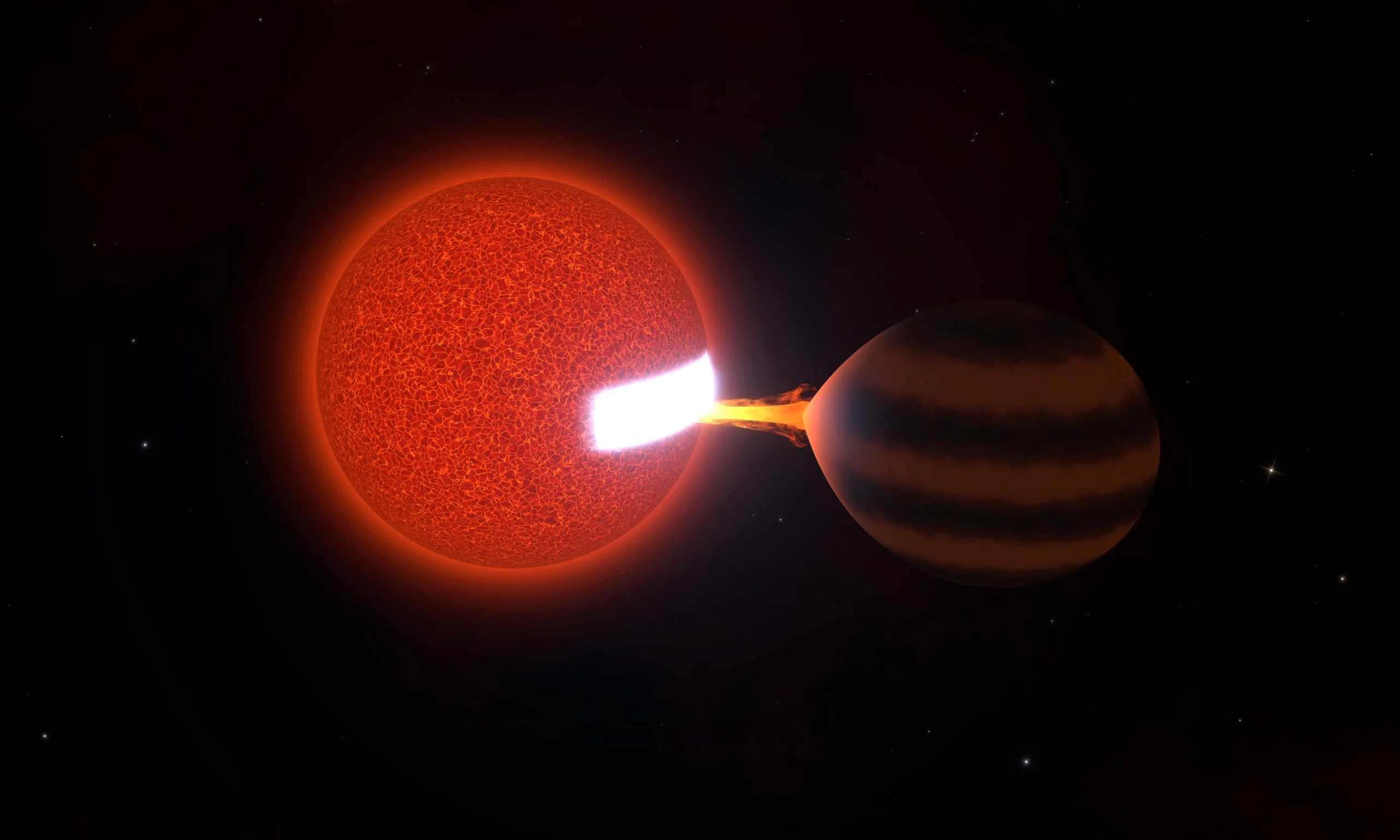
This system is named ZTF J0440+2325 and is located in the Milky Way. The two members of the system are extremely close to each other, completing an orbit every 87 minutes. The lighter object is a brown dwarf, about 25 times the mass of Jupiter; the other star is about 85 times the mass of Jupiter. Both are low-mass objects, and the entire orbit of a brown dwarf can even fit within the diameter of the sun.
Traditional observations show that most planets orbit their stars in stable orbits, with only a few cases showing stars quickly engulfing planets that get too close. This discovery shows a completely new way of evolution. Researchers pointed out in a paper published in the journal Nature Astronomy that this is the first time humans have directly observed a low-mass star continuously and stably acquiring material from another low-mass celestial body.
This discovery originally originated from an unusual observation a few years ago. Kevin Birch, associate professor of physics at MIT, noticed an unusual brightness curve while examining observational data from the Zwicky Transient Survey (ZTF). Instead of the bell-shaped brightness curve common to supernova explosions, this target exhibits recurring triangular fluctuations.
At the time, the research team was studying another system called a "black widow binary." In such a system, a dense and rapidly rotating neutron star will gradually devour its less massive companion star. However, the observed characteristics of the newly discovered target are not consistent with those of the Black Widow binary. According to theory, the black widow binary star should show an obvious reciprocating swing effect, but this phenomenon did not appear in the observation results, which made researchers unable to explain its true identity for a time.
In recent years, Burch and MIT graduate student Aaron Householder have reexamined this mysterious signal. They put forward a conjecture: If the overall mass of the system is lower, the orbital motion between the two celestial bodies will be smoother and there will be no violent swings. In order to verify this idea, the research team used multiple telescopes to conduct follow-up observations of the target.
The observations show that the system does have a slight but measurable wobble. Through comparative analysis with known binary star systems, researchers confirmed that there is no neutron star in it. Ultimately, they determined that this was a binary system composed of a low-mass star and a brown dwarf, and that the swing was too small to be caused by other types of objects.
After determining the masses and orbital parameters of the two celestial bodies, the research team further studied whether there is any material transfer phenomenon. Under normal circumstances, the accretion process is most common in compact objects such as black holes and neutron stars, and their strong gravity will pull the companion star material together to form an accretion disk.
But in this system, the accretor is not a very small black hole, but a star with a relatively large actual size. Researchers used computer simulations to track the movement of material particles on the surface of brown dwarfs, and the results showed that these materials would fall directly onto the star's surface instead of forming a typical accretion disk.
The simulation further confirmed that this is the first time a low-mass star has been found to be actively accreting material from another low-mass object. Researchers explained that the falling material will hit the star's surface at extremely high speeds, a process similar to an asteroid hitting the moon.
This continued impact also explains the triangular brightness curve originally discovered. As brown dwarfs orbit their stars, high-temperature hotspots formed by falling material periodically appear in the field of view. When the hot spot is facing the Earth, the brightness reaches its peak, forming a regular triangular waveform.
The research team estimates that the mass delivered by brown dwarfs to stars every year is equivalent to about one hundred thousandth of the mass of the Earth. When converted, this is equivalent to the material flow of about 40 million heavy-duty dump trucks per second, or the mass corresponding to about 1.3 trillion one-pound burritos per second.
Although this value seems astonishing, this loss rate is still very slow compared to the huge mass of the brown dwarf itself. Therefore, the researchers believe that this "eating" process will not end quickly, but can continue over extremely long time scales.
Researchers pointed out that people’s previous understanding of the interaction between stars, planets, and brown dwarfs was usually that the stars would eventually completely swallow up the latter. For example, when the sun evolves into a red giant in the future, the earth is likely to face such a fate. However, ZTF J0440+2325 shows another possibility: the star does not necessarily swallow the companion star all at once, but can gradually "cannibalize" the companion in a long and stable way, and continue this process for billions of years.
With the mystery of the triangle's brightness changes successfully solved, the research team plans to look for more similar systems. They hope to use this to further understand possible new interaction mechanisms between planets, brown dwarfs and host stars, and to deepen human understanding of the stellar evolution process.
Comments