
Abstract:
The MEGATRON research project, led by the University of Bath in the UK, has released a new batch of simulation results about the early universe. The research team incorporated star formation, gas movement, starlight radiation and chemical element evolution into the same set of cosmological simulations, trying to connect the early galaxies observed by the James Webb Space Telescope (JWST) with the chemical "fossils" left by ancient stars in and around the Milky Way. The team said that if starlight radiation and complex chemical processes are ignored, the model may underestimate the impact of early stars on the gas around the galaxy.
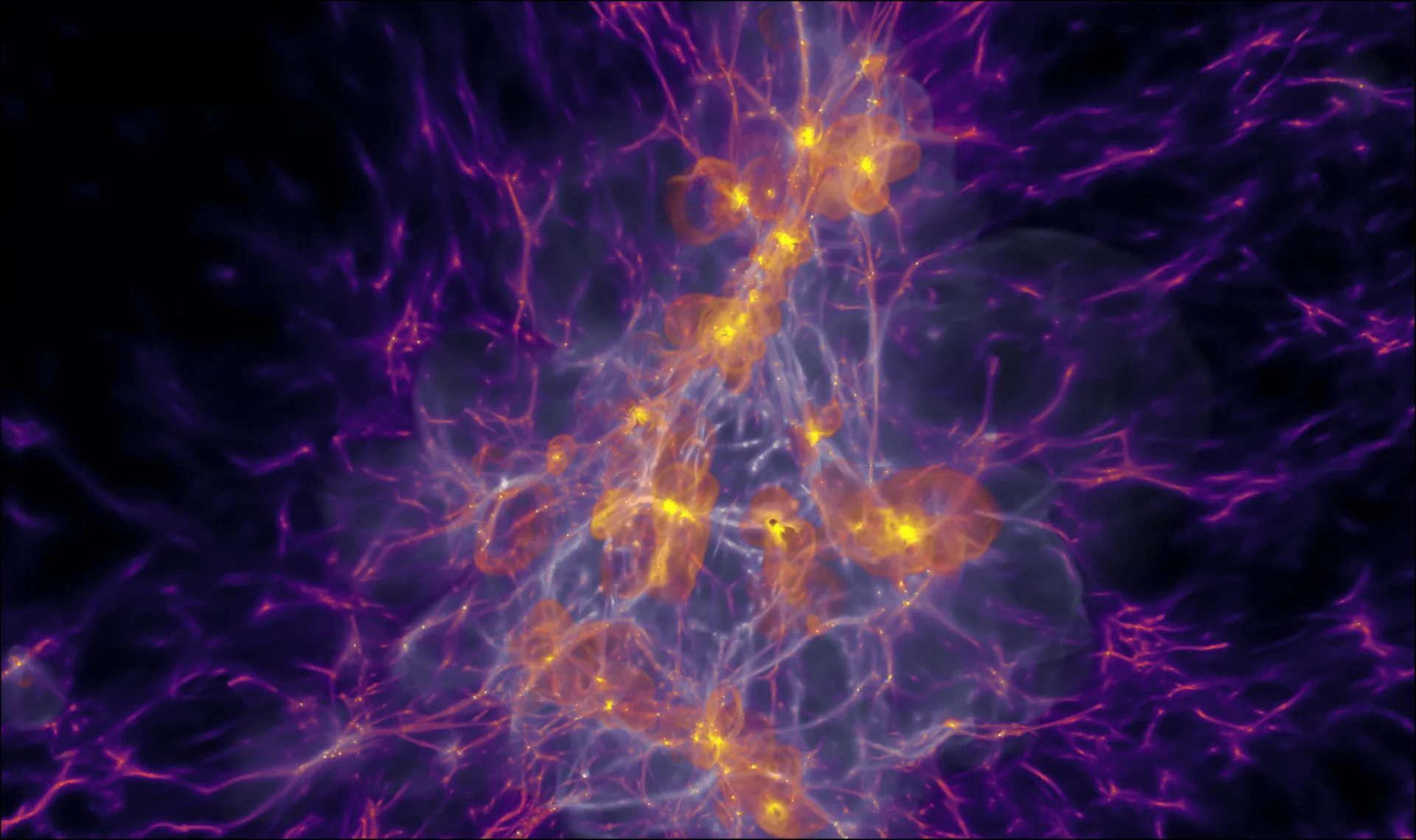
Starting from primordial gas containing almost no heavy elements, the simulation tracks the formation of the first stars, the radiation they emit, the dispersion of new elements as supernovae, and the subsequent evolution of stars and galaxies. The first-generation stars, often called Population III stars, were formed in the early universe; their radiation would change the surrounding gas, and their death explosions would throw iron, oxygen, carbon and other elements formed inside the stars into space, providing raw materials for subsequent stars and planets. The team simulated a region that would eventually develop into a galaxy the size of the Milky Way, and allowed the model to track the interaction of gas and starlight in the galaxy for billions of years.
The MEGATRON project released a total of four studies this round, one of which was published in the "Open Astrophysical Journal" and focused on studying how the first generation of stars shapes the iron abundance of the smallest dwarf galaxies. High-resolution radiation fluid simulations show that in dwarf galaxies with stellar masses no more than about 100,000 times the solar mass, a "platform" structure with an average iron abundance of about three thousandths of the solar iron abundance may be formed, that is, the astronomical notation [Fe/H] is about -2.5. The model links this feature to pair-instability supernovae (PISN) of Population III stars: elements generated and thrown out after the explosion of the primordial star are retained by the gas of the surrounding dwarf galaxy and become components of subsequent stars.
The simulation also points out that the strong Lyman-Werner radiation background produced by the primitive galaxy will affect the environment in which unstable supernovae occur, causing them to appear in a dark matter halo with a mass of about 10 million times the sun; in this deeper gravitational potential well, elements such as iron thrown out by the explosion are more likely to be retained. Research predicts that about one-fifth of dwarf galaxies may fall into the extremely iron-poor category, with an average [Fe/H] no higher than -3. The paper states that regardless of the model assumptions that significantly change the feedback process of Population II stars, the iron abundance plateau and low-iron tail still exist; in simulations, these features can also be retained in satellite dwarf galaxies orbiting large galaxies today. These are simulation predictions that still need to be further compared with JWST observations and chemical measurements of ancient stars in the Milky Way.
The project is carried out by the University of Bath in cooperation with the University of Chicago in the United States, the Institute of Astrophysics in Paris, France and other institutions. It will start in 2023 and is planned to continue until 2030. The team has obtained 40 million processor hours of follow-up computing resources from the UK National Supercomputer to run next-generation simulations with higher resolution and more physical processes; this computing resource is for future research plans and is not the computing hours used for this round of completed simulations. The researchers hope to use follow-up data to more directly test different formation models of the first generation of stars, and to clarify how they lit up the early universe, changed the chemical environment, and ultimately left traces of elements that can still be observed today.
Comments