
Abstract:
Researchers at Carnegie Mellon University, Stanford University and Purdue University have demonstrated a method of regulating heat transfer at the nanoscale: creating microscopic gold structures on thin films so that two surfaces face each other across a very narrow gap, thereby significantly enhancing the efficiency of heat transfer across the gap in the form of electromagnetic radiation.
In the experiment, the heat transfer capacity of the structurally designed metamaterial device was up to about four times that of the control device that did not use the same pattern structure. The research, published in Nature, provides experimental verification for the use of artificial structures to regulate near-field radiation heat transfer.
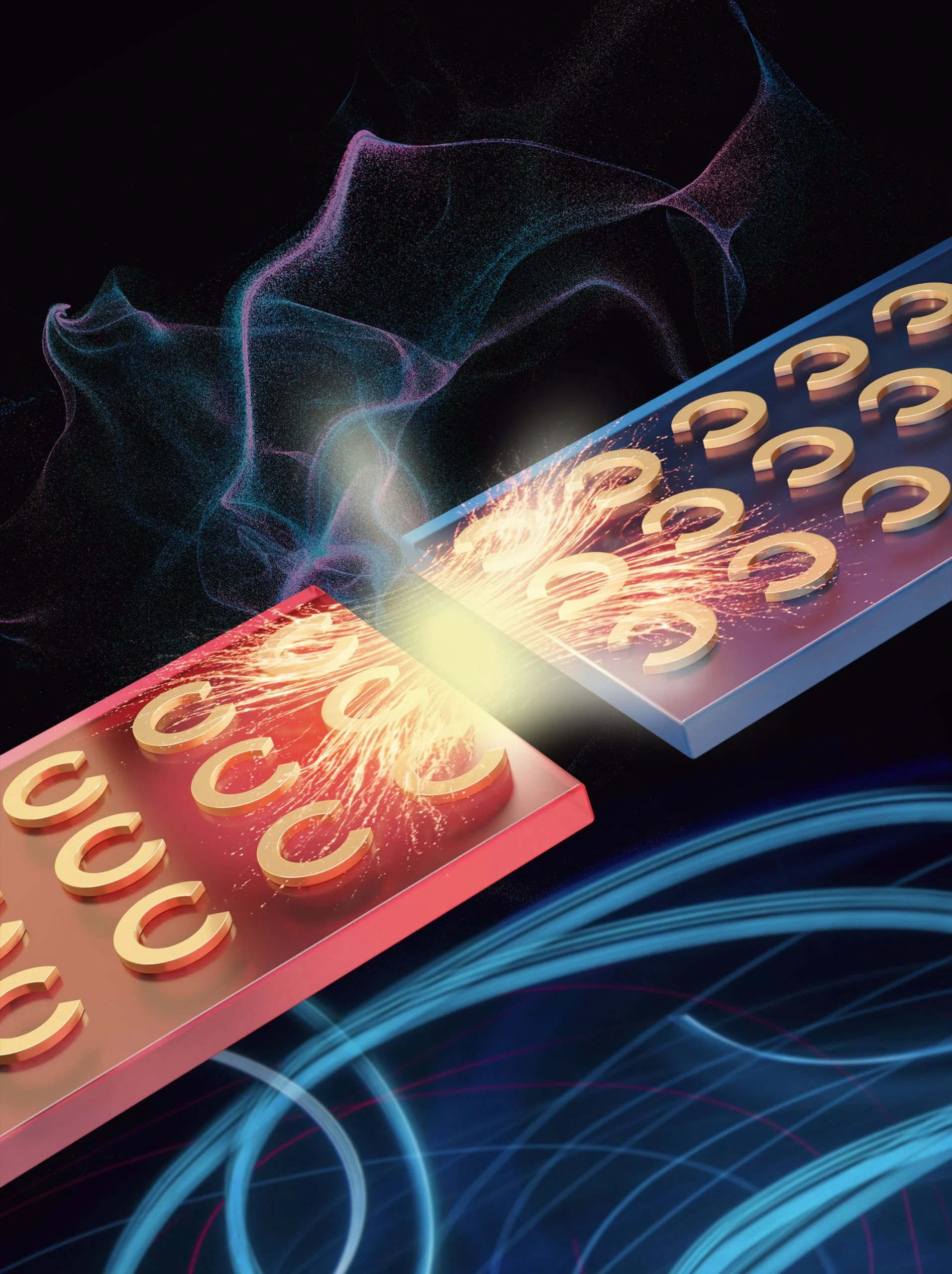
On everyday scales, objects exchange heat mainly through thermal conduction, convection and ordinary thermal radiation; but when two surfaces are close to hundreds of nanometers, near-field effects become important. At this time, the electromagnetic field near the surface can transfer energy to the other side through gap coupling, making thermal radiation heat transfer exceed the limit of far-field blackbody radiation. The team tested surface spacings of about 250, 450 and 730 nanometers, constructed structures including gold split-ring resonators on silicon nitride films, and measured changes in heat transfer through the nanogaps.
Enhance the synergy from both structures. The resonance mode generated by the gold split ring resonator is strongly coupled to the phonon polaritons on the silicon nitride surface; phonon polaritons are surface waves formed by the coupling of electromagnetic waves and material lattice vibrations. They can transfer energy across gaps in the near field. The research team supported this explanation through electromagnetic simulations and coupled mode theoretical analysis. In other words, the research is not simply to increase the heat conduction channel, but to make the two resonances enhance each other by carefully designing the surface structure of the material.
Researchers believe that this method may provide new cooling ideas for chips and high-performance computing systems in the future. It may also improve the efficiency of thermophotovoltaic systems using thermal radiation to generate electricity, and help enhance the signal control capabilities of infrared sensors. However, the current results were obtained under nanoscale, precisely aligned and controlled laboratory conditions, and no coolers, power generation devices or sensing products that can be directly used in commercial chips have yet been demonstrated. The research team said that in the future, engineering issues such as how to integrate this structure into actual devices, maintain extremely small spacing, and achieve large-area manufacturing still need to be solved.
Comments