
Abstract:
Researchers at Maynooth University in Ireland have developed a new type of DNA computer that does not rely on traditional silicon chips and continuous input of electrical energy, but uses the interaction between DNA molecules to complete mathematical operations. The system is capable of performing operations such as addition, subtraction, multiplication and division, and in experiments successfully processed complex calculations involving 100-bit data.
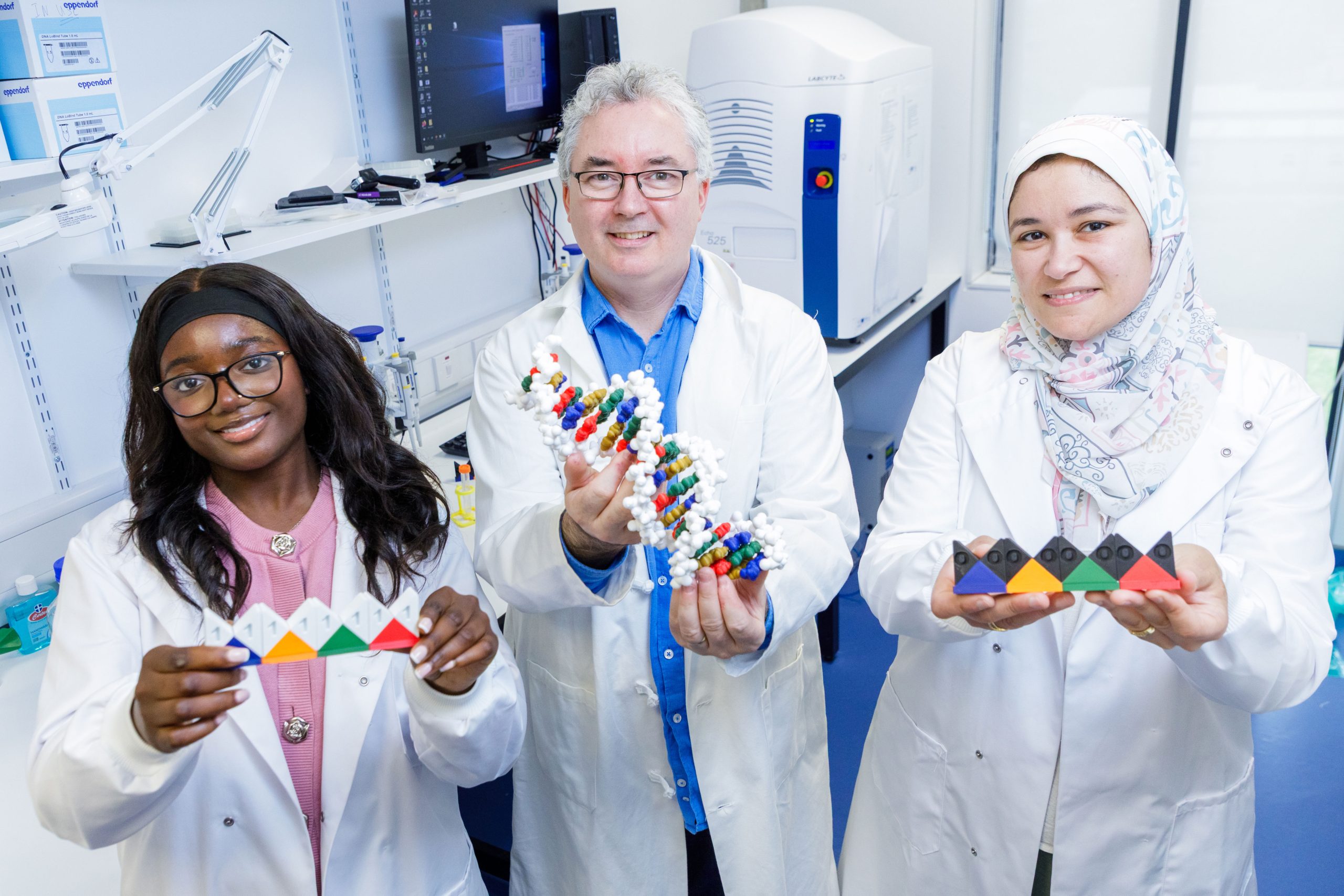
The researchers said that the system not only has the ability to be reused, but can also rely on the interaction of the molecules themselves to complete calculations after startup, providing new research directions for future low-energy computing, long-term data storage and biomedical applications.
This research result was published in the international academic journal Nature. The research team calls this system a Scaffolded DNA Computer (SDC) and describes it as one of the more complex and faster molecular computing systems reported so far.
Unlike traditional computers that process binary information through the switching states of transistors, DNA computers use the chemical properties of nucleic acid molecules to process information. Researchers pre-design the sequences of different DNA fragments, allowing these molecules to combine with each other according to specific rules, and ultimately form a molecular structure that can represent the calculation results.
The entire system does not look like a computer in the traditional sense. It does not require a motherboard, processor or graphics card, nor the large number of high-speed switching transistors found in traditional electronic computers. During the experiment, the researchers only need to mix water, salt, short DNA fragments and a longer DNA scaffold in a test tube, and through a small amount of heating and subsequent cooling, the calculation process can be started.
Among them, longer DNA strands act as scaffolds, and short DNA fragments are combined with them according to pre-designed rules. As the temperature changes, molecules continue to combine and rearrange, gradually forming a more stable structure. The final molecular arrangement corresponds to the answer to the calculation problem.
Professor Damian Woods of the Hamilton Institute of Maynooth University said that a key innovation of this technology is that the system can naturally find the corresponding answer without the need for continuous input of energy to drive each step of calculation.
This calculation method makes use of the principles of thermodynamics. When DNA molecules interact, different binding methods have different energy states. By rationally designing DNA sequences and scaffold structures, researchers can make the molecular arrangement that represents the correct answer correspond to a more favorable energy state, so that the entire system gradually tends to this state during the self-assembly process.
In other words, instead of asking the processor to perform calculations step by step according to a series of electronic instructions like traditional programs, researchers encode the calculation rules into DNA molecules in advance, and then let the molecules rely on their own chemical interactions to find results that comply with the rules.
This method is particularly suitable for studying calculations at the molecular level. A large number of DNA molecules can interact simultaneously in the same solution, so the system has potential parallel processing capabilities. However, the large number of molecules does not mean that all calculations can be completed immediately. The final speed still depends on multiple links such as molecular reactions, structure assembly, and result reading.
To verify the actual capabilities of the system, the research team designed and tested 10 different calculation programs involving a variety of mathematical operations, including calculation tasks up to 100-bit data scale.
In a simple experiment, the DNA computer successfully completed the operation of 10 plus 3, which took about 30 seconds. For a conventional computer, this calculation would be completed almost instantaneously, but for a system that relies on the self-assembly of molecules to complete the calculation, this result demonstrates its ability to handle simple computing tasks.
In another, more complex experiment, the researchers asked the system to add numbers ranging from about 11 million to 34 million. Due to the larger scale of calculations, the system ultimately takes up to about 14 hours to get results.
These experiments show that DNA computers can handle problems much more complex than simple single-digit addition, but there is still a huge gap between its calculation speed and traditional silicon chips. The researchers are not trying to build it as a direct replacement for ordinary computers, but hope to explore another way to use the matter itself for information processing.
Assistant Professor Abir Eshra, who participated in the research, said that the response speed of this system is not as fast as that of silicon chips, but its performance has advantages compared with other DNA computers previously developed. She emphasized that the goal of the research is not to make DNA computers surpass traditional electronic computers in all tasks, but to take advantage of the potential advantages of molecular computing in terms of energy consumption and parallel processing.
In addition to computing power, the reusability performance of the system is also one of the important results of this research. Experiments have shown that the same DNA computing system can continuously perform up to 25 different computing tasks without having to completely rebuild the system each time.
For molecular computing, reusability is important. Some early DNA computing methods consumed a large amount of molecular materials, making it difficult to continue to use the original system after completing a calculation. If a large number of DNA molecules must be prepared anew for each operation, the cost and practical application difficulty of the related technology will increase significantly.
The system developed by the Maynooth University team can be reused in continuous calculations, providing the possibility to establish a more practical molecular computing platform in the future. However, the research is still in the laboratory stage, and the system's stability in more complex tasks, longer runs, and large-scale deployments needs further verification.
The background to this research is the energy pressure brought about by the continued growth of global computing and data storage needs.
Artificial intelligence models, cloud computing services, and large data centers require large numbers of processors to run continuously. As the scale of computing tasks continues to expand, the energy consumption of traditional electronic computing systems has become an increasingly important issue in industrial development.
Woods pointed out that computing and data storage account for a significant proportion of Ireland's electricity consumption. He believes that for a long time, people have tended to equate computers with silicon chips and electronic circuits, but have ignored that there are other systems in nature that can process information.
The brain is one example. The human brain is capable of completing complex information processing tasks with far less power consumption than many modern computing systems. Although DNA computing does not work in the same way as the brain, researchers hope to find new computing architectures by exploring physical and chemical processes that are different from traditional electronic computing.
DNA itself also has extremely high information density. It is made up of four basic nucleotides, which encode information in different arrangements. In theory, DNA can store large amounts of data in an extremely small volume, so it has long been regarded as a potential medium for future high-density data storage.
However, DNA storage and DNA computing are two related but different research directions. DNA storage mainly focuses on how to encode digital information into nucleic acid sequences and reliably read it when needed; DNA computing attempts to use the interactions between molecules to directly complete logical or mathematical operations. The focus of this research is on the latter, and it also provides a basis for future exploration of systems that combine computing and storage.
Researchers believe that this technology may be used in the future for specific scenarios where long-term preservation of information is required, energy supply is limited, or the parallel processing capabilities of molecules can be fully utilized. For example, in some long-term data storage systems, if information preservation can be integrated with part of the computing task, there is an opportunity to reduce reliance on traditional electronic equipment.
In the further future, molecular computing may also be combined with biomedical research. Since DNA itself is an information molecule in living organisms, researchers hope to explore whether similar molecular systems can be used to perform specific tasks inside cells or in biological environments, such as identifying certain molecular signals related to disease.
If realized in the future, such systems are expected to help researchers develop new molecular sensors, or allow specific biomolecules to respond to their surrounding environment. However, the current DNA computer is still an experimental system running in a test tube, which does not mean that scientists have been able to implant a complete DNA computer into human cells.
From an engineering perspective, there are still many problems to be solved with this technology. First, the DNA molecule assembly process requires appropriate temperatures, solution conditions, and molecule concentrations, and researchers must ensure that different batches of experiments can produce consistent results. Secondly, after the calculation is completed, the system also needs to read the molecular structure through appropriate methods and convert the results into information that humans or other computing devices can use.
For large-scale applications, it is also important to improve the speed of complex calculations, reduce errors, reduce the cost of DNA materials, and establish repeatable preparation processes. Even if molecules can perform operations without the need for constant power, the process of heating, preparing and reading the experimental equipment can still consume energy. Therefore, the more accurate significance of this research is to demonstrate a molecular computing mechanism that does not require continuous electricity to drive the calculation process, rather than proving that the entire experimental process requires no energy at all.
The DISCO project that the research team participated in, the DNA Basic Storage and Computing Infrastructure Project, hopes to further develop methods of using DNA for information storage and computing. The project received approximately €4 million in funding from the European Innovation Council and was led by Woods.
The researchers said that the current work is exploratory basic research, and there is still great uncertainty in the future application direction. DNA computers won't replace traditional processors in PCs, smartphones or artificial intelligence data centers in the short term, but it may provide a different way to implement certain specialized computing tasks.
What’s really important about this research is that it shows that computing doesn’t have to rely solely on transistors and continuously powered electronic circuits. By carefully designing the molecular structure, the researchers were able to allow DNA to complete mathematical operations during its self-assembly process and retain a structure that represented the results after the calculations were completed.
As computing demands and energy consumption continue to grow, finding computing methods that are different from traditional silicon chips has become an important research direction in the scientific community. DNA computers are still a long way from practical applications, but they provide a direction worth continuing to explore for low-energy computing, molecular information processing, and new data storage technologies.
Comments