
Abstract:
For decades, the astronomical community has been puzzled by a profound mystery at the center of massive galaxies: Since the powerful jets emitted by supermassive black holes heat the surrounding gas that is supposed to serve as "nutrients," how do they continue to obtain supplies and maintain "feeding"? Now, the latest observational images returned by the James Webb Space Telescope (JWST) provide the clearest direct evidence of this process so far, marking a milestone step for astronomers to solve this mystery.
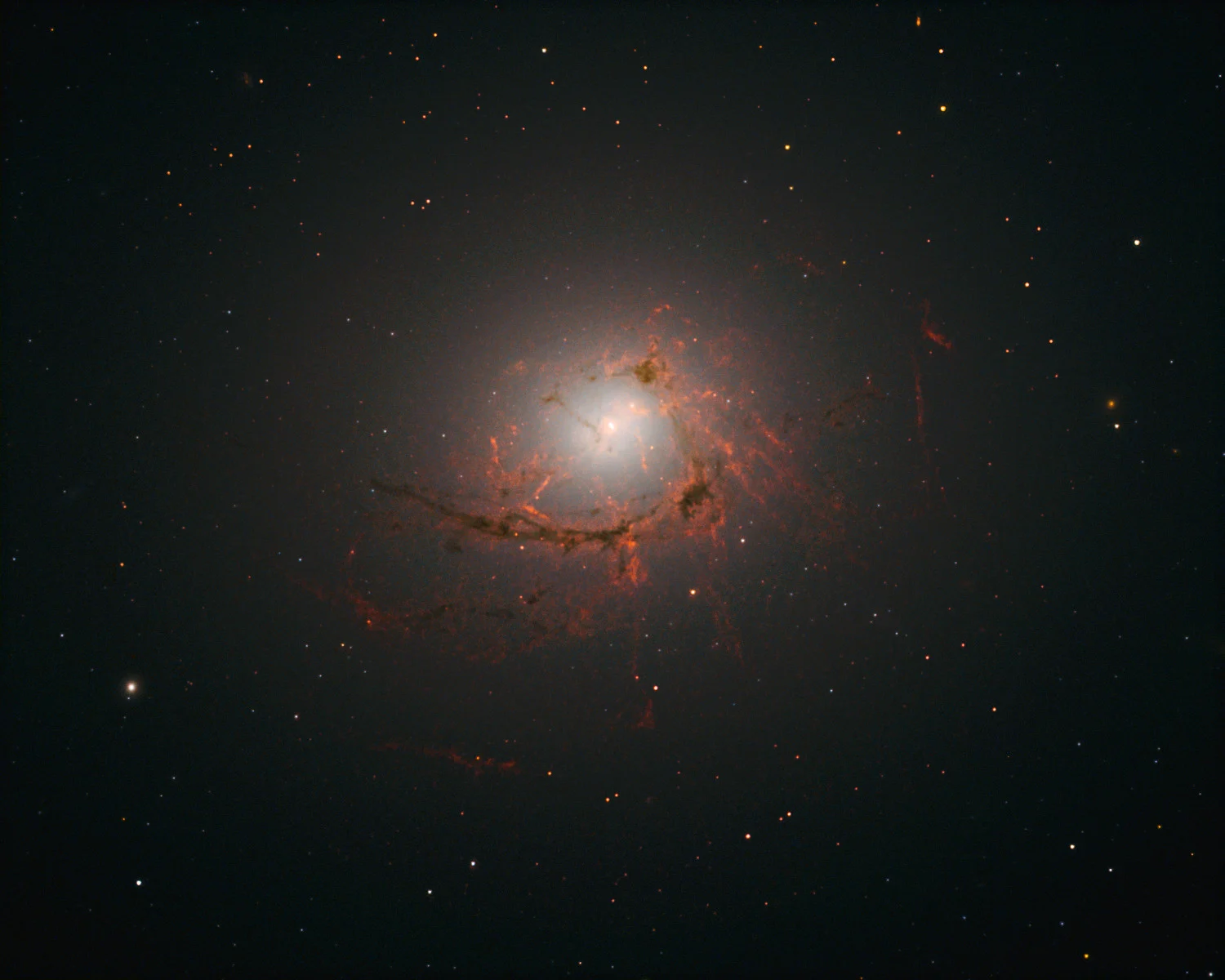
This international collaborative research published in The Astrophysical Journal Letters was led by the University of Montreal in Canada and participated by Michigan State University in the United States and other institutions. The research team set their sights on NGC 4696, the elliptical galaxy at the center of the Centaur Galaxy Cluster, about 145 million light-years away from Earth. This dense galaxy cluster is an excellent natural laboratory for the astronomical community to study the workings of active galactic nuclei (AGN).
At the center of almost all large galaxies lurks a supermassive black hole with a mass millions or even billions of times that of the sun. When they violently devour surrounding matter, they form active galactic nuclei, and at the same time release surprisingly powerful high-energy jets outwards. These jets not only reshape the host galaxy and inhibit the birth of new stars, but also dominate the evolution of the entire galaxy. However, this intense activity also triggers the so-called "feeding paradox": the jet continuously heats the gas around the black hole, and in theory will eventually completely cut off the supply of raw materials required for the black hole to survive and grow.
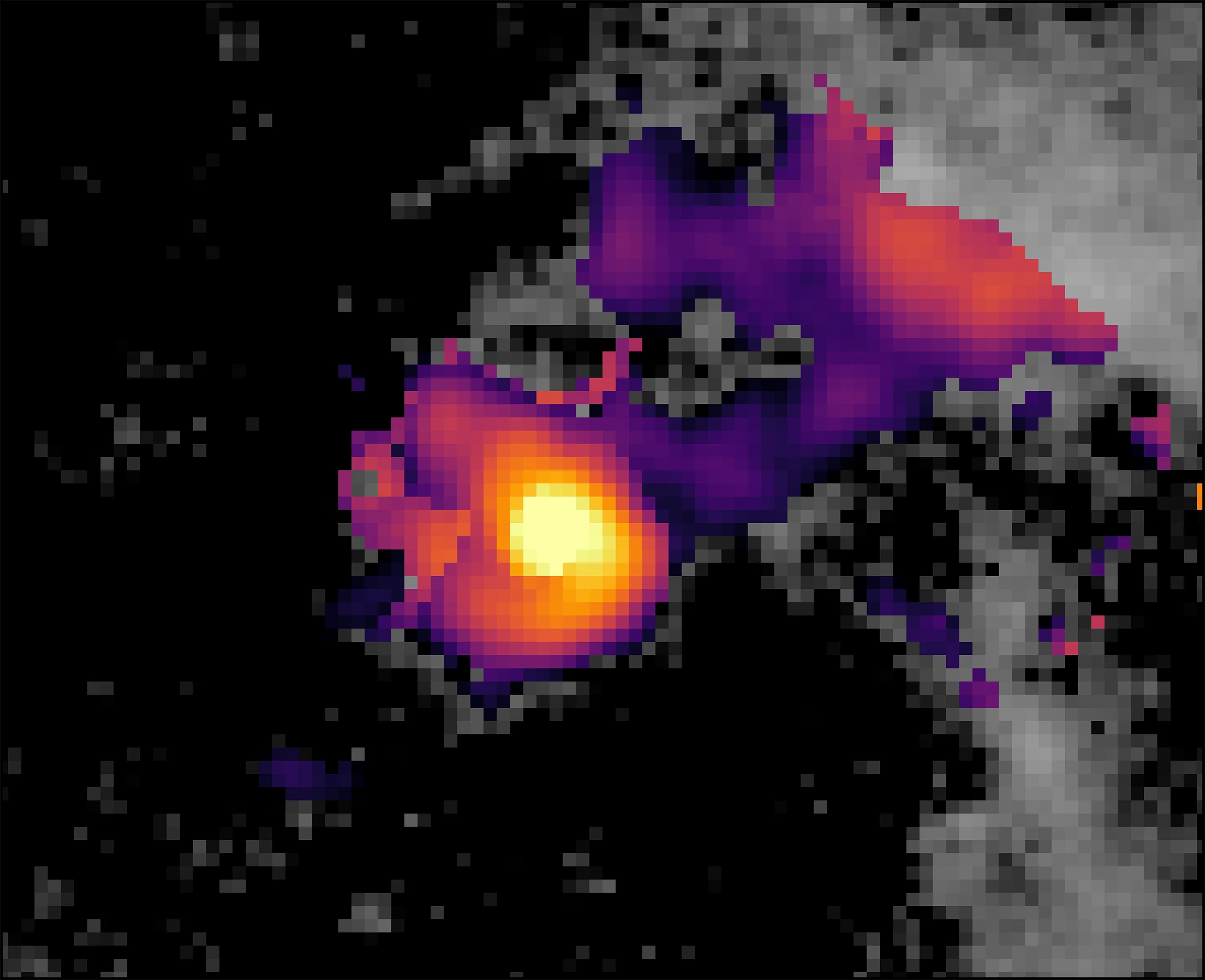
The mainstream academic hypothesis is that part of the heated gas will cool and condense over time into slender filamentous structures and fall back to the center of the galaxy, thus forming a "self-regulating" material cycle that allows the black hole to replenish its fuel while destroying the environment. In order to verify this hypothesis, the research team used the Webb Telescope Near-Infrared Spectrometer (NIRSpec) to conduct in-depth observations for nearly 8 hours, and successfully tracked the movement of gas deep within the gravitational sphere of the black hole.
In the context of galaxies spanning hundreds of thousands of light-years, the Webb Telescope has demonstrated amazing resolving power, accurately analyzing microscopic structures on a scale of only about 30 light-years. Observation spectra and images show that the "S-shaped" vortex previously observed at the center is actually a gas disk with a diameter of nearly 800 light-years and rotating at high speed around the black hole. The material in the disk moves at a speed of up to 600 kilometers per second.
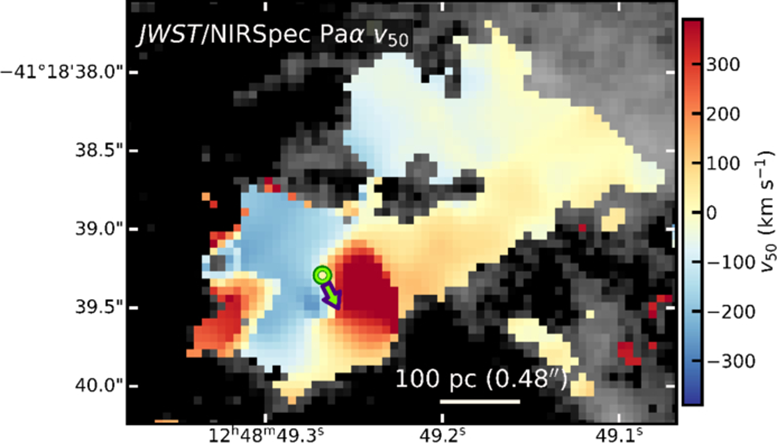
Even more groundbreaking is that the rotating disk is directly connected to the huge filaments of gas that extend in the galaxy. The data clearly show that gas is flowing inward along these filaments, which are hundreds of light-years across and thousands of light-years long, directly into the rotating accretion disk that feeds the black hole. The magnetic field plays a key role in this process, slowing down the rotation of the falling gas and guiding the material to converge inward. The black hole then erupts into another jet, allowing the entire self-sufficient cycle to continue over and over again.
Advanced computer numerical simulations also confirmed this model from independent dimensions. The dynamic behavior of the gas in the simulation closely matches the real scene captured by the Webb telescope. Researchers pointed out that theoretical calculations originally predicted that magnetic fields would guide cold gas to flow toward giant black holes. However, with the unprecedented resolution of the Webb Telescope, this cosmic cycle that has long been on paper has been fully presented to human eyes.
Comments