
Abstract:
U.S. President Donald Trump recently posted a number of photos of the White House after renovation on the social platform Truth Social, showing the results of the renovation of the southern facade, new entrance and helicopter pad of the White House. However, one of the photos used to compare the before and after renovation of the White House pillars sparked controversy. There are multiple inconsistencies in this comparison image, and Google’s SynthID detection tool also flagged it as an image generated or edited using OpenAI tools.
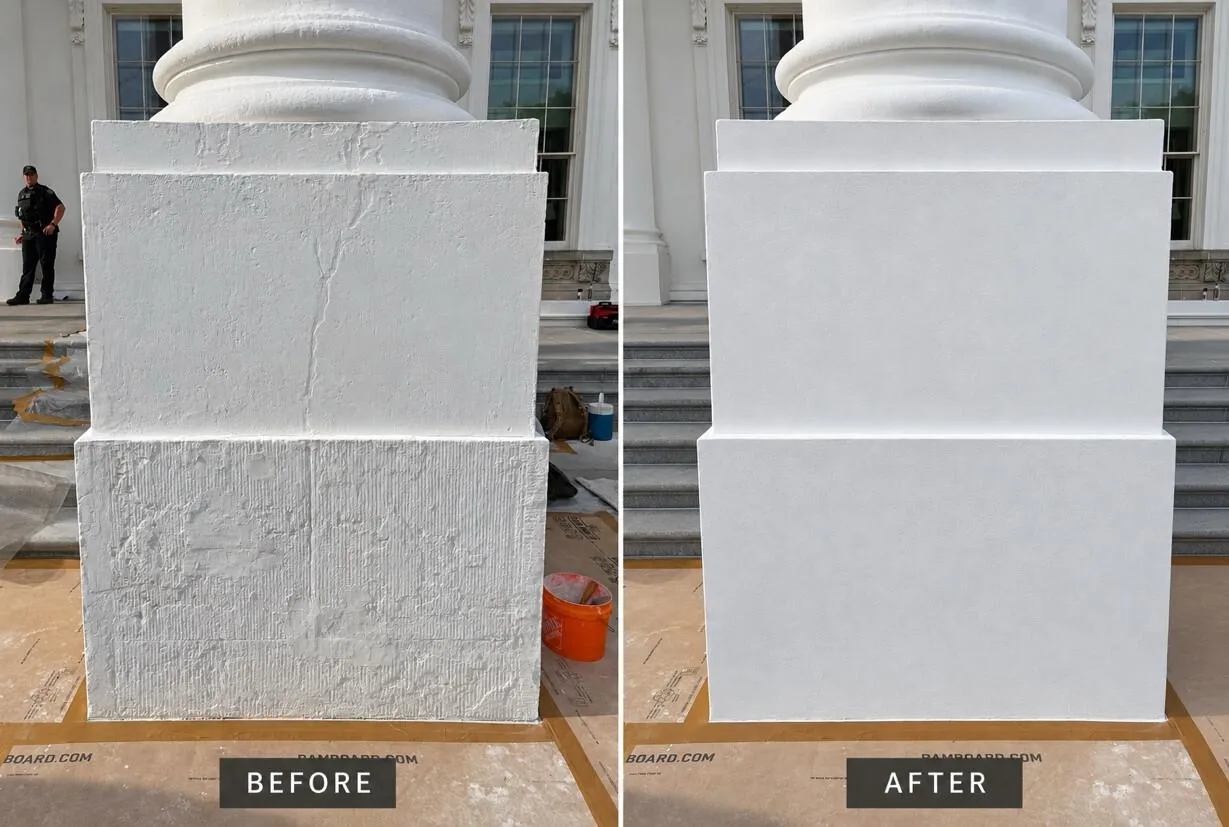
The photos released by Trump are intended to show recent maintenance and renovation work at the White House. One of the images takes the form of a common "before and after" comparison, showing the columns before the renovation on the left and the repainted exterior on the right. Trump used this to emphasize that the appearance of the White House building had been improved, but the details of the photo later attracted the attention of netizens.
The first thing that came into question was the number of steps on either side of the pillar. Netizens found that the number of steps on both sides of the pillar in the comparison picture was not symmetrical, and was also inconsistent with the number of steps in the "before renovation" photo. For a fixed building, such structural details would not typically change due to a repaint, raising the question of whether the image had been digitally altered.
Secondly, the shooting angles and details of the two photos look almost identical. The reflections in the windows are fairly close, and the cardboard used to protect the ground at the base of the columns appears to be in the same position. Meanwhile, the surface of the so-called renovated column on the right appears unusually smooth, different from the subtle textures that may appear after a regular building is repainted.
These anomalies do not alone prove that the photo has been edited by AI, but they prompt further examination of the source of the image. Using the SynthID detection tool launched by Google to analyze the photo, the detection results show that the image has tags related to AI generation or editing, indicating that it may have been processed using OpenAI related tools.
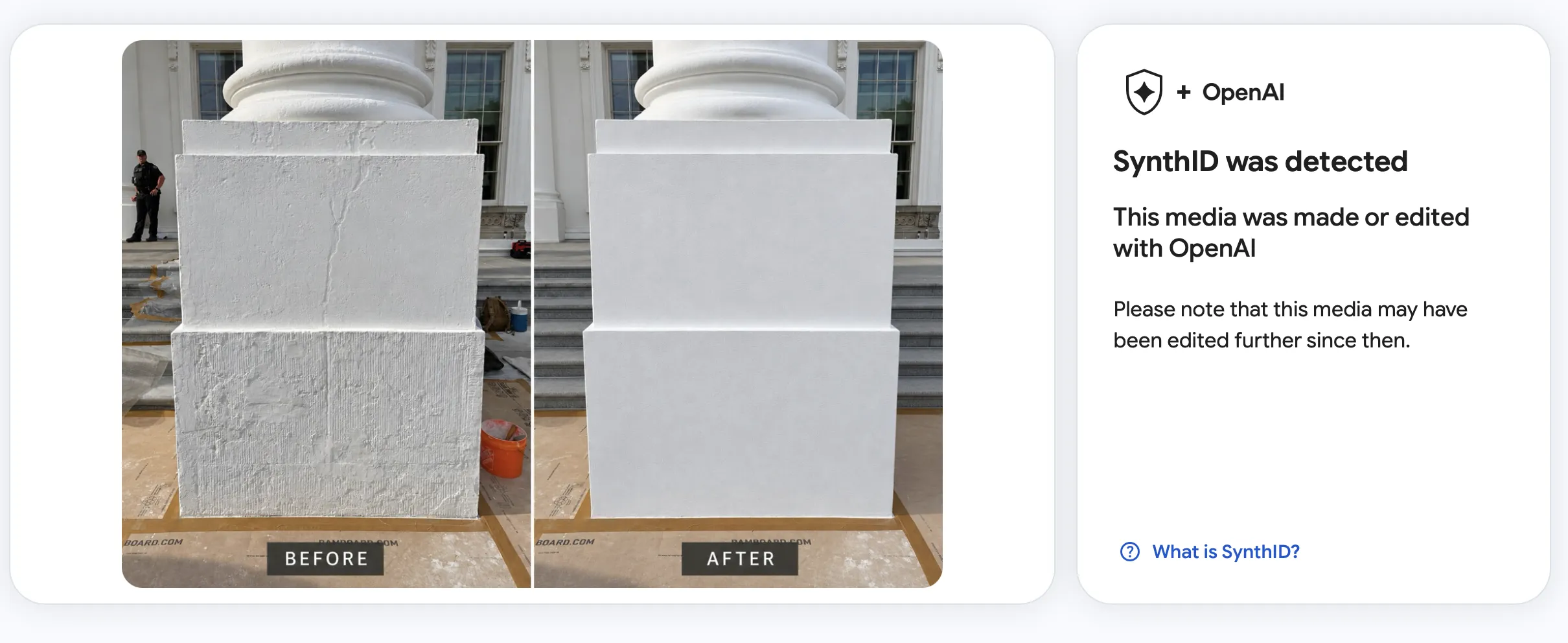
SynthID is a set of digital watermarking technologies developed by Google, designed to add tags that are difficult to detect by the human eye on images, videos and audio generated by AI. Relevant detection tools can try to identify these watermarks to help determine whether the media content has been generated or edited by corresponding AI tools. However, such detection results still need to be understood in conjunction with other evidence. It cannot be concluded that all the content in the image is fictitious based on detection marks alone, nor can it be determined based on this what specific modifications have been made.
It is worth noting that the White House did carry out relevant maintenance work. Previously released real photos showed workers painting the exterior of the White House in June 2026. So the columns themselves may have indeed received a repaint, and the dispute is about whether the "before and after" photos Trump posted accurately represent the actual construction results, not whether any maintenance was performed at the White House.
The White House has not responded to media inquiries about whether the photo was edited by AI. Other photos Trump posted at the same time, including images of the White House facade and a helicopter pad, did not detect the SynthID watermark by the same detection tool. Therefore, there is currently no evidence that all the photos he posted of White House renovations were processed by AI.
Trump has previously posted AI-generated personal images or satirical images many times. The White House and its related accounts have also posted controversial AI images, including Internet memes that have been criticized for being racist, and a photo that was accused of misleadingly editing to change the expressions of protesters. These events have brought more attention to the comparison of the White House renovation.
This incident involves not only AI image technology, but also how public institutions and politicians use digital media to display government work. AI image editing tools can be used to repair photos, improve footage, or create schematics, but if the edited image is released as a real record without clearly stating that it has been processed, it may make it difficult for the public to distinguish the actual changes from the effects of digital processing.
For public affairs such as government building maintenance, accurate presentation of project progress is particularly important. Before-and-after photos are often used to demonstrate construction results, and if structural details in the images are altered, it may undermine the credibility of the material as a record of fact, even if actual renovation work did occur.
What can be confirmed so far is that one of the White House pillar comparison pictures released by Trump has obvious visual inconsistencies and was marked by Google's SynthID detection tool as being generated or edited using OpenAI tools. As for who specifically modified it, which parts were modified, and whether the modification changed the actual renovation effect, the White House has not yet received an explanation.
As generative AI tools become more popular, it becomes increasingly difficult for the public to identify the authenticity of images. This controversy once again illustrates that AI detection tools can provide clues for verification, but to judge whether the images released by public figures are accurate, it is still necessary to combine the original photos, construction records, image sources and responses from relevant agencies, rather than relying solely on a single detection result.
Comments