
Abstract:
Astronomers used NASA's James Webb Space Telescope to conduct an in-depth study of a rare type of young star system and, for the first time, identified traces of collisions between different types of planets through their dust composition. The research results show that the large amount of dust surrounding distant stars not only records the violent impact process during the planet formation period, but may also help scientists understand the history of the early formation of the moon and even the earth.
The scientific community has long believed that in the early days of the solar system, a Mars-sized object called "Theia" violently collided with the young Earth. The impact caused large amounts of rock to vaporize and be ejected into space, and eventually some of the debris gathered to form the moon. This event, known as the "Big Impact Hypothesis," is thought to have profoundly changed the early state of the Earth.
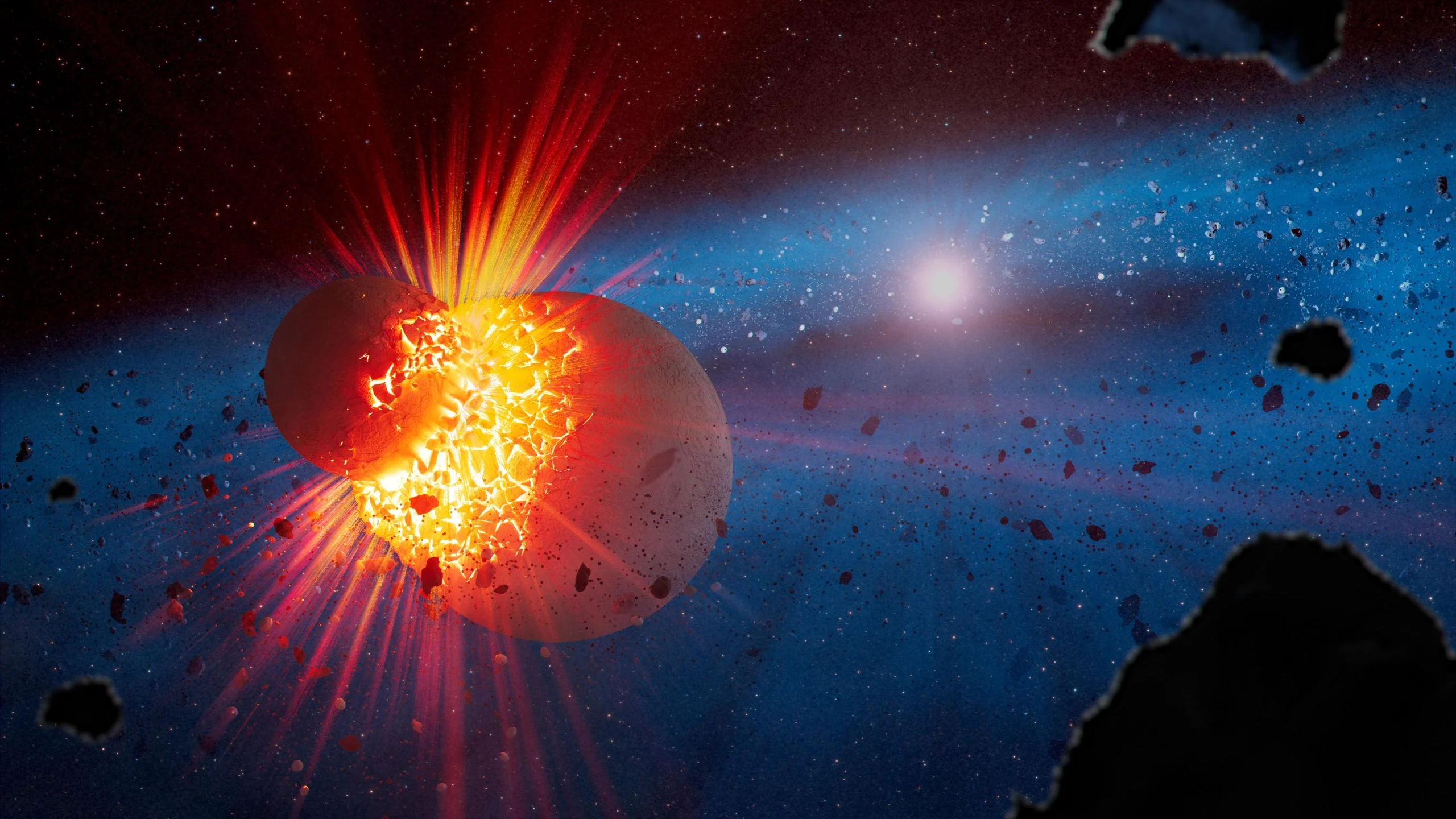
However, for other star systems, scientists are unable to directly observe these impact events because the forming planets are too small and far away. So they turned to looking for evidence of dust left behind after the collision. The research team used data from the Webb Telescope and the retired Spitzer Space Telescope to investigate a special star system called an "extreme debris disk." Such systems are unusually rich in warm dust and are located in regions similar to the orbits of the rocky planets in our solar system.
Theoretical models had predicted that this type of environment would be common, but actual observations show it to be extremely rare. Only about 1% of young stars are currently known to exhibit characteristics of this stage. The researchers ultimately compiled 21 extreme debris disk samples, including five targets from Spitzer archive data and 16 targets obtained from Webb telescope observations, thus establishing the largest sample library of its kind to date.
By analyzing the unique spectral characteristics of the dust in the mid-infrared band, the research team successfully determined the mineral composition contained in it. It was found that these debris disks can be divided into two broad categories: silica-rich debris disks and silica-poor debris disks.
Researchers believe that the silica-rich dust likely came from high-energy collisions between Mars-sized objects. Such impacts can vaporize large amounts of rock material and produce abundant siliceous debris. The components in question have similar characteristics to volcanic glasses on Earth, such as obsidian. About one-third of the debris disks in the study sample were of this type.
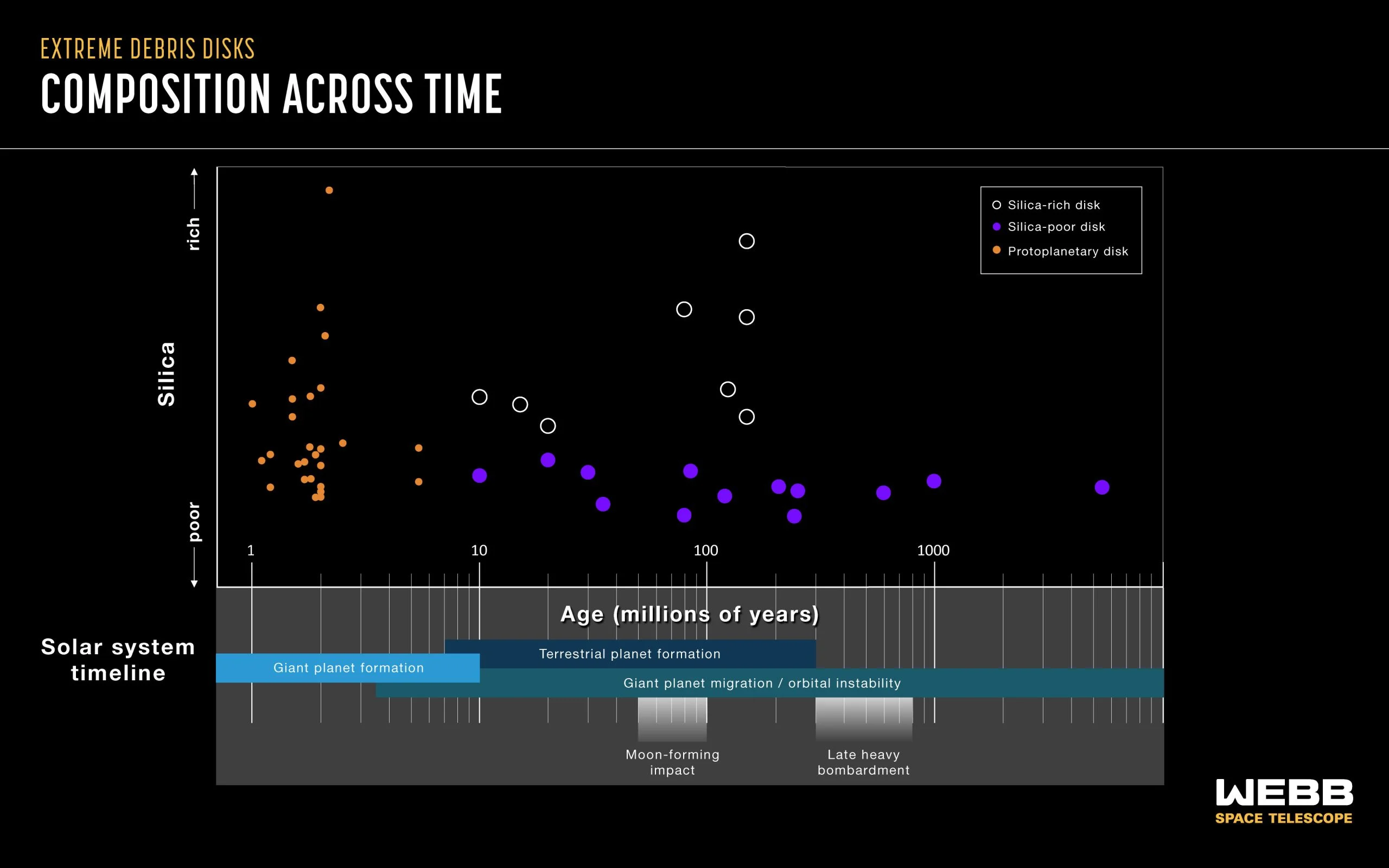
The remaining two-thirds of the samples were dominated by silica-poor materials. Researchers speculate that this type of dust may originate from relatively gentle collisions or pass-by impacts between moon-sized objects. One of the main minerals is forsterite, which is found on Earth in the green sand of some Hawaiian beaches.
Research shows that by identifying these differences in mineral composition, astronomers can infer the intensity and scale of impact events in distant star systems, even if the collisions themselves cannot be directly observed. In other words, the dust is like a "fossil record" that preserves the history of catastrophic impacts, helping scientists reconstruct key stages in the planet's formation process.
Agnes Kospal, an astronomer at the Konkoj Observatory in Hungary who participated in the study, said that the mid-infrared radiation and clear spectral features recorded by the Webb telescope are exciting because these data allow the research team to accurately identify the chemical composition of the dust.
The researchers pointed out that this is the first time that the scientific community has collected a sufficient number of extreme debris disk samples to truly understand the role of this special stage in the formation and evolution of planets. As the Webb Telescope continues to conduct observations, future research is expected to further reveal cosmic-scale collision events similar to those experienced during the formation of the Earth and the Moon, and help humans gain a deeper understanding of how rocky planets are born in chaos and impact.
Comments