
Abstract:
With the help of the James Webb Space Telescope, astronomers have found strong evidence of an atmosphere on an exoplanet similar to the early Earth. The planet, called HD 3167b, is a lava planet, but it is too cold for a lava planet and too hot for life. Previously, academic circles generally believed that the atmosphere of a rocky planet so close to a star would be stripped away by stellar radiation. The relevant results were completed by a team from the University of Chicago and have been published in the latest issue of The Astrophysical Journal Letters.
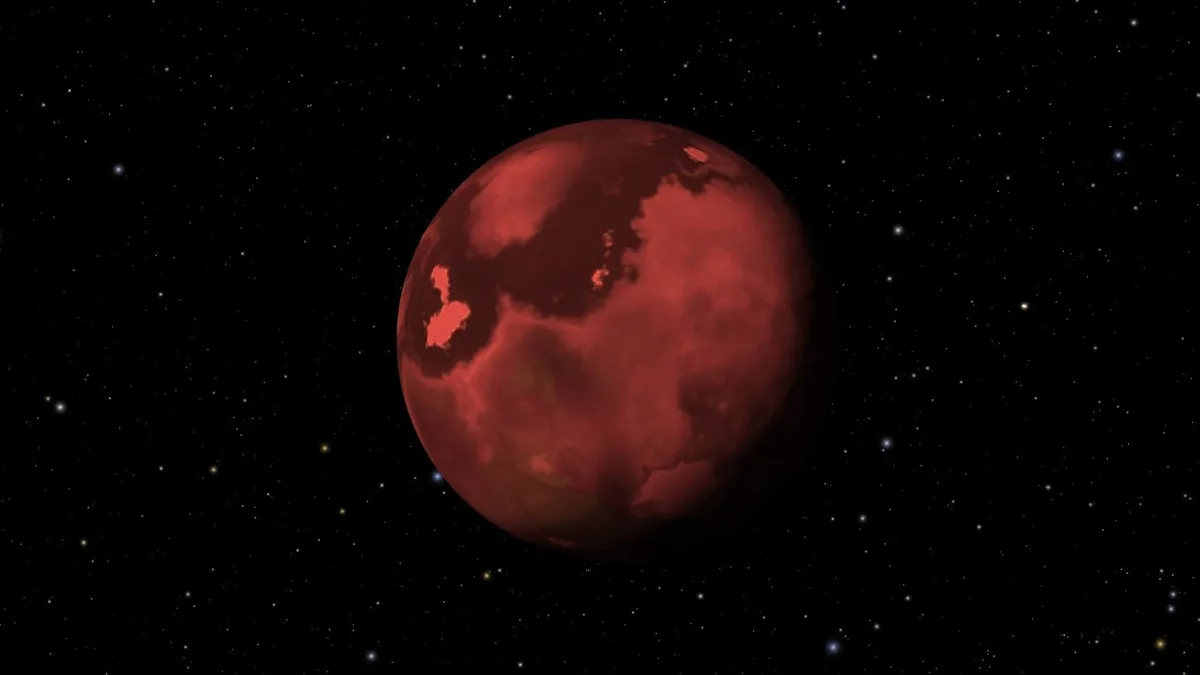
Newly discovered lava world HD 3167b. Image source: NASA official website
HD 3167b is located in the direction of Pisces, about 154 light-years from Earth. It takes only 0.96 Earth days, less than 24 hours, to orbit its host star once, and is tidally locked: one side always faces the star, and the other side is always dark. Theoretical calculations show that the equilibrium temperature on its sunny side can reach 1,786 Kelvin, which is enough to melt silicate rocks.
The planet has a radius of about 1.6 times that of the Earth and a mass of about 4.84 times that of the Earth. It is a rocky "super Earth". Its host star HD 3167 is slightly smaller than the sun, but due to its extremely close orbit, the intensity of radiation received by the planet is still very high.
The research team used the Webb Telescope's MIRI mid-infrared instrument to measure the thermal radiation on the sunward side during the window period of the planet's secondary eclipse. The results show that the brightness temperature on the dayside is significantly lower than theoretical expectations for a bare rock planet without an atmosphere. The most reasonable explanation is that the atmosphere plays a cooling role: part of the stellar radiation is reflected back, and the atmospheric flow can also transport heat from the dayside to the shady hemisphere, thereby lowering the peak temperature on the sunward side.
This discovery changes people's understanding of the evolution of molten planets. According to past models, the star's high-energy ultraviolet radiation and stellar wind will continue to blow away the outer gas of the planet, making it difficult for such planets to maintain their atmosphere for a long time. Based on this, it is speculated that the atmosphere of HD 3167b is likely to come from the planet itself. The magma ocean continuously evaporates rock material, replenishes the upper atmosphere, and competes with the stripping of the stellar wind. It is also the lava planet currently known to receive the weakest stellar radiation but has evidence of an atmosphere.
The team also reminded that it has only found strong evidence of the existence of the atmosphere, not final confirmation. The chemical composition of the atmosphere cannot be accurately determined, and more Webb spectroscopic observations are needed to distinguish it.
Because the primitive Earth billions of years ago was also a world filled with magma, lava planets are regarded as "models" for the early Earth. Observing how HD 3167b retains its atmosphere will help us understand the process by which the young Earth gradually cooled in its hot environment, creating conditions for the emergence of liquid water on the surface.
However, researchers pointed out that even if the atmosphere takes away some of the heat, the dayside of the planet is still hot enough to melt rocks, and does not have a living environment for known life.
Comments