
Abstract:
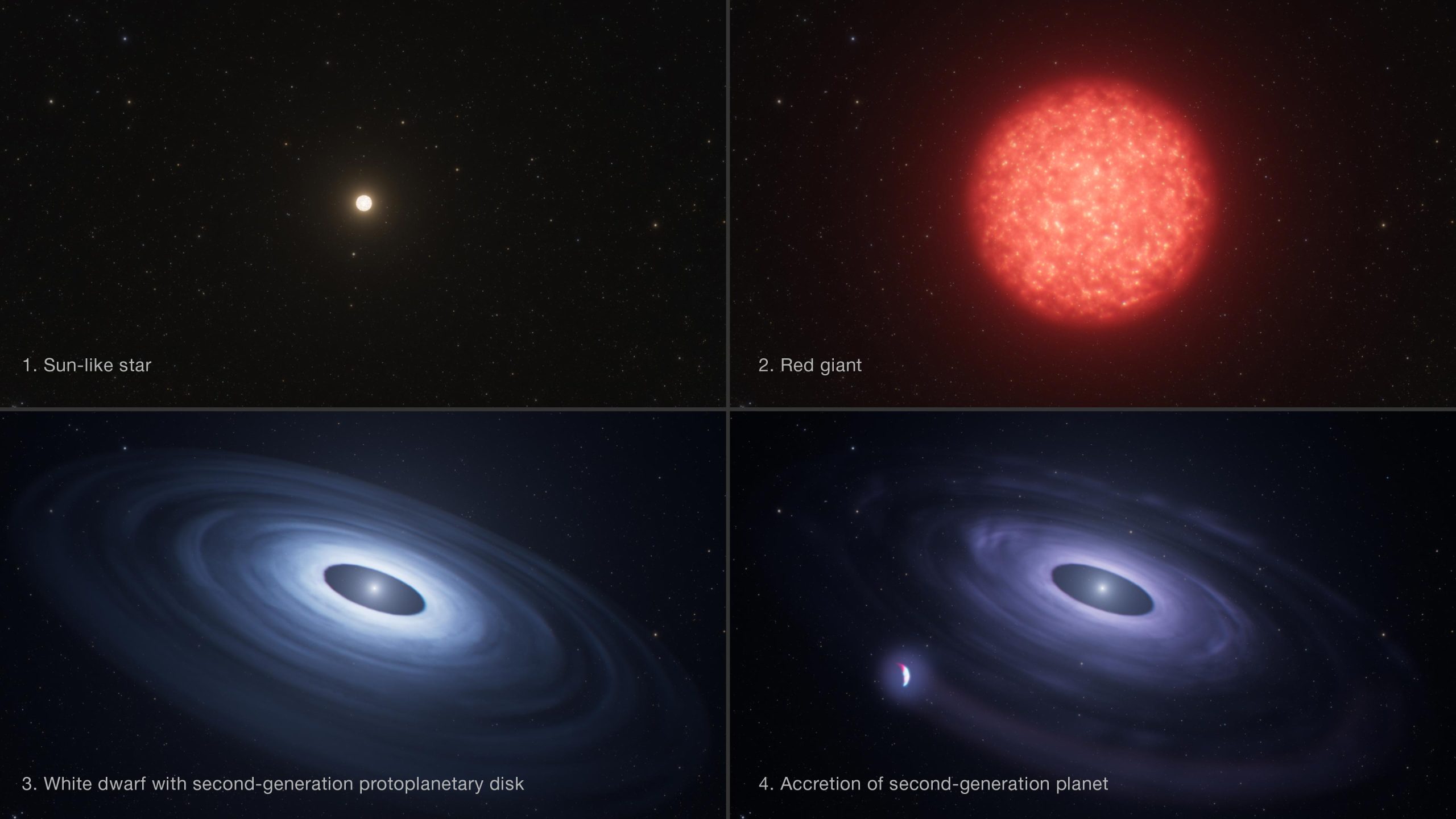
Reanalyzing data collected by NASA's Hubble Space Telescope more than two decades ago, astronomers have discovered an important clue that may solve a long-standing mystery. A new study published in "Nature Astronomy" shows that there may be a "second-generation planet" near the white dwarf HS 0209+0832. This planet may not be born at the same time as the star, but is formed by the reintegration of material ejected after the death of the star.
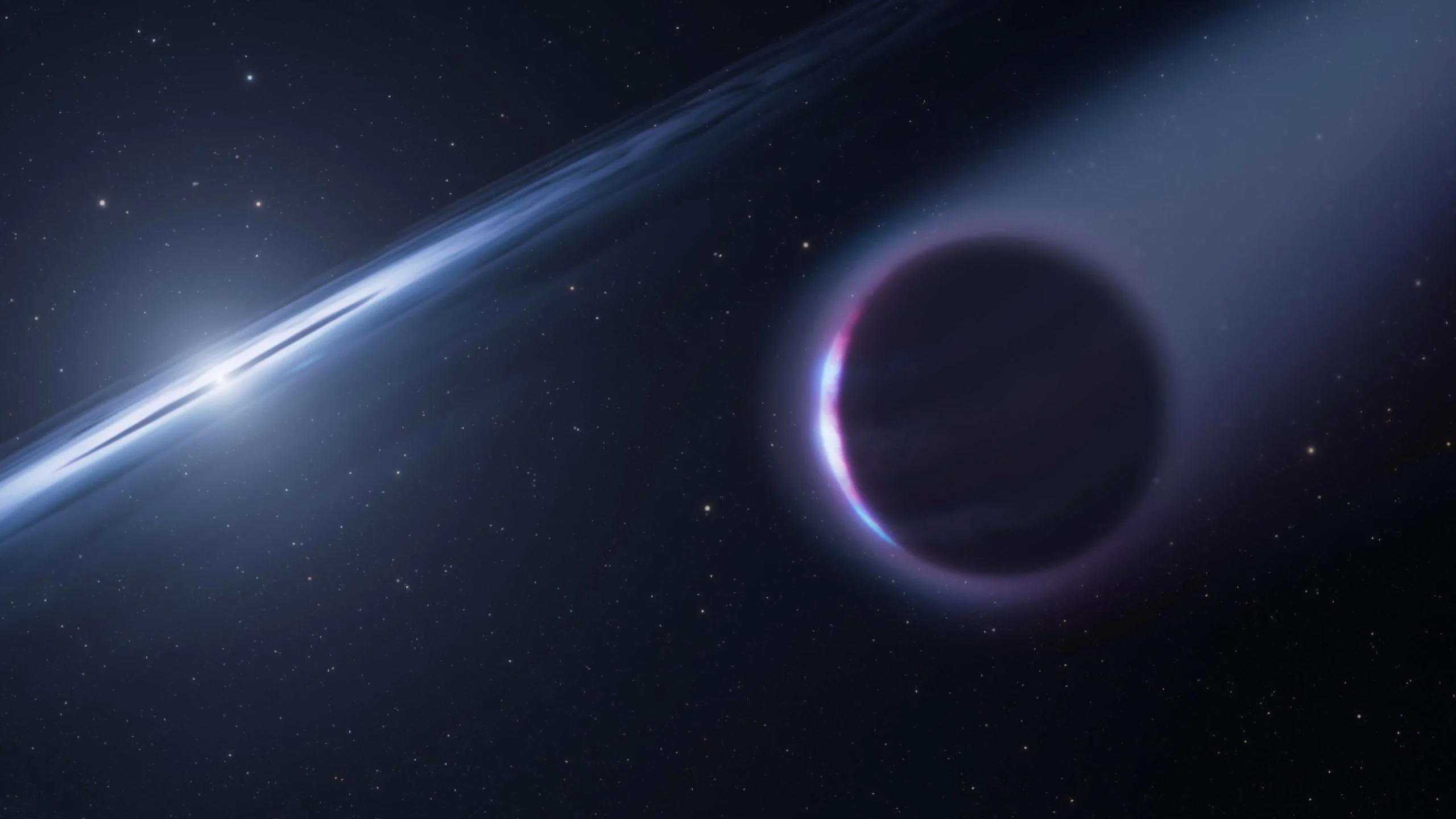
White dwarfs are the hot cores left behind after low-mass stars have exhausted their nuclear fuel. When a star reaches the end of its life, it sheds its outer layers of gas and dust into space. Researchers believe that the so-called second-generation planets were formed using the material left behind by these dead stars, and have completely different origins from the first-generation planets orbiting the sun such as the Earth.
Jamie Williams, the first author of the study and a doctoral student at the University of Warwick in the UK, said that this discovery implies that the white dwarf stage is not the end of the story of stars and their planetary systems. The planetary system that humans are familiar with may be just the first chapter in a long evolutionary history, and after the death of the star, brand-new celestial bodies may appear, which brings exciting new directions for future research.
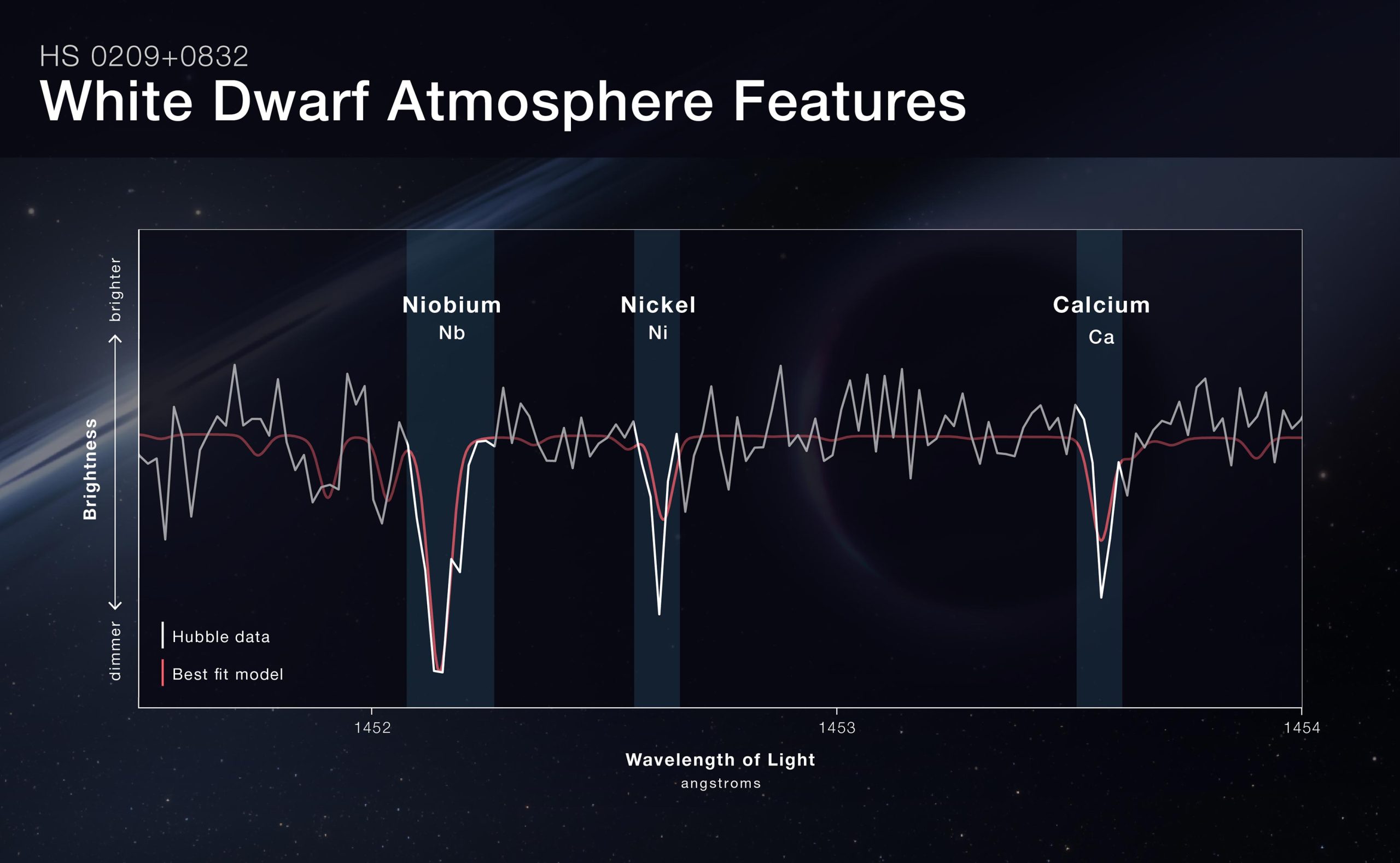
The breakthrough came from an unusual chemical signal hidden in old observational data. In 1999, the Hubble Telescope observed the HS 0209+0832 system and recorded about 100 spectral features that were not identifiable at the time. Years later, Williams re-examined the archival data and compared it with an updated database of atomic spectra, eventually discovering that many of the unknown signals corresponded to the element niobium.
Niobium element also exists in the solar system, and is also widely used on earth in fields such as jewelry and medical imaging. However, the researchers found that the abundance of niobium around HS 0209+0832 far exceeded expectations. Its source does not seem to be the original material left when the star was born, but more likely to come from the eruption products during the death of the star.
Nicholas Stone, a theoretical astrophysicist at the University of Wisconsin-Madison, explained that some elements heavier than iron, including niobium, have special significance. Unlike many common elements, these heavy elements are not produced through ordinary nuclear fusion inside stars, but are briefly formed in the extreme environments that occur at the end of a star's life. The very presence of niobium is a clear sign of the star's death process.
The research team speculates that when the star dies, the heavy element-rich material thrown out enters the surrounding space, part of which later reassembles and eventually forms a gas giant planet, while most of the remaining material gradually dissipates. In other words, the suspected planet was likely born after the star died.
When the team confirmed that niobium was indeed present in the data, the whole puzzle suddenly became coherent, said study co-author Boris Gansik, an astronomer at the University of Warwick. Such a niobium signature has never been found in any studied white dwarf star before.
The researchers also found additional evidence from data from NASA's retired Far Ultraviolet Spectroscopic Explorer (FUSE) mission. FUSE observations also show that there is an obvious niobium element signal in the HS 0209+0832 system.
At the same time, NASA's Transiting Exoplanet Survey Satellite (TESS) also provided another key clue. TESS monitored the white dwarf star for four consecutive months and found periodic changes in its brightness. This change suggests that a planet may be orbiting the white dwarf star at an orbit distance of only about 6 million kilometers, much closer than the distance between Mercury and the sun.
According to current speculation, this candidate object is a gas giant planet close to Jupiter in size, but it may be losing its atmosphere rapidly.
Due to the relatively short formation time of this white dwarf, it still maintains an extremely high temperature. Researchers believe that intense radiation is stripping away atmospheric material from neighboring planets. The escaping gas may form a structure similar to a comet's tail, and eventually form a ring-shaped disk of material around the white dwarf.
Part of the stripped material will then fall back onto the surface of the white dwarf, which may be an important reason why the Hubble Telescope detected a large amount of niobium in its observations.
Even so, Williams believes that if this second-generation planet does exist, it may still survive for a long time. Over time, the white dwarf will gradually cool and enter a relatively stable state. By then, the planet may remain in a stable habitable zone for millions of years.
However, there are still many unsolved mysteries surrounding the second-generation planets. Scientists still don't know exactly how such planets form, whether they are a common phenomenon or an extremely rare exception, nor do they know what kind of evolution they will undergo while orbiting a "dead star".
In the next few years, the research team plans to continue to use the Hubble Space Telescope to conduct follow-up observations, hoping to accumulate more evidence to paint a complete picture of this potential new planet group.
The results once again show that scientific discovery does not follow a straight path, the researchers said. Many major breakthroughs often come from the re-examination of old data and the collision of ideas between researchers in different fields. This "cold case re-examination" of a white dwarf star may be opening the door to understanding a new mechanism of planetary birth.
Comments