
Abstract:
Astronomers recently confirmed an extremely young giant exoplanet, Elias 2-24 b. The planet is about 450 light-years away from Earth and is less than 1 million years old. It is still buried deep in the disk of gas and dust surrounding its parent star and is continuing to accrete material from the surrounding material. Not only is it the youngest planet ever discovered, but it formed far faster than current theories of planet formation expected.
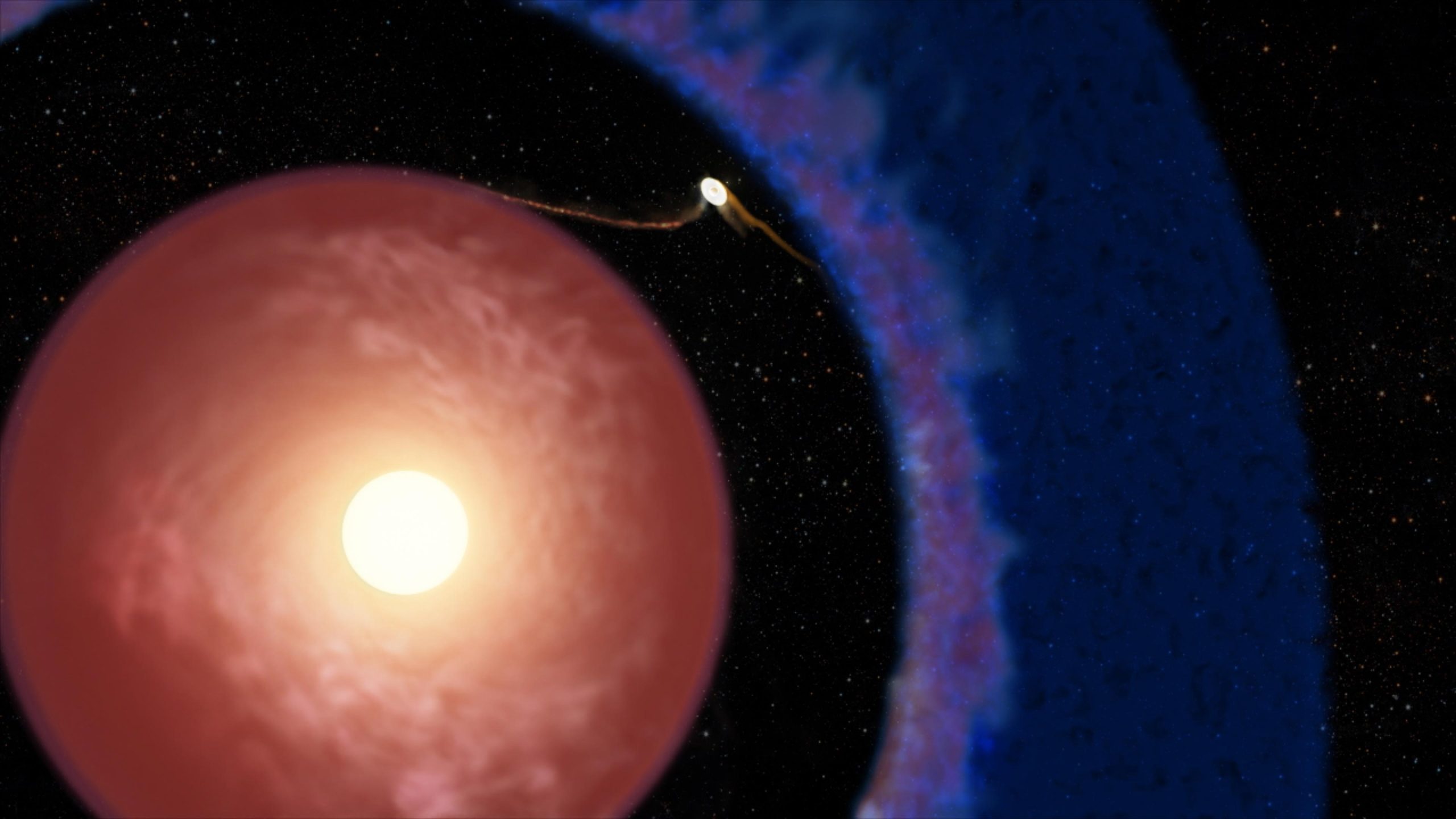
Elias 2-24 b is about the same mass as Jupiter, and the star system it is in is still in a very early stage of evolution. After a young star is born, there is usually a large amount of gas, dust, ice and rocky material left around it, which rotates around the star to form a protoplanetary disk. Over time, the material in the disk gradually collided, gathered, and formed larger and larger celestial bodies under the influence of gravity, and eventually grew into planets. It's extremely rare for astronomers to directly observe planets in the process, because newborn planets are often obscured by the very gas and dust that formed them.
The researchers used the coronagraph at Keck Observatory in Hawaii to re-analyze previously accumulated observation data. A coronagraph blocks a star's extremely bright light, giving astronomers the opportunity to search for nearby, much less luminous objects. The research team has previously conducted observations on 7 stars with material disks around them, and structures such as rings and gaps in these disks have been considered to be possibly related to the planets being formed.
Among them, there is a very obvious narrow gap in the dust disk around Elias 2-24. Researchers believe that if a planet was growing here, its gravity would continue to suck away surrounding material and clear an orbit in the disk, creating an obvious gap. Finally, the researchers found Elias 2-24 b inside this gap.
The discovery of this planet actually dates back about 10 years. Previously, the Atacama Large Millimeter/submillimeter Array (ALMA) in Chile had discovered a gap in the dust disk surrounding Elias 2-24. Subsequently, the European Southern Observatory's Very Large Telescope (VLT) discovered a very faint point of light in this gap. Astronomers suspected at the time that it might be a planet in the making, but this explanation was difficult to square with existing models of planet formation.
The problem is that this candidate planet is very far away from its parent star, about 55 times the distance from the Earth to the sun. According to current theory, it would take about 5 million years to form a giant planet with the mass of Jupiter at a distance from the sun equivalent to the orbit of Jupiter, and if it is farther from the star, it usually takes longer. However, the star system in which Elias 2-24 b is located is less than 1 million years old, which means that it must have completed large-scale growth in a much shorter time than theoretically expected.
The researchers then retrieved the historical observation files of the Keck Observatory, hoping to confirm whether the mysterious light spot had already appeared. The results showed that the same faint light source also appeared in the Keck Telescope observation data in 2018 and 2020. By combining observations from different years and tracking the spot's position over time, the researchers found that it moved in a manner consistent with a planet orbiting the star, rather than a background star or an artifact produced by the telescope's imaging process.
These long-term observations finally allowed the research team to confirm that this mysterious light spot is Elias 2-24 b. Not only does it have a mass close to Jupiter, but it is still in the growth stage of continuing to accretion surrounding material, so astronomers are actually observing the "birth" process of a giant planet.
This discovery poses new challenges to existing theories of planet formation. The youngest planets previously thought to be located in the PDS 70 and WISPIT 2 systems are all over 5 million years old. Elias 2-24 b is less than 1 million years old, but has grown to nearly the mass of Jupiter, indicating that the formation rate of giant planets may be much faster than previously thought.
Researchers pointed out that the Milky Way is constantly forming new stars and planets, so there are actually planets at various stages of evolution in the universe. However, the range that existing telescopes can directly observe is still very limited. Most of the approximately 6,000 confirmed exoplanets are billions of years old and typically orbit relatively close to their parent stars. In contrast, newborn planets are often hidden in thick layers of dust and gas, making it difficult for astronomers to see them directly.
Traditional exoplanet discovery methods further exacerbate this bias. A large number of exoplanets are discovered through the transit method, which is when a planet passes between Earth observers and the star, it briefly blocks part of the star's light, causing a slight decrease in the star's brightness. But for young planets, thick dust disks may obscure them, and planets farther from their stars have very long orbital periods, so transit events are more rare.
Elias 2-24 b therefore provides an extremely rare opportunity for scientists to directly study the earliest growth of a giant planet. Researchers believe that this type of extremely young planets can help improve planet formation models currently established based on theoretical calculations, computer simulations and observations of young stars, and explain why some planets can grow rapidly in a very short time.
In the future, NASA's Nancy Grace Roman Space Telescope is expected to further expand this observation capability. The Roman Telescope was launched on August 30 and is equipped with a more advanced coronagraph, which can more effectively distinguish the extremely faint surrounding planets from the strong glare of stars.
The Roman telescope can also use direct imaging methods to find young planets, and is expected to observe planets closer to the star, including some "Jupiter twins" that are currently difficult to see directly with telescopes. By comparison, Elias 2-24 b currently orbits about 10 times farther from its parent star than a typical Jupiter orbit.
Astronomers hope that as a new generation of observation equipment such as Roman comes into use, a large number of "baby planets" that have been hidden in the protoplanetary disk for a long time will gradually come into view. By observing young planets of different ages, different orbital distances, and different masses, scientists may be able to more completely restore the entire process from a dust and gas disk to a mature planetary system for the first time.
The discovery of Elias 2-24 b means that astronomers can now directly see signs of the growth of giant planets in a real cosmic environment, and this planet, which is less than 1 million years old, also shows that at least some giant planets may form rapidly in a much shorter time than predicted by traditional models. The research results were published in "The Astrophysical Journal Letters" on September 16, 2026.
Comments