
Abstract:
Astronomers used NASA's James Webb Space Telescope to map the spatial distribution of the edge of a distant giant exoplanet's atmosphere in unprecedented detail for the first time. Observations found that the atmosphere of this planet named WASP-17b is not evenly distributed around the planet, but shows obvious shape differences in different areas. Among them, the atmosphere on the evening side of the planet extends farther outward, and the temperature is significantly higher than that on the morning side.
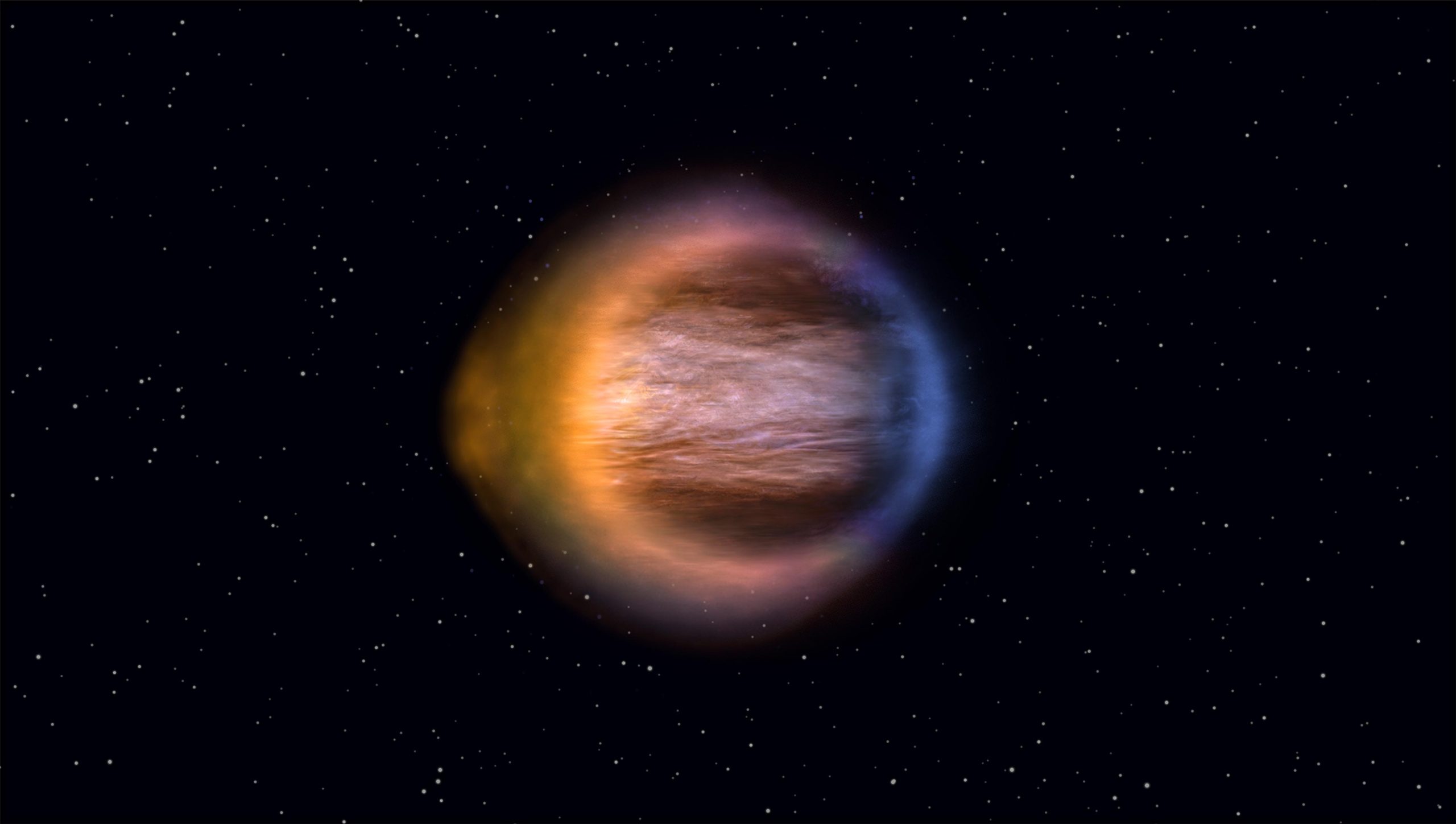
This study was jointly led by researchers from Cornell University in the United States and the University of Bristol in the United Kingdom, and the results were published in the magazine "Nature Astronomy" on October 14, 2026. The research team used a new technology called "transmission strings" to analyze the starlight that passes through the edge of the planet's atmosphere when it passes in front of the star, thereby splitting the atmospheric information that was usually merged into different locations in the past. This result not only reveals the asymmetric structure of WASP-17b's atmosphere, but also opens up a new way to draw weather maps of distant planets in the future.
WASP-17b is about 1,300 light-years away from Earth and is a type of what astronomers call a "hot Jupiter." Such planets are usually bulky gas giants, but unlike Jupiter in the solar system, they orbit very close to their parent stars and are therefore heated by intense stellar radiation.
The size of WASP-17b is particularly eye-catching. Its diameter is nearly twice that of Jupiter, but its mass is only about half that of Jupiter. Due to the extremely expanded atmosphere, the planet's average atmospheric temperature is about 1,500 degrees Celsius. It only takes about 3.7 Earth days to orbit its parent star. The extreme orbital environment makes its atmosphere appear completely different from that of the planets in the solar system.
There is another special feature about this planet: it is affected by the tidal locking effect, always facing the same side towards its parent star. Therefore, half of the planet is permanently illuminated by the star, while the other half is constantly in darkness. Even though the planet itself doesn't go through a full day-night cycle like Earth does, its atmosphere can still transport heat from the day side to the night side via strong winds.
The researchers found that this heat transport creates significant differences in the planet's atmosphere between the early morning and evening regions. The evening side, located at the junction of day and night, has a significantly higher temperature due to the influence of thermal airflow from the day side, and the atmosphere also expands outward. In contrast, the atmosphere on the morning side becomes cooler as it passes through the cooler night area, making it more contracted overall.
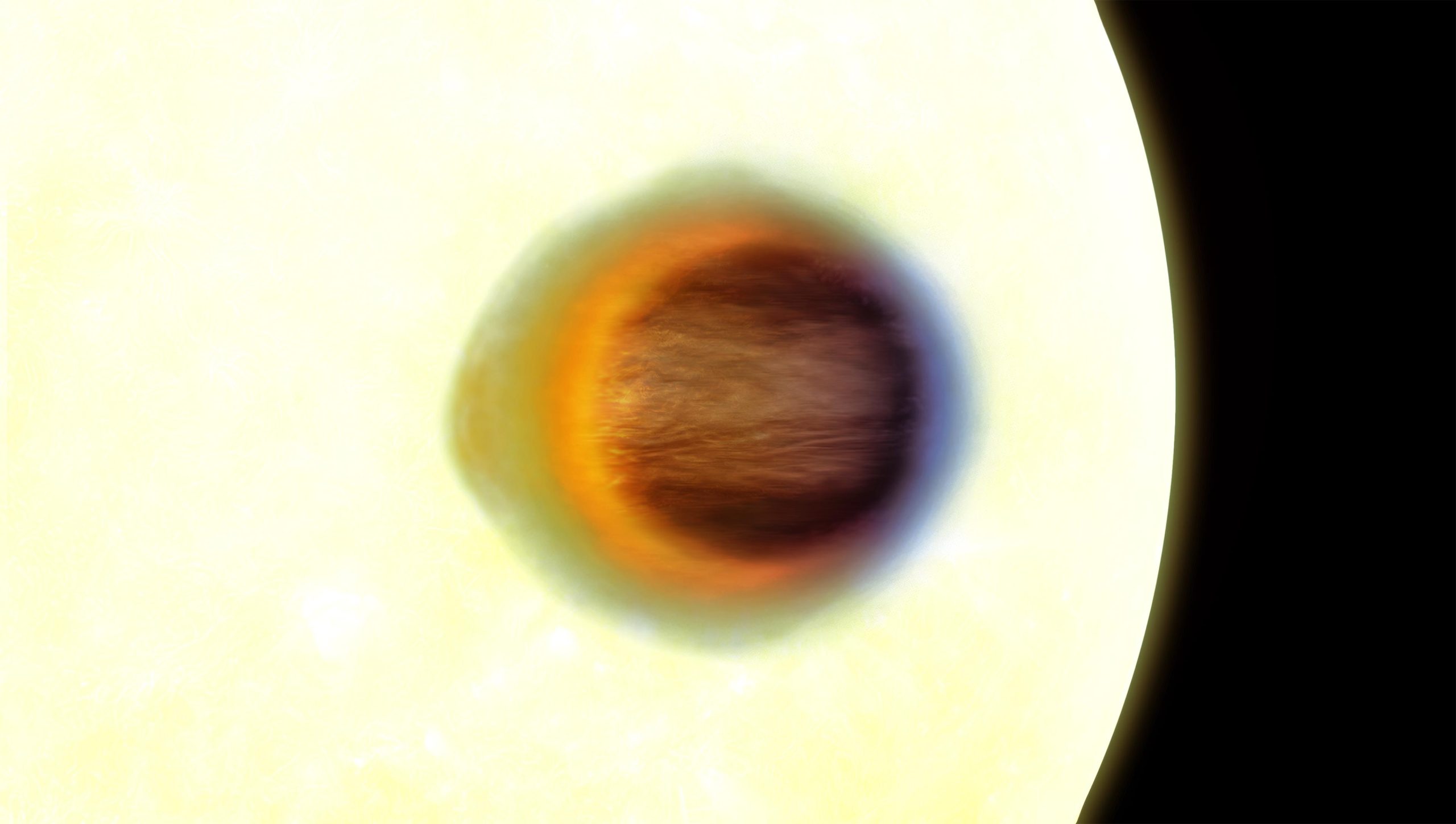
According to measurements by the research team, the atmospheric temperature on the morning side of WASP-17b is about 590 degrees Celsius, while on the evening side it reaches about 1250 degrees Celsius. The difference between the two is about 660 degrees Celsius, or about 1200 degrees Fahrenheit. The atmosphere on the evening side extends outward approximately 1.8 times as much as on the morning side.
This difference is easily overlooked if one only looks at the overall outline of the planet. In the past, when astronomers analyzed the light changes caused by exoplanets crossing in front of their stars, they usually approximated the edge of the atmosphere around the planet as a ring with a uniform radius, and then combined the spectral signals across the entire ring. This effectively analyzes the composition of a planet's atmosphere, but may mask differences in temperature and structure between regions.
The new method used in this study changes this approach. Instead of assuming that the edge of a planet's atmosphere has the same radius everywhere, researchers try to measure the distance from the center of the planet to the outer edge of the atmosphere individually to reconstruct the shape of the atmosphere in different directions.
The technique, developed by astrophysicists David Grant and Hannah Wakeford at the University of Bristol, the researchers call "transmissive strings," also known as transit mapping technology. The method uses changes in light as the planet passes in front of the star to analyze signals from different regions at the edge of the atmosphere.
When an exoplanet passes in front of its parent star, some of the light emitted by the star passes through the outer atmosphere of the planet and then reaches the Earth. Different gas molecules in the atmosphere absorb specific wavelengths of light, so by analyzing changes in starlight at different wavelengths, researchers can infer what materials are contained in the atmosphere and how those materials are distributed at different locations.
At the same time, if the atmosphere is hotter somewhere, the expansion of the gas will cause it to extend farther outward. By measuring this change, researchers can determine the actual extent of a planet's atmosphere in different directions, rather than just averaging the entire ring.
The research team used observation data obtained by the James Webb Space Telescope in March 2023 to conduct analysis. The observations used three instruments covering multiple wavelength bands from near visible light to mid-infrared. In order to complete the analysis, the researchers need to process the data of 24 bands separately. The fitting calculation of each band requires a large amount of computing resources. The analysis of a single band requires about 40 computing cores to run continuously for two weeks.
After complex data processing, the research team finally obtained spectral information from different angles at the edge of the planet's atmosphere, and reconstructed its uneven spatial structure.
The results show that there is a powerful atmospheric jet near the planet's equator, transporting heat from the side that is permanently illuminated to the other side that is constantly in darkness. Due to the direction of atmospheric circulation and the planet's rotation, the evening side retains more heat from the dayside and is therefore hotter and more expanded than the morning side.
It is worth noting that this finding is highly consistent with the researchers' previous predictions through theoretical calculations and computer simulations. The research team originally expected that hot Jupiters like WASP-17b would have significant temperature differences between the morning and evening areas, and this observation confirmed this judgment.
Lily Alderson, the principal leader of the study at Cornell University, said that this result proves that the atmosphere of an exoplanet is indeed a three-dimensional system with a complex spatial structure, and is not just a uniform gas layer that can be described by an average temperature or a single spectrum. Directly verifying theoretical predictions through observations is a completely different matter than relying solely on computer simulations to draw conclusions.
The researchers also analyzed water vapor and carbon dioxide in the planet's atmosphere. The results show that the two gases are generally distributed evenly at the edge of the planet's atmosphere, consistent with previous computer models. However, because the atmosphere on the evening side is more expanded and the spectral signals produced by the gases are stronger, it is easier for researchers to measure the content of related substances on this side.
In contrast, there are still uncertainties in the distribution of clouds. Different models have given different explanations for the location of the clouds. One model believes that clouds may mainly appear on the cooler morning side, while parts of the area extending from the poles to the evening side are relatively devoid of clouds; another model cannot clearly determine the specific nature of the clouds.
Researchers pointed out that the temperatures in different areas of WASP-17b span the temperature range where silicate clouds and salt clouds may form. Therefore, different types of clouds may exist in different areas of the planet. More refined mid-infrared observations will be needed in the future to further determine the composition and spatial distribution of these clouds.
In addition, the research team currently assumes in part of the analysis that the northern and southern hemispheres of the planet have an approximately symmetrical structure, which may not be applicable to other exoplanets. The range of wavelengths in the available observations may also mask subtler changes at the edges of the atmosphere. Therefore, although this research has made important progress, scientists still need more observations to improve the planet's atmospheric model.
Researchers believe that the real significance of this work is not just to discover that a planet's atmosphere is not symmetrical enough, but to prove that astronomers are beginning to have the ability to study the local environment in different areas of distant planets.
So far, astronomers have confirmed more than 6,000 exoplanets, but humans still can only obtain limited average information about the atmospheres of most of them. Even with the most advanced telescopes, it is difficult for researchers to directly image the surfaces or clouds of these distant worlds, so their physical properties can often only be inferred indirectly through spectral and brightness changes.
New transmission string technology can separate signals at different locations at the edge of a planet's atmosphere, allowing researchers to further study changes in temperature and chemical composition from the equator to the poles, and from morning to evening. This means that in the future, scientists are expected to gradually shift from measuring the average atmospheric characteristics of a planet to mapping more detailed three-dimensional atmospheric structures.
The research team stated that as this technology is applied to more exoplanets, astronomers may gradually identify the airflow structure, local temperature changes and cloud distribution at different latitudes, and may even study large storms on distant planets in the future.
For WASP-17b, which is 1,300 light-years away from Earth, this observation revealed only a part of its complex atmospheric system. But researchers have shown that even without direct access to these distant worlds, they can use the subtle changes left behind by a star's light as it passes through a planet's atmosphere to reconstruct the invisible weather structures inside it. This progress provides new observational tools for future studies of the climate, circulation and atmospheric evolution of exoplanets.
Comments