
Abstract:
In recent years, as Windows 11 continues to adjust system functions and hardware requirements, more and more users are looking for alternatives to Windows. However, most of the existing alternative systems are based on Linux distributions, and there are few projects that truly try to develop a new desktop operating system from scratch. Recently, an open source project called Impossible OS has attracted attention. Its developers hope to create a new operating system that is neither based on Linux nor relies on Windows code, but can run Windows applications natively.

According to the project’s official website and GitHub repository, the goal of Impossible OS is to develop a 64-bit operating system for x86-64 (AMD64) hardware. Unlike ReactOS and other projects that try to reproduce the Windows NT architecture, Impossible OS claims that it is neither a Linux distribution nor a branch of Windows, but is independently built from the bottom up, including the UEFI boot program, operating system kernel, desktop environment and native Win32 API interface.
The entire project is mainly developed using C language and AMD64 assembly language. Developers said that for mature functions that do not need to be implemented repeatedly, existing open source components will be used to avoid unnecessary development costs and technical risks in pursuit of complete autonomy.
The most eye-catching design is its Windows application compatibility. Impossible OS plans to use Win32 API directly as the system's native interface, instead of converting Windows program calls through a compatibility layer like Wine, and does not need to rely on a virtual machine to run Windows.
According to the design concept of the project, Windows applications can directly call the native system interface provided by Impossible OS, and 64-bit Windows executable files in PE32+ format will also be directly loaded and run by the system. Developers also plan to use the familiar Windows directory structure, such as C:ImpossibleSystem32, so that users’ usage habits are as close as possible to Windows.
However, this compatibility is still in its early stages. The project has provided a set of limited-scale Win32 SDK, which can support basic operations such as obtaining process ID, reading system timing information, creating files, and reading files, but the complete Win32 API system has not yet been completed. Therefore, at this stage, we cannot expect Chrome, Office or other commonly used Windows software to be installed and run directly.
In addition to Windows applications, Impossible OS also plans to support Linux applications. Developers hope to enable unmodified Linux ELF binaries to run on the system through a built-in compatibility layer. It does this by translating Linux system calls into native calls that the Impossible OS kernel understands, thus avoiding the use of WSL, containers, or full Linux virtual machines.
However, this Linux compatibility feature has not been implemented yet and is still a future development goal.
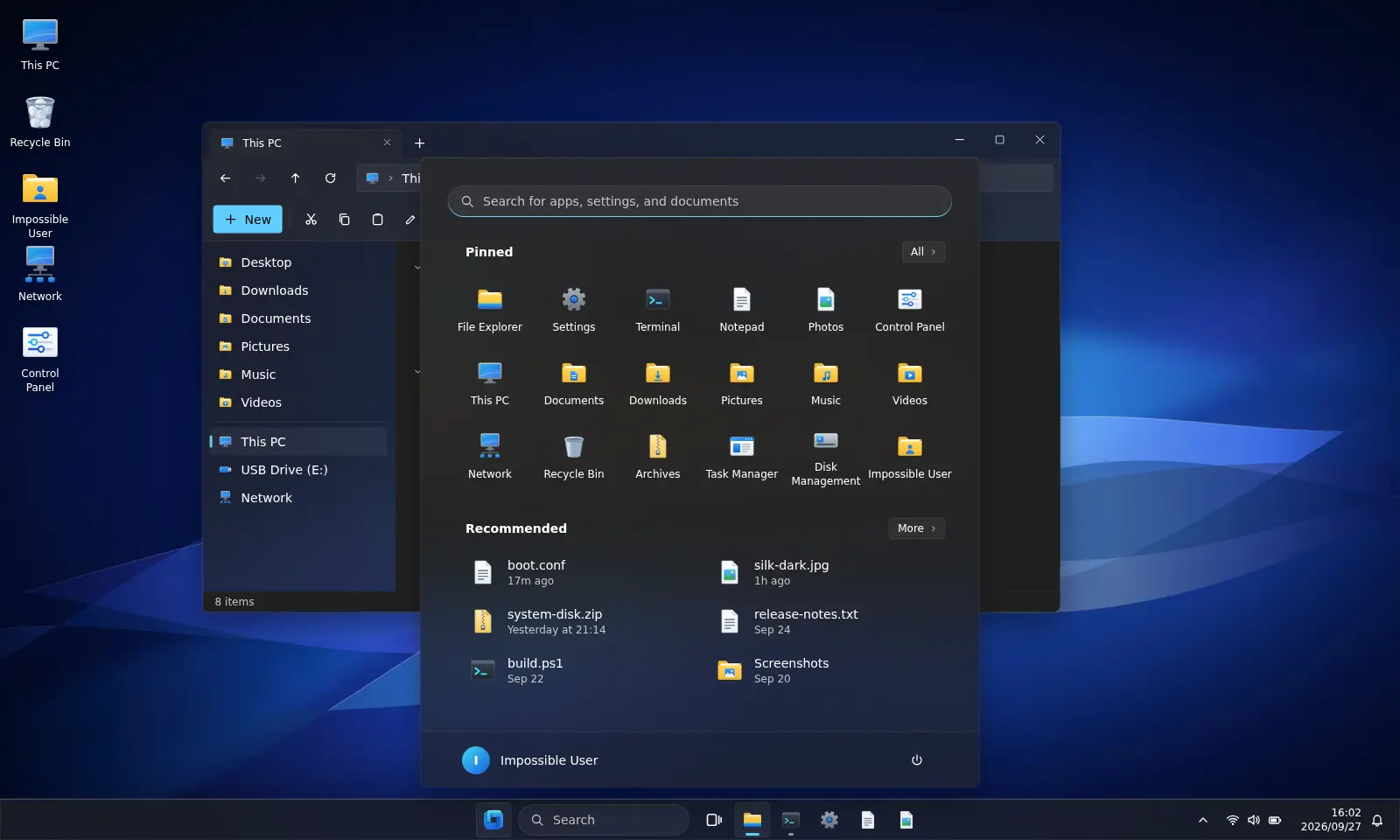
In terms of completed functions, Impossible OS does not just have a conceptual design drawing. The project currently has a self-developed UEFI boot program, a 64-bit operating system kernel, multi-processor core support, virtual memory management, as well as a FAT32 file system and a self-developed IXFS file system.
Network functions have also begun to be implemented, currently including basic protocols such as Ethernet, ARP, IPv4, ICMP, UDP and DHCP, and provide RTL8139 network card driver. However, features such as TCP, DNS, and VirtIO network drivers are still under development plans.
In terms of desktop environment, Impossible OS adopts a design that is obviously inspired by Windows 11. The system has a centered taskbar, start menu, window composition manager and translucent visual effects similar to Windows Acrylic. The overall interface attempts to allow users who are familiar with Windows to get started quickly.
In addition, the project also implements some Windows-style registry functions, including configuration partitions such as HKLM and HKCU, and basic interfaces such as RegOpenKeyEx and RegSetValueEx. Graphics drawing currently mainly relies on the CPU to execute SSE2 instructions for acceleration, supporting transparent mixing, gradients, blur processing and TrueType font rendering. GPU hardware acceleration is still in the research stage.
Judging from the current development progress of the project, Impossible OS already has some of the underlying infrastructure required for a real operating system, but it is still far from a mature desktop system. Developers also admitted that the current version is still in the Pre-alpha stage and is far from qualified to replace Windows as the main daily system.
The official website of the project even describes the difficulty of development in a self-deprecating way: Can one compete with large software companies with hundreds of engineers? The answer is of course no, but that doesn't mean you can't try.
According to the roadmap announced by the developer, Impossible OS plans to launch the first official version in the third quarter of 2028, with a target date of August 8, 2028. By then, if the development progress can proceed as planned, it will become a quite special operating system project: it neither relies on the Linux kernel nor is it directly built on Windows code, but hopes to be compatible with both Windows and Linux applications.
Users can currently try to use QEMU or VirtualBox virtual machines to compile and run the system through the build instructions provided by the project.
Of course, the real difficulty in operating system development is not just getting the kernel to boot successfully, or making the desktop interface look like Windows. Hardware driver coverage, application compatibility, graphics acceleration, system security, update maintenance, and long-term stability are the keys to determining whether an operating system can truly be put into daily use.
The most noteworthy aspect of Impossible OS currently is its attempt to build an independent operating system from scratch with Win32 as its native interface. If developers can ultimately achieve this goal, it will be significantly different from existing projects such as Linux distributions, Wine, and ReactOS. However, until the complete compatibility is actually verified, the release time of 2028 is still only a development goal, not a guarantee for the launch of mature products.
Learn more:
https://github.com/rizonesoft/impossible-os
https://impossibleos.co/
Comments