
Abstract:
As AMD's next-generation Zen 6 processor architecture gradually emerges, the Linux kernel also begins to adapt to related products in advance. Recently, the Linux kernel development community has merged an important patch to introduce the "Capacity-Aware Scheduling" (CAS) mechanism to support AMD's future Zen 6 processors using heterogeneous core designs.
For a long time, AMD desktop and server processors have mainly adopted symmetrical core designs with the same performance. All CPU cores are basically the same in terms of instruction execution capabilities and performance. However, as processor designs become increasingly complex, AMD plans to introduce heterogeneous core configurations with different performance in the Zen 6 era, which means that some models will have CPU cores of different levels and capabilities in the future.
According to the information disclosed so far, AMD's future Zen 6 product line is expected to use a hybrid design of standard Zen 6 cores and higher-density Zen 6C cores. Although the two types of cores are based on the same architecture, there are differences in cache capacity, frequency range, and overall performance. Therefore, the operating system needs a more intelligent task scheduling mechanism to unleash the potential of the hardware.
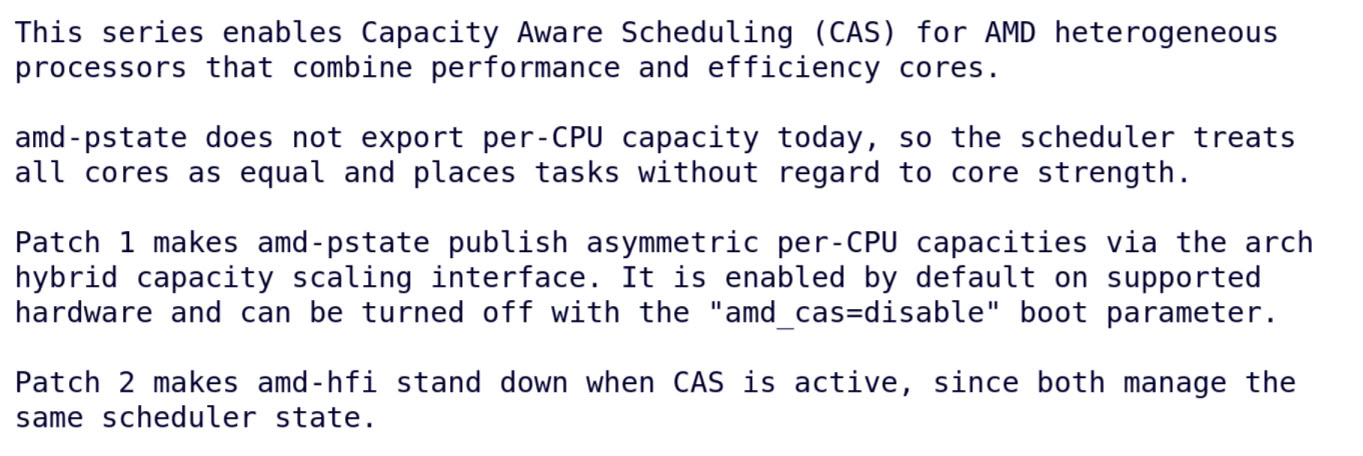
The CAS mechanism added to the Linux kernel this time is designed to solve this problem. The scheduling system is able to identify the actual computing capabilities of different CPU cores and dynamically allocate threads based on task load characteristics. For example, application tasks with higher performance requirements can be prioritized on stronger cores, while background work or lightly loaded threads can be moved to more efficient cores for execution, thereby achieving a better balance between performance and energy consumption.
Similar to the hybrid design of performance core (P-Core) and energy efficiency core (E-Core) that Intel has widely adopted in recent years, AMD's future heterogeneous architecture also requires deep support at the operating system level. Linux developers said that the capacity-aware scheduling function allows the scheduler to make decisions based on the computing power of different cores, rather than simply treating all cores as exactly the same resources.
It is worth noting that this patch does not directly target a specific processor model, but establishes a basic framework for future AMD heterogeneous CPU architecture. Developers have added support logic related to AMD processor capability levels into the code to prepare for subsequent product releases.
Industry analysts believe that this change further supports AMD’s trend of advancing in the direction of heterogeneous computing. As transistor costs continue to rise and energy efficiency requirements continue to increase, integrating cores of different performance levels in the same processor has become an important means to improve overall efficiency. By allowing different types of cores to perform their own duties, manufacturers can reduce power consumption and chip area while maintaining multi-threaded performance.
For Linux users, it is of great significance for relevant support to enter the mainline kernel in advance. This means that after processors equipped with Zen 6 heterogeneous architecture are launched in the future, Linux systems can realize their performance potential faster without having to wait for a long time for additional software adaptation.
Although AMD has not officially announced all Zen 6 product details, the Linux kernel has begun to add capacity-aware scheduling support, which is regarded as an important signal that the next-generation Zen architecture is about to enter a deeper development stage. As subsequent patches and hardware information continue to be exposed, the actual design of AMD's heterogeneous processors is expected to gradually become clear.
Comments