
Abstract:
Scientists recently discovered that a microorganism living in the extreme environment of the Arctic Ocean may have mastered a special way of survival that has never been observed in marine bacteria before. Research shows that this bacterium is not only able to use sunlight to obtain energy, but may also produce substances needed for its own growth through the joint metabolism of acetone and carbon dioxide, providing new clues for people to understand the ocean carbon cycle and microbial adaptation mechanisms.
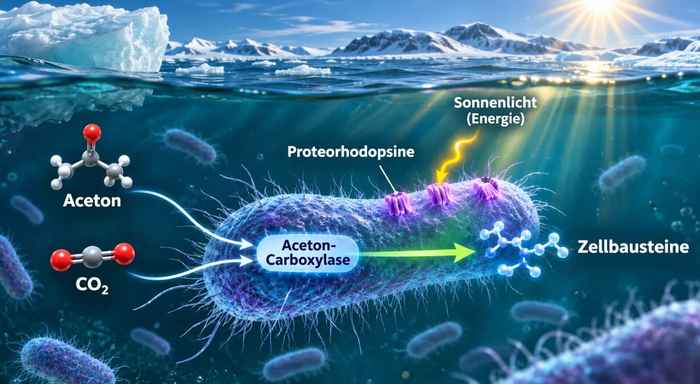
The study focused on a species of bacteria called Porticoccus arcticus. It lives in the cold surface waters of the Beaufort Sea in the Canadian Basin, in the Arctic Ocean north of Canada's Yukon Territory. Researchers found that in some sampling locations, this bacterium can account for 9% of the total number of bacteria detected locally, indicating that it is an important member of the Arctic marine microbial community.
Arctic waters have long faced survival challenges such as scarce nutrients and limited organic content. The researchers believe that H. arcticum may have developed a unique metabolic system to cope with this environment. To put it simply, it seems to have the ability to be similar to a "solar charger" and can also use a special "food source" to maintain life activities.
Research shows that one of the key substances is acetone. Acetone is widely found in the marine environment, produced naturally by marine organisms such as planktonic microalgae, and can also be formed when sunlight reacts with dissolved organic matter. While science has long known that some marine bacteria consume acetone, H. arcticus appears to use it in a completely different way.
Gene analysis found that this bacterium possesses a complete set of genes related to "acetone carboxylation". Through this process, bacteria are able to combine acetone with carbon dioxide to create compounds that can enter their core metabolic systems to make the basic raw materials the cells need to stay alive and grow.
At the same time, the research team also discovered a variety of Proteorhodopsins-related genes in its genome. This type of light-sensitive protein helps cells capture solar energy. Further analysis showed that genes related to light energy utilization and acetone metabolism were the most active genes in the bacterium.
The researchers speculated based on this that Portococcus arcticus may have a unique metabolic model: on the one hand, it obtains energy from sunlight, and on the other hand, it uses acetone and absorbs carbon dioxide to replenish its own carbon source, thereby maintaining survival in the resource-poor Arctic waters.
The leader of the research said that the team did not initially deliberately look for bacteria with this ability, but accidentally discovered this phenomenon while analyzing microbial genomes. Portococcus arcticum has an extremely streamlined genome, but retains key gene combinations closely related to acetone metabolism and light energy utilization. This configuration has not received widespread attention before.
What interests researchers even more is that this metabolic method has some characteristics of both animals and plants. Bacteria obtain carbon sources by ingesting organic matter such as acetone, similar to how animals obtain nutrients through eating; at the same time, they can absorb and utilize carbon dioxide, which is similar to the ability of plants to fix carbon dioxide. This unique combination is considered by researchers to be a very special "photoheterotrophic" survival strategy.
Scientists believe that the significance of this discovery is not limited to the Arctic. Acetone in the ocean is widely found in coastal waters, high seas and even freshwater environments, so similar metabolic mechanisms may also exist in other unknown microbial groups. If future research confirms this suspicion, our understanding of how marine ecosystems absorb, transform and store carbon may need to be recalibrated.
The research team said that as the Arctic continues to warm and sea ice coverage continues to change, it becomes increasingly important to understand how these basic microorganisms obtain energy and participate in the carbon cycle. In the future, scientists plan to further verify through experiments whether H. arcticus actually uses acetone to drive the carbon dioxide absorption process, and explore the actual impact of this mechanism in the global ocean.
Comments