
Abstract:
A latest geochemical study published in the international comprehensive academic journal "The Innovation" proposes important revisions to the classic timeline of the evolution of Earth's oxygen. Wang Haiyang and Li Chao, two geochemists at Chengdu University of Technology, pointed out that the scientific community's long-standing reliance on ancient ocean chemistry indicators to estimate atmospheric oxygen content may be biased. The Earth's atmosphere actually experienced major oxygenation much earlier than traditional understanding, while the deep sea experienced a lag of hundreds of millions of years before complete oxygenation.
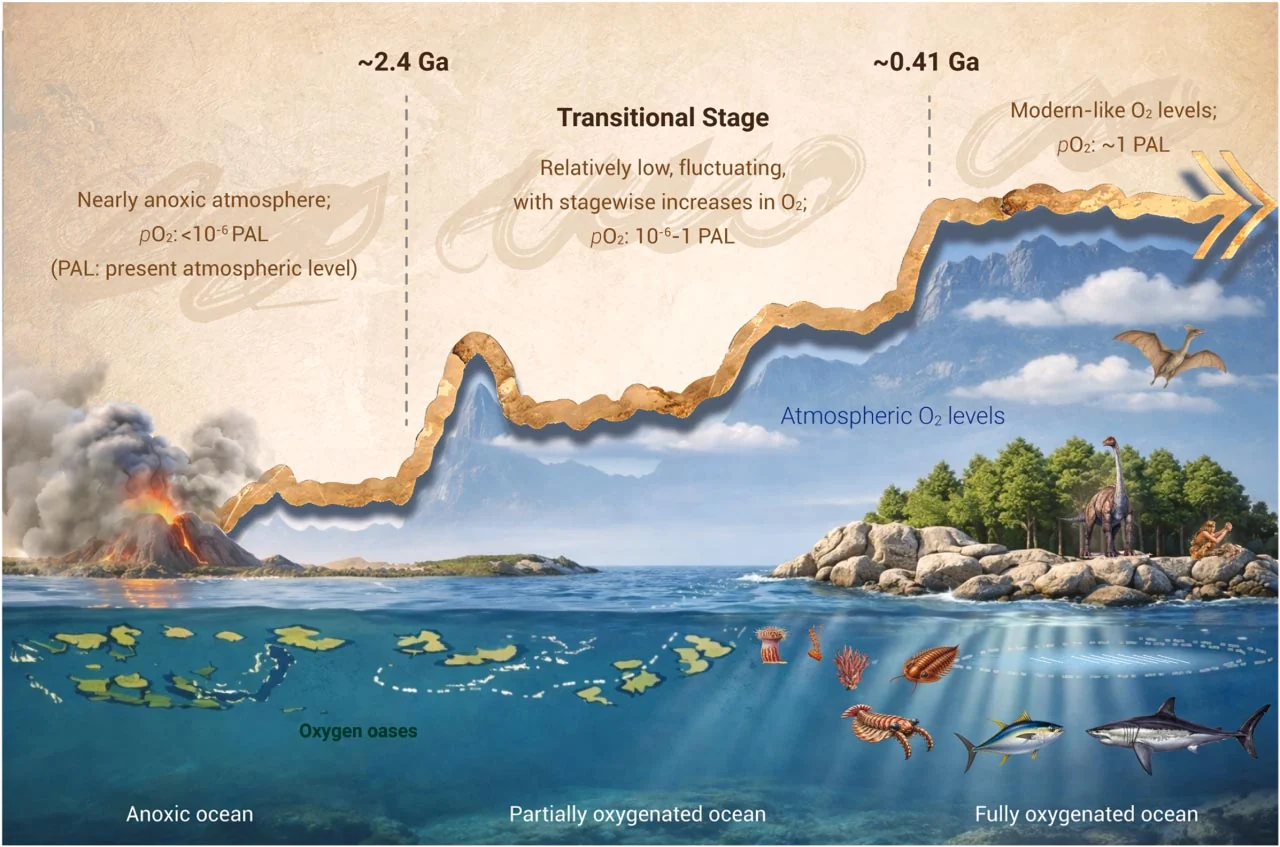
During Earth's long early history, the atmosphere contained almost no oxygen, a stark contrast to the environment that supports complex life today. The research team pointed out that the ancient ocean chemical environment was controlled by multiple factors such as nutrients, biological activities, ocean current circulation, and basin morphology at the same time, and could not accurately and simultaneously reflect changes in atmospheric oxygen content. To do this, the researchers turned to analyzing the three oxygen isotope signatures preserved in sedimentary sulfates. Because photochemical reactions between oxygen, ozone and carbon dioxide in the atmosphere result in a unique depletion of oxygen-17, which enters sulfate deposits during the weathering of sulfide minerals, this signal has become a reliable indicator of the oxygen content of the ancient atmosphere.
Based on the evidence of three oxygen isotopes, researchers reconstructed the evolutionary history of the earth's atmospheric oxygen content jumping in three main stages. The first major increase in oxygen, the famous "Great Oxygenation Event", occurred between 2.4 and 2.1 billion years ago, increasing the atmospheric oxygen content from less than one millionth of the modern level to between 0.1% and 10%. The subsequent two periods of atmospheric oxygenation occurred from 1.3 billion to 1 billion years ago and from 440 million to 410 million years ago, significantly earlier than the time node generally believed by the academic community. The traditional understanding of the Neoproterozoic oxidation event from 800 million to 500 million years ago and the Paleozoic oxidation event from 420 million to 360 million years ago actually reflects the lagging response of the ocean system to atmospheric changes. The delay times of the two reached about 200 million years and 30 million years respectively.
Although the atmosphere has experienced many step-by-step oxygen increases, the overall oxygen concentration has remained at a low level for a long time. Isotope model estimates show that atmospheric oxygen content during the Mesoproterozoic was only 0.1% to 1% of modern levels. It was not until about 420 million years ago that charcoal formed by combustion first appears in the geological record, suggesting that atmospheric oxygen concentrations at that time were about three-quarters of modern levels.
The study further revealed that although the oxygen content of the atmosphere and oceans generally increases simultaneously on a billion-year scale, they may go in opposite directions on a million-year scale. When atmospheric oxygen enters seawater rich in accumulated organic carbon and sulfides, violent chemical reactions will consume a large amount of oxygen and even lower the atmospheric oxygen concentration. Therefore, some geological signals that were previously interpreted as "oxygenation" may actually represent a decrease in local oxygen content. At the same time, the diffusion of oxygen within the ocean is also extremely uneven: as early as 3 billion years ago or even earlier, photosynthetic microorganisms created an oxygen-rich microenvironment in local shallow seas and dominated the Archean marine ecology; it was not until about 410 million years ago that comprehensive oxygenation was truly achieved in the deep sea.
This gradual and asynchronous oxidation process has profoundly shaped the evolutionary trajectory of life on Earth. The early anaerobic environment strictly limited the development of aerobic organisms, while the fluctuating and rising oxygen content in the Proterozoic opened up a new ecological niche for early animal evolution. After the completion of the third atmospheric oxygenation, the more abundant oxygen supply supported the increase in the size of organisms, the rise of active predatory behavior, and the expansion of organisms into deep water areas. The researchers also pointed out that, limited by the time resolution of existing isotope records, there are still many unsolved mysteries about the specific oxygen concentration changes since 1 billion years ago. However, this result clearly shows that the Earth's transformation to an oxygen-rich world not only depends on the accumulation of atmospheric oxygen, but is also deeply affected by the long oxidation delay effect of the deep ocean.
Comments