
Abstract:
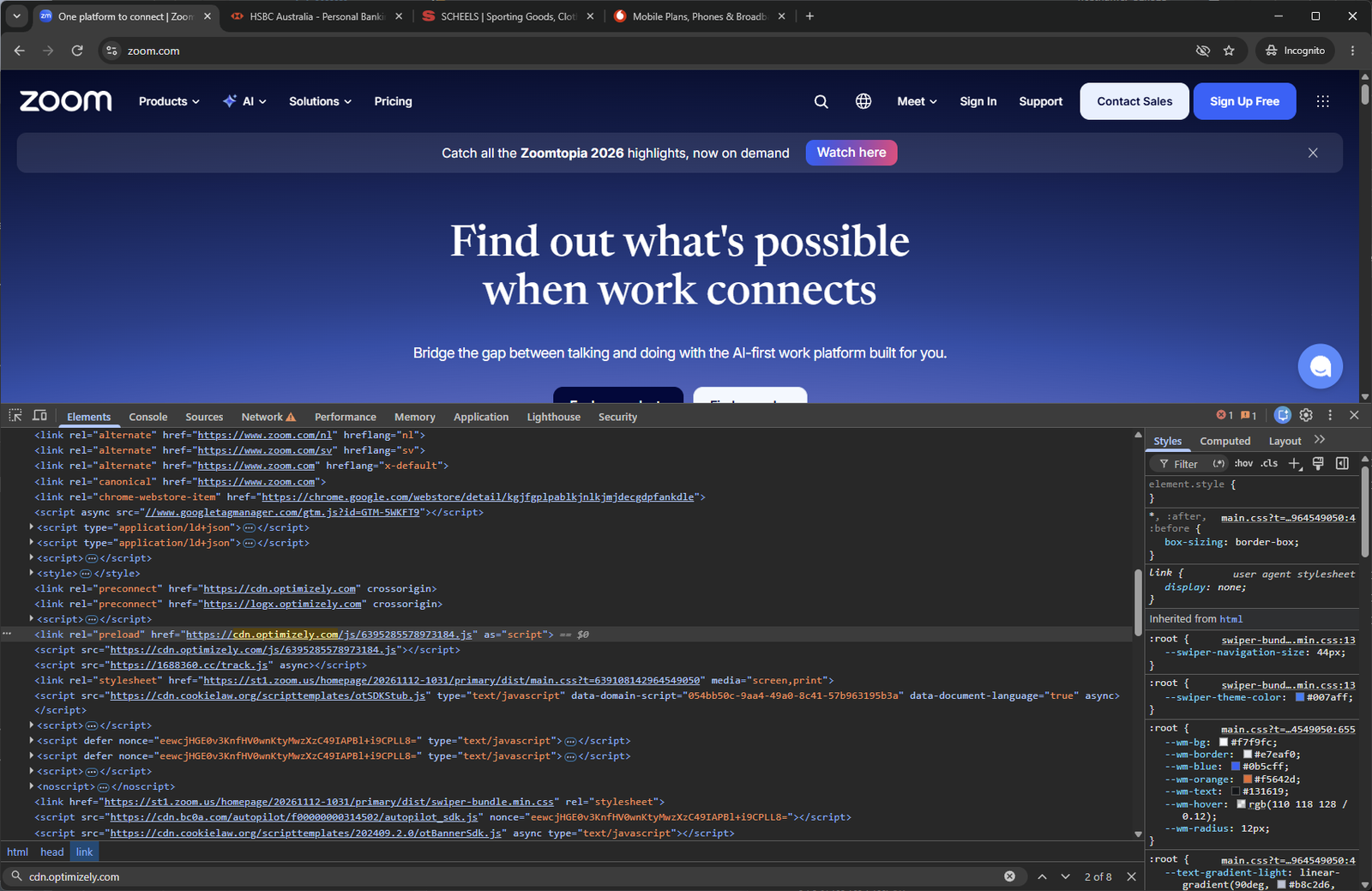
Last night, the security research organization Report URI discovered a major security incident during daily inspections. This security incident involved 178 world-renowned companies or websites such as BBC, CNN, HSBC, Salesforce, GitLab, and IKEA. Hackers tampered with website content and loaded malicious scripts. This malicious script leverages the DarkSword penetration framework to target users running older versions of iOS 13-18.x.
The main purpose of this hacker attack was to steal cryptocurrency or bank account information, and allowing so many websites to be poisoned in batches naturally involves supply chain attacks. These websites all use services provided by Optimizely, and related products have been exploited by hackers due to security vulnerabilities.
Hackers write malicious code into Optimizely customer projects:
Optimizely Web is used for website experimentation and personalized display. Customers can add custom code in the Project JavaScript field of the project, and then the website loads the project script from Optimizely CDN, and these resources will be run in the visitor's browser.
Optimizely said in a follow-up status update that hackers exploited security vulnerabilities in its experimental products to add malicious JavaScript scripts to customer projects. The scripts would enter the page along with the Optimizely script that the website loads normally, so it would look normal when accessed through browsing.
Hackers upgrade scripts while attacking to achieve more goals:
The timeline recorded by the security research agency shows that the BBC's Optimizely script was first observed to load malicious code at 04:21 UTC on November 16; at 08:28 UTC, the BBC page first loaded the external attack payload 1688360 [.] cc/track.js.
The hackers then continued to modify the attack payload, and the security research agency recorded 26 different versions that day. For example, at 13:43 UTC, the hacker added a bank card stealing module to the payload, and later added the DarkSword penetration framework to launch attacks against older versions of iOS systems.
The main purpose is to steal wallets, bank cards and other data:
The malicious payload dropped by the hacker contains a variety of functions. The malicious script will first collect the visitor's basic information such as operating system, version and browser, and return different malicious payload operations based on this information. Malicious behaviors observed so far include:
Replace password address: The malicious payload will scan the text, forms, links, clipboard and some network requests on the page to find a valid wallet address, and then replace it with an address controlled by the attacker. The malicious payload can also monitor the copy operation, so when the user copies the wallet address, it will be automatically replaced with an address controlled by the hacker.
Steal bank account information: The malicious payload will look for the verified credit card number, expiration date and CVV security code in the website's self-built payment form and related requests, and then send this information to a server controlled by the attacker. Therefore, if the user has initiated a payment, information may also be leaked.
For iOS 13-18.x: The malicious payload will load different icu domain names and hidden pages according to the iOS version, directing visitors to DarkSword related paths. In the sample, iOS 13-17 is directed to the Coruna path, and iOS 18.x is directed to the DarkSword path.
Current cleanup progress:
Optimizely updated its status on November 17, stating that it has fixed relevant product security vulnerabilities, removed injected code in affected projects, protected customer accounts, and added measures to prevent unauthorized code from being released further. However, the scale of this attack is very large, covering hundreds of thousands or even millions of visitors. It is currently difficult to estimate the specific scale of affected users.
In addition, Content Security Policy (CSP) works on some websites. The survey showed that the CSP policies of 24 websites successfully prevented malicious scripts from running. Although another 17 websites load scripts, their connect-src prevents some data from being transmitted out, but the wallet address copied by the user will still be replaced.
Operators using Optimizely Web should check each project's Project JavaScript and experimental custom code for 1688360 [.] cc, .icu domain names, atob(), and unknown scripts. Also review write permissions for accounts, API tokens, and integrations. Users who have visited affected websites should check their cryptocurrency transfer addresses and bank card statements. Users of iPhone and iPad should update to the latest version of iOS immediately.
Some affected companies:
HSBC Bank branches: United States, Hong Kong, Mexico, Singapore, Australia, United Arab Emirates, Malaysia, Vietnam, Egypt, Philippines
Zoom
Bitly
Salesforce
Gitlab
IKEA
CNN
BBC
Fox
Bloomberg
Fluke
O2
Vodafone Australia
Alaska Airlines
Honeywell Home
Heineken
Chamberlain University
Levis
Comments