
Abstract:
Intel's next-generation desktop processor Razor Lake has announced new product plans. According to Jaykihn, a well-known hardware whistleblower, Intel is developing an unlocked processor with 12 performance cores (P-Core) and equipped with a large-capacity last-level cache (bLLC). This product no longer uses the traditional P-core and E-core mixed configuration, but concentrates computing resources on the performance core, which is obviously designed for the high-end gaming market.
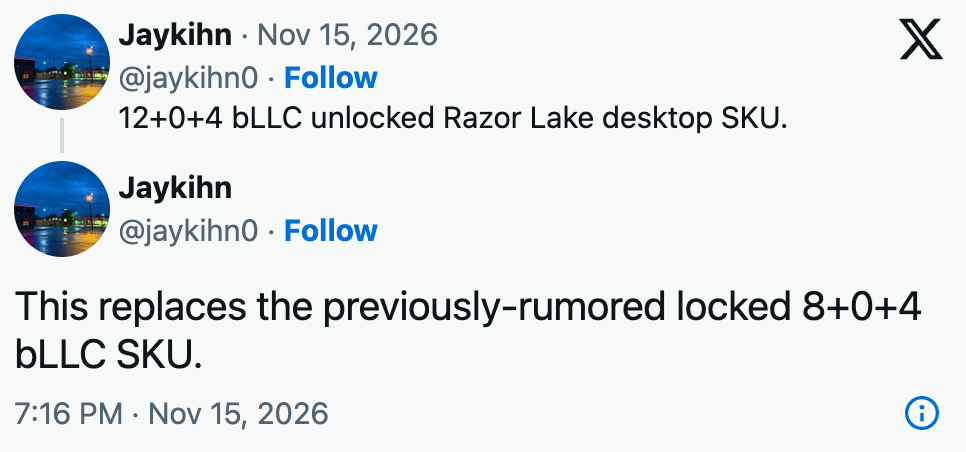
According to the information currently exposed, this processor uses a 12+0+4 core configuration, that is, 12 performance cores, 0 conventional energy-efficiency cores, and 4 low-power energy-efficiency cores (LP-E). The 0 here does not mean that the processor has no energy-efficiency core at all, but that the traditional E-Core computing cluster has been cancelled, leaving only 4 low-power cores to undertake some background and lightweight tasks.
What is more noteworthy is that these 12 P cores are all concentrated on the same independent computing core (Compute Die), rather than being implemented by a combination of two cores each containing 6 P cores, nor simply turning off the E core in a hybrid architecture chip. This means that Intel may have designed a pure P-core computing core specifically for this processor, which is different in physical structure from conventional hybrid architecture products.
According to reports, these performance cores use the Coyote Cove microarchitecture, which is the same performance core architecture used by the previously rumored Nova Lake processor. The processor will also offer unlocked overclocking capabilities, meaning users can further adjust the operating frequency based on cooling and power supply conditions.
Another core aspect of this exposure is bLLC, which is the Big Last Level Cache (large capacity last level cache).
This technology is Intel's competition for the large-capacity cache design used in AMD's X3D processors. AMD uses 3D V-Cache technology to add additional level 3 cache capacity to the processor, significantly reducing the access requirements for system memory for some games, thereby improving game frame rates, especially games that are sensitive to cache latency and capacity.
Intel obviously also hopes to narrow the gap with AMD X3D series processors in terms of game performance by increasing the last-level cache capacity. However, the specific cache capacity of this 12-core processor has not yet been announced, and there is no credible performance test data, so it is impossible to judge what level its actual game performance can reach.
According to Jaykihn’s previous statement, this 12P core bLLC processor will replace the previously rumored 8+0+4 configuration model. The latter was originally considered a product with locked multipliers, but the new solution not only adds 4 performance cores, but also provides overclocking capabilities, and the product positioning has obviously been improved.
At the same time, Intel originally planned to launch a 125W processor in the Nova Lake-S series, which is also said to have been adjusted to the Razor Lake product line. This processor uses a 22-core configuration of 6P+12E+4LP-E and is equipped with bLLC cache.
This means that Nova Lake-S's originally rumored large-capacity cache product lineup may be reduced, and some models will be postponed to the next generation of Razor Lake. However, there is currently no further information on whether this product will adjust other specifications at the same time, and the specific arrangements for the 65W version are also unclear.
In terms of manufacturing technology, this 12P core processor is also special. Sources who broke the news said that its computing core will use Intel's own 18A-P manufacturing process, rather than the TSMC advanced process that other Razor Lake products may use.
18A-P is a further evolved version of Intel’s 18A process and is an important technical route for Intel to promote its own wafer manufacturing business. For Intel, if it can use its own advanced processes to produce high-performance desktop processors, it will not only help improve product competitiveness, but also accumulate more advanced process commercialization experience for Intel Foundry.
In contrast, other Razor Lake desktop processors are said to still use TSMC's N2P process. These include different core configurations such as 4P+8E and 8P+16E. Some 8P+16E models may also provide different versions with and without bLLC.
This parallel product strategy of multiple manufacturing processes means that Intel may allocate production between its own wafer fabs and TSMC based on the design needs of different computing cores.
According to the current product roadmap, Razor Lake is expected to be launched in 2028, replacing Nova Lake-S, which is planned to be launched in 2027. It may be included in the Core Ultra 500 series in the future and continue to use the LGA-1954 socket.
If this plan is finally implemented, Intel desktop processors will have an interesting product branch: they will no longer rely solely on increasing the number of cores to improve multi-threaded performance, but will use pure performance core design and large-capacity cache to optimize gaming and high-frequency computing tasks.
However, all relevant specifications currently still come from unofficial leaks. Intel has not officially confirmed Razor Lake's core configuration, manufacturing process, cache capacity, or time to market. There is still quite a long time before 2028, and product planning may still change.
For gamers, the most noteworthy thing about this 12P core bLLC processor is not the 12 performance cores themselves, but whether Intel can combine high-performance cores, large-capacity cache and 18A-P process to truly create a game processor that can compete head-on with the AMD Ryzen X3D series.
If the final performance meets expectations, Intel may finally be able to establish its own competitive line in the large cache gaming CPU market, instead of just passively catching up with AMD's 3D V-Cache technology.
Comments