
Abstract:
A research team from The University of Texas at Austin and Zhejiang University has developed a porous material woven from a molecular network that can selectively adsorb benzene from a mixture of benzene and cyclohexane. In the experiment, the researchers passed a mixture of half and half benzene and cyclohexane through the material, and adsorbed 97.9% of the benzene in a single treatment. The research was published in the journal Nature.
Cyclohexane is an important chemical raw material for the manufacture of nylon and other products. It is usually processed from benzene; benzene is carcinogenic and may also remain in the product mixture as unreacted matter. The boiling points of the two compounds are very close, making it difficult to effectively separate them by traditional distillation, which often requires additional additives and consumes a lot of energy. The research team hopes to use new materials to filter benzene and provide another possible solution for chemical separation.
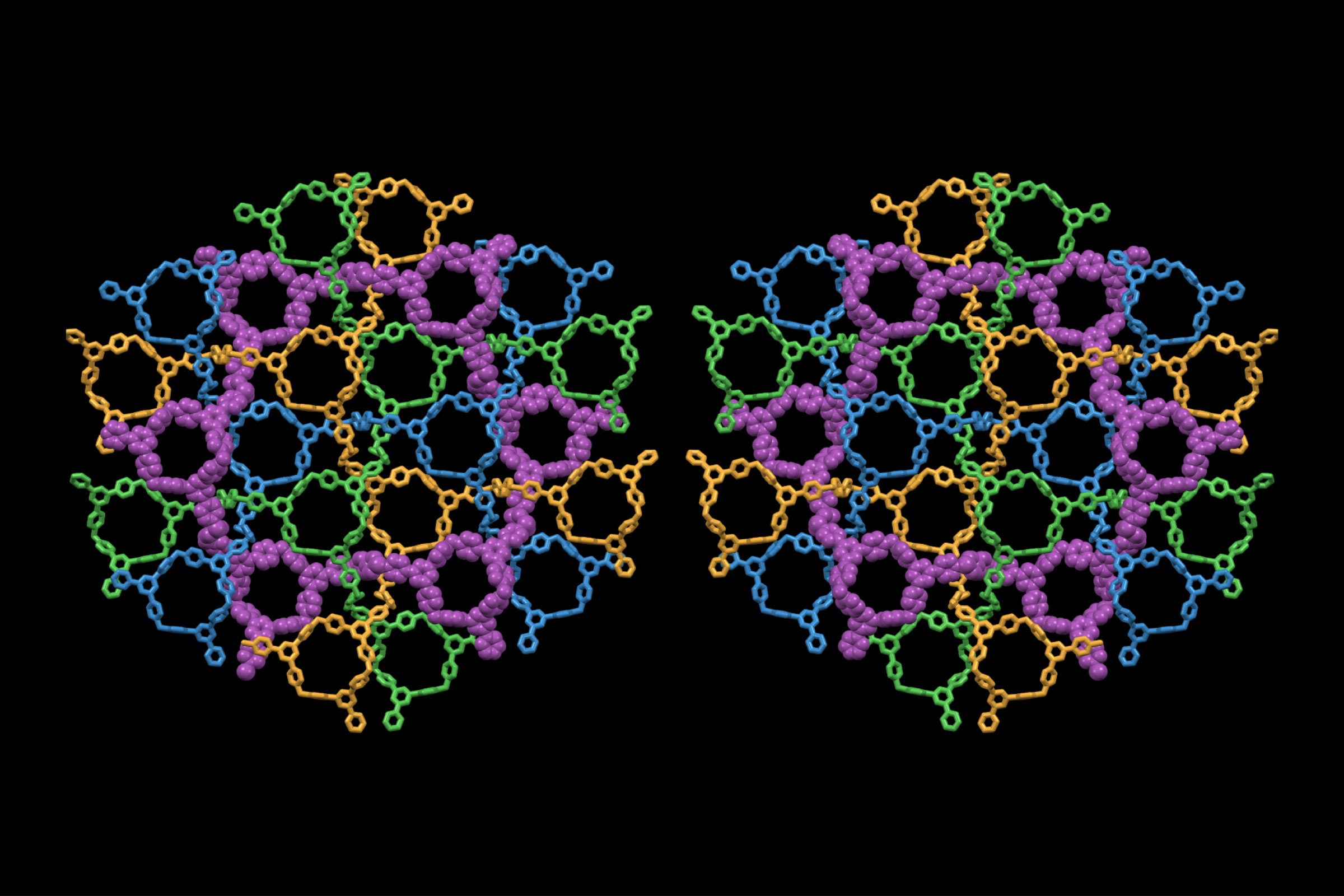
This material consists of four groups of molecular networks that are intertwined with each other and interspersed up and down to form a fabric-like structure. Each layer can be arranged in a clockwise or counterclockwise mirror-image spiral, and the researchers stacked the two "chiral" structures alternately to create a porous material with a triaxial braided topology. It can self-assemble by relying on intermolecular chemical interactions to form a thick, elastic fabric; the staggered network also makes the structure stronger than a single-layer linear weave.
After the material adsorbs benzene, it can be heated to volatilize the benzene, thereby restoring the filtration capacity and being reused. The researchers also demonstrated its ability to separate several other compounds of commercial value; for processes requiring higher purity, multiple filtrations may be required. The Zhejiang University team also demonstrated how to use it for larger-scale processing, but this does not mean that industrial deployment has been achieved.
At present, the research team has not completed the cost and economic analysis, nor has it provided a comparison of energy consumption in large-scale applications. Therefore, whether the material can ultimately replace or supplement distillation in chemical plants remains to be verified. Co-authors of the paper include 2016 Nobel Prize winner J. Fraser Stoddart; he died before the study was completed.
Comments