
Abstract:
Researchers at the Massachusetts Institute of Technology (MIT) in the United States have recently made an important theoretical progress. They re-examined the Brownian motion theory proposed by Einstein in 1905 and found that when particles travel through a fluid at a relativistic speed close to the speed of light, the random motion laws described by the traditional theory do not fully apply. Through new theoretical calculations, researchers have revealed a previously unrecognized asymmetric momentum change pattern when high-speed particles move in fluids. This discovery may provide scientists with new ways to study the state of matter in the first moments after the Big Bang.
This research was jointly completed by Jean Du Plessis, a graduate student at the MIT Center for Theoretical Physics, and Bruno Scheihing-Hitschfeld of the Institute of Theoretical Physics at the University of California, Santa Barbara. The research results were published in "Physical Review Letters" on November 5, 2026.
The core object of research attention is Quark-Gluon Plasma (QGP). This is a special state of matter formed under extremely high temperatures and is thought to have existed in the initial brief period after the Big Bang.
In the very early stages after the birth of the universe, the temperature reached trillions of degrees Celsius, ordinary atomic nuclei had not yet formed, and the quarks and gluons that make up protons and neutrons were not bound together, but moved freely at close to the speed of light, forming an extremely hot mixture of matter.
This state only lasted for microseconds. Then, as the universe expanded and the temperature dropped, quarks and gluons gradually combined to form more stable protons and neutrons, which eventually constitute the vast majority of ordinary matter in the universe today.
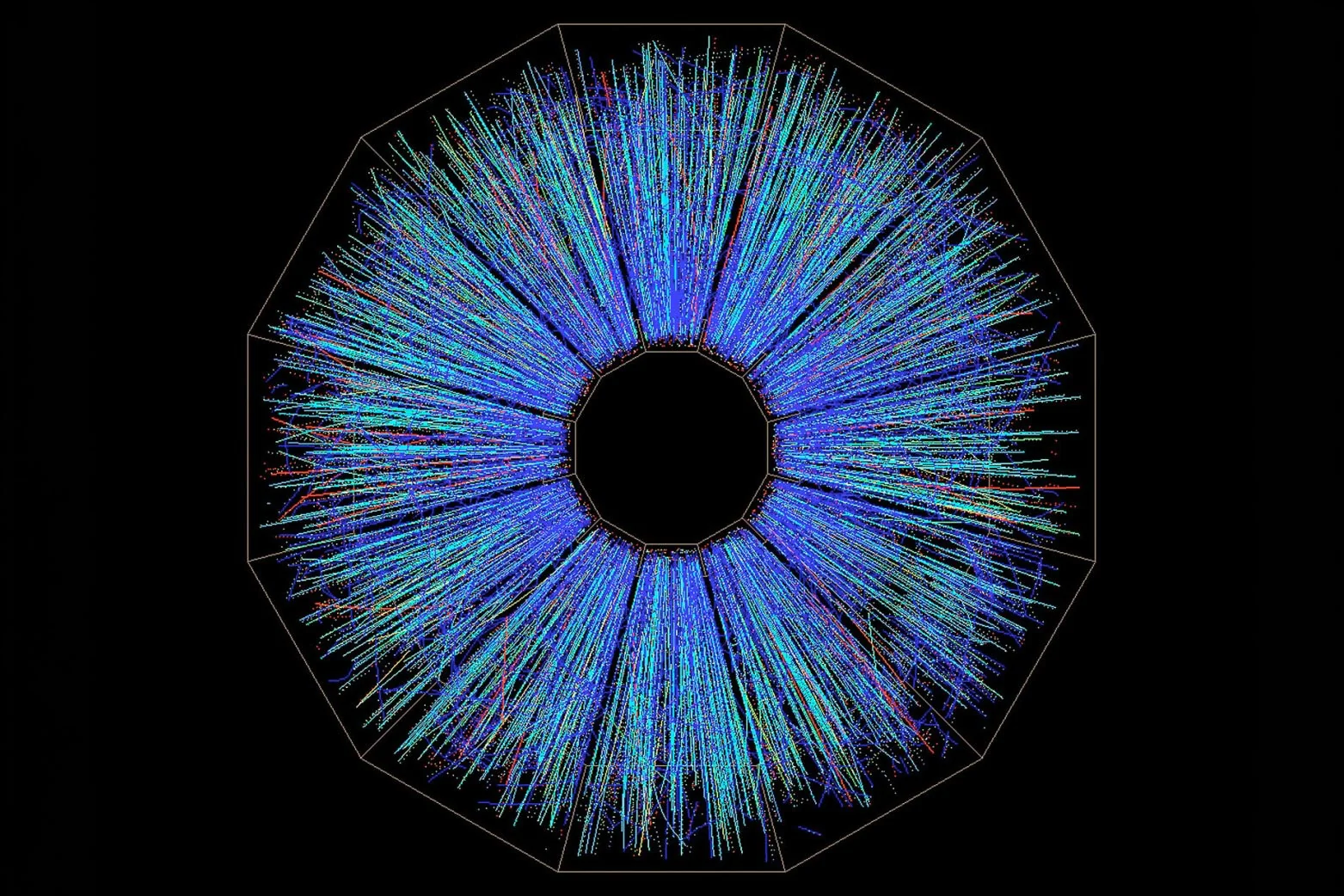
Since this primitive state of matter cannot be directly observed in nature, scientists can only use particle accelerators to simulate it. The Large Hadron Collider at CERN and the Relativistic Heavy Ion Collider (RHIC) at Brookhaven National Laboratory in the United States are both able to create tiny quark-gluon plasma in a very short time by colliding heavy ions with each other at speeds close to the speed of light.
The plasma droplets produced by these collisions are usually only the size of atomic nuclei, but have extremely high temperatures and can only exist for tens of zeptoseconds, which is an extremely short time of the order of 10 to the power of negative 21 seconds.
Researchers hope to understand the microscopic structure inside the quark-gluon plasma by observing heavy quarks passing through these droplets.
Heavy quarks are a type of quark with a mass much higher than up quarks and down quarks, including charm quarks and bottom quarks. After they are created in high-energy particle collisions, they pass through the surrounding quark-gluon plasma and interact with the quarks and gluons within it.
During this process, the speed, direction and momentum of heavy quarks will change. By tracking these changes, scientists can infer the properties inside the plasma in reverse order, just as they can determine the flow of water and internal microscopic activity by observing how floating objects in the water move.
This research idea can actually be traced back to 1827. At that time, the British botanist Robert Brown discovered that pollen grains suspended in still water continued to move irregularly. This phenomenon came to be known as Brownian motion.
In 1905, Einstein proposed the famous Brownian motion theory, which mathematically explained the origin of this random motion. He pointed out that atoms and molecules in the liquid constantly bump into larger suspended particles, causing them to move randomly, while the resistance of the liquid itself slows down the particles.
Under this theoretical framework, there is a specific relationship between the random impacts to particles and fluid resistance. After enough time, the particles eventually reach thermal equilibrium with their surroundings.
For more than a century since then, scientists have used this theory to study a large number of different types of fluids, and even applied it to the study of quark-gluon plasma.
However, problems gradually emerged.
The Brownian motion originally studied by Einstein mainly focused on particles with speeds much lower than the speed of light, but the heavy quarks in the quark-gluon plasma may move at speeds close to the speed of light. Under such relativistic conditions, the interaction between particles and the surrounding fluid is far more complex than traditional Brownian motion models.
Scientists have actually realized about 20 years ago that traditional theories have shortcomings in describing the motion of relativistic particles, but they have been lacking a complete theoretical framework that can accurately describe these interactions.
This time the MIT research team is trying to fill this theoretical gap.
The researchers first built a theoretical gas model composed of weakly interacting quarks and gluons, and let a high-speed heavy quark pass through it. Because the particle interactions in the model are relatively weak, researchers can use the strong interactions in quantum chromodynamics to calculate the forces on the particles and derive the probability distribution of their momentum changes.
The research results show that for small momentum changes, the traditional Brownian motion theory can still provide a fairly accurate approximate description, but when particles encounter strong collisions and large momentum changes occur, the situation changes significantly.
According to traditional theory, random impacts to particles usually follow a Gaussian distribution, which is the familiar bell curve. Most impacts produce momentum changes that are clustered around a mean value, while particularly strong impacts are rare and roughly symmetrical in both directions.
However, the MIT team found that heavy quarks are subject to strong impacts more frequently than predicted by the traditional Gaussian distribution, and there is obvious asymmetry in the probability distribution.
Specifically, when a heavy quark encounters a strong collision that slows it down more than traditional fluid resistance predicts, it's more common for a heavy quark to continue moving at a higher speed than a change of the same magnitude.
In other words, the motion experienced by heavy quarks in the quark-gluon plasma is not a completely symmetric random process described by traditional theory. Particularly strong momentum changes have more complex probability distributions that cannot be explained simply by ordinary Brownian motion models.
The researchers then extended their calculations to plasmas composed of different particles and found that similar asymmetric distributions still existed.
What is even more interesting is that the research team also found similar structures in previous calculations of strongly coupled plasmas. Although the microscopic interaction mechanisms within these systems are different, the probability distributions they exhibit during high-speed particle motion have similar characteristics.
This means that this non-Gaussian, asymmetric momentum change law may not be an accidental result of a specific particle composition, but a certain universal physical feature when relativistic particles interact with fluids.
Jean Du Plessis, the first author of the study, said that this study is the first to integrate similar phenomena that have appeared scattered before into a clear theoretical structure, providing a specific direction for using heavy quarks to study the internal properties of quark-gluon plasma.
The researchers believe that this theory can be used in the future to predict the trajectory of heavy quarks as they pass through the quark-gluon plasma, and then compare the calculation results with experimental data from the Large Hadron Collider and the Relativistic Heavy Ion Collider.
By analyzing the frequency of strong momentum changes and their degree of asymmetry, scientists are expected to more accurately understand the internal structure of quark-gluon plasma and what kind of interactions there are between quarks and gluons.
This research may also help scientists answer a long-standing question: Is the material first formed after the Big Bang closer to a gas or a liquid?
Previous experiments have shown that quark-gluon plasma has very special fluid properties, with extremely low viscosity and behavior close to ideal fluids. This study further suggests that this material in the primordial universe may have more complex and tighter interactions than described by traditional Brownian motion models.
Du Plessis believes that the quark-gluon plasma in the early universe is likely to have stronger particle interactions, and its overall properties are closer to a liquid than a simple gas.
Of course, this research is still a theoretical calculation result and does not mean that scientists have directly observed the complete microstructure of the early matter in the universe. The next step for researchers is to compare theoretical predictions with real particle collision experiments to test whether this asymmetric momentum change law can be confirmed in experimental data.
If follow-up experiments can confirm this theory, then scientists may be able to obtain information that is difficult to provide by traditional measurement methods by tracking a very small number of unusually strong particle collision events.
In a sense, the Brownian motion theory established by Einstein in 1905 has not been overturned. It can still accurately describe the motion of low-speed particles in a large number of ordinary fluids, but in extreme environments close to the speed of light, a more complete relativistic description needs to be introduced.
The significance of this study lies precisely in the fact that it reveals a theoretical boundary that has been ignored before: when particles move close to the speed of light, those seemingly insignificant and violent collisions with extremely low probability of occurrence may just carry key clues to understanding the initial material state of the universe.
The research paper is titled "Heavy Quark Transport Is Non-Gaussian beyond Leading Logarithm" and was published in "Physical Review Letters" on November 5, 2026.
Comments