
Abstract:
A research team at the University of Tokyo in Japan has recently developed a new ultra-high-speed photography technology that can record transient events that occur in a span from one trillionth of a second to one billionth of a second using only 11 images with precisely controlled time intervals. It provides a new observation method for studying laser pulses, shock waves, plasma and other high-speed physical phenomena that are difficult to repeat.

In scientific research, the early stages and subsequent evolution processes of many ultra-high-speed phenomena often occur on completely different time scales. Traditional imaging technology usually works at the microsecond or millisecond level, that is, the scale of one millionth of a second or one thousandth of a second, while existing single-shot ultra-high-speed imaging systems generally use uniform time intervals to record images. When the number of frames that can be shot is limited, researchers have to make a choice between "observing the first moment" and "recording the complete process", resulting in the loss of key information.
To solve this problem, a research team led by Keiichi Nakagawa, associate professor at the Department of Bioengineering at the University of Tokyo, proposed a new method called "logarithmic ultrahigh-speed photography." Different from the traditional uniform sampling method, this technology can flexibly allocate a limited number of shooting frames according to the characteristics of process changes, focusing more images on key stages of change, thereby simultaneously recording the initial moment of the event and its subsequent evolution.
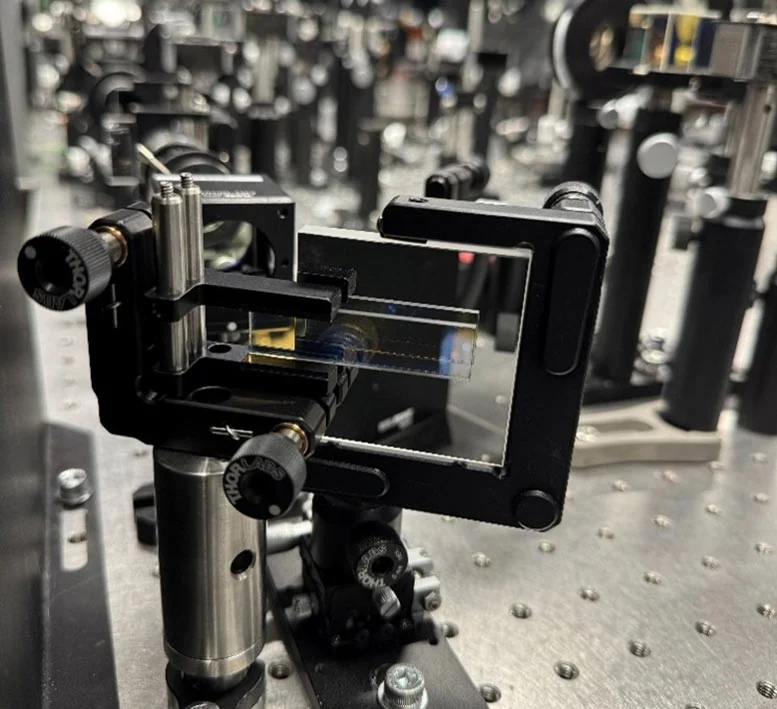
Keitaro Shimada, the first author of the study and postdoctoral researcher, said that the team hopes to be able to connect information on different time scales in one measurement, so that they can not only see the initial moment of the phenomenon, but also observe the subsequent development process, without having to choose between the two.
The researchers integrated this solution into an ultra-high-speed imaging technology called STAMP (Sequential Timed All-Optical Mapping). STAMP itself has both extremely high temporal resolution and good imaging quality, and the team further introduced a band-independent delay generation method called BRIDGE, which achieves independent control of each shooting moment by sequentially extracting spectral components of different wavelengths and adjusting their corresponding time delays respectively.
The core advantage of this technology is that researchers can freely determine the time nodes corresponding to each photo, rather than being limited to fixed intervals. In this way, the shooting time can be flexibly arranged from the femtosecond level, which is one quadrillionth of a second, to the nanosecond level, which is one billionth of a second, and more accurately capture key nodes in the rapid change process.
According to reports, this system can cover a time range spanning five orders of magnitude with only 11 frames of images, which is equivalent to covering a time scale difference of 100,000 times. In this way, scientists can observe very brief initial changes and track their subsequent development without having to record them separately in different experiments and then splice them together to infer.
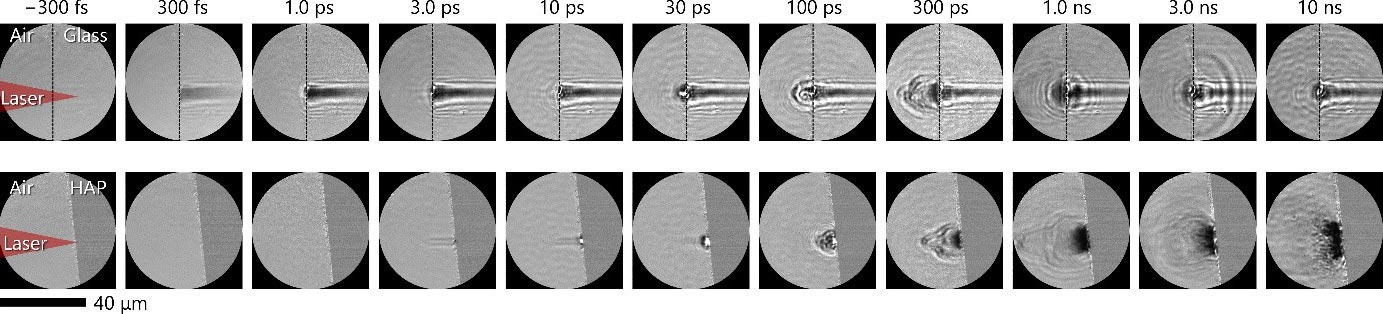
Nakagawa Keiichi said that the team is particularly concerned about phenomena that are difficult to reproduce accurately. In these scenarios, if early and later stages of an event can be recorded simultaneously in the same experiment, it may be possible to uncover important correlations that have been overlooked in the past due to reliance on multiple experimental reconstructions.
The researchers believe that this technology is particularly suitable for studying phenomena with extremely short peak durations and extremely difficult to capture, as well as physical processes that have previously been unable to be completely observed because they span different time scales. They plan to apply it to laser processing, research on dynamic changes in materials, plasma and shock wave experiments, and high-speed imaging tasks in the biomedical field.
Relevant research results have been published in the international optical journal "Optica". The research team said that logarithmic ultra-high-speed photography is expected to help scientists observe fleeting natural phenomena in an unprecedented way, bringing new breakthroughs to materials science, optical engineering and life science research.
Comments