
Abstract:
A research team at the Korea Advanced Institute of Science and Technology (KAIST) recently solved a problem that has plagued the materials science community for decades: how barium titanate crystals interact with light of different wavelengths. For the first time, researchers have systematically measured the intrinsic optical properties of this material in an extremely wide spectral range, providing a reliable data basis for the design of higher-speed, low-loss optical communication equipment.
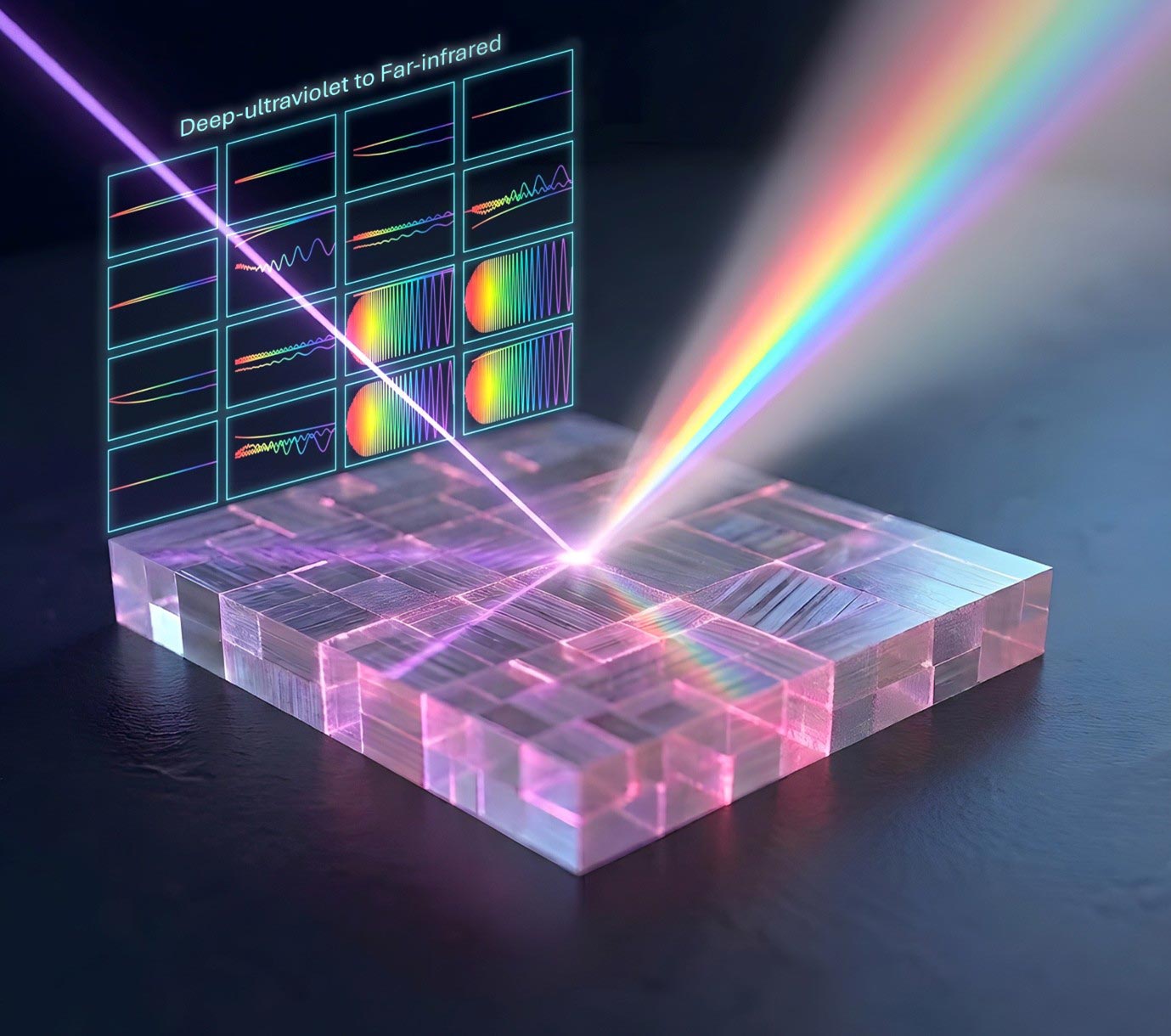
According to SciTechDaily's report on November 13, 2026, this research was led by Professor Jang Min Seok of the School of Electrical Engineering of the Korea Institute of Science and Technology, and was completed in collaboration with the California Institute of Technology (Caltech), the Korean Institute of Standards and Science, and the American J.A. Woollam Company. The research results were published in the journal "ACS Photonics" on October 20, 2026.
Barium titanate (BaTiO₃, referred to as BTO) is a crystal material with special electro-optical effects. One of its most important features is its ability to change its refractive index under the action of an external electric field, that is, to change the speed and direction of light propagating inside the material. This phenomenon, known as the Pockels effect, makes barium titanate an important candidate for making high-speed light modulators.
The optical modulator is a key component in the optical communication system. Its function is to convert electrical signals into optical signals and encode digital information onto optical carriers by controlling the intensity, phase or polarization state of light. As the demand for transmission bandwidth continues to grow in data centers, artificial intelligence computing clusters, and high-speed Internet, materials that can control light signals quickly and accurately are becoming increasingly important.
However, although the electro-optical properties of barium titanate have long attracted researchers' attention, its basic optical parameters have long been subject to inconsistent measurement results. The refractive index and light absorption data published by different laboratories vary greatly, making it difficult for engineers to accurately predict the propagation of light inside this material, and also increasing the cost of trial and error during device design and manufacturing.
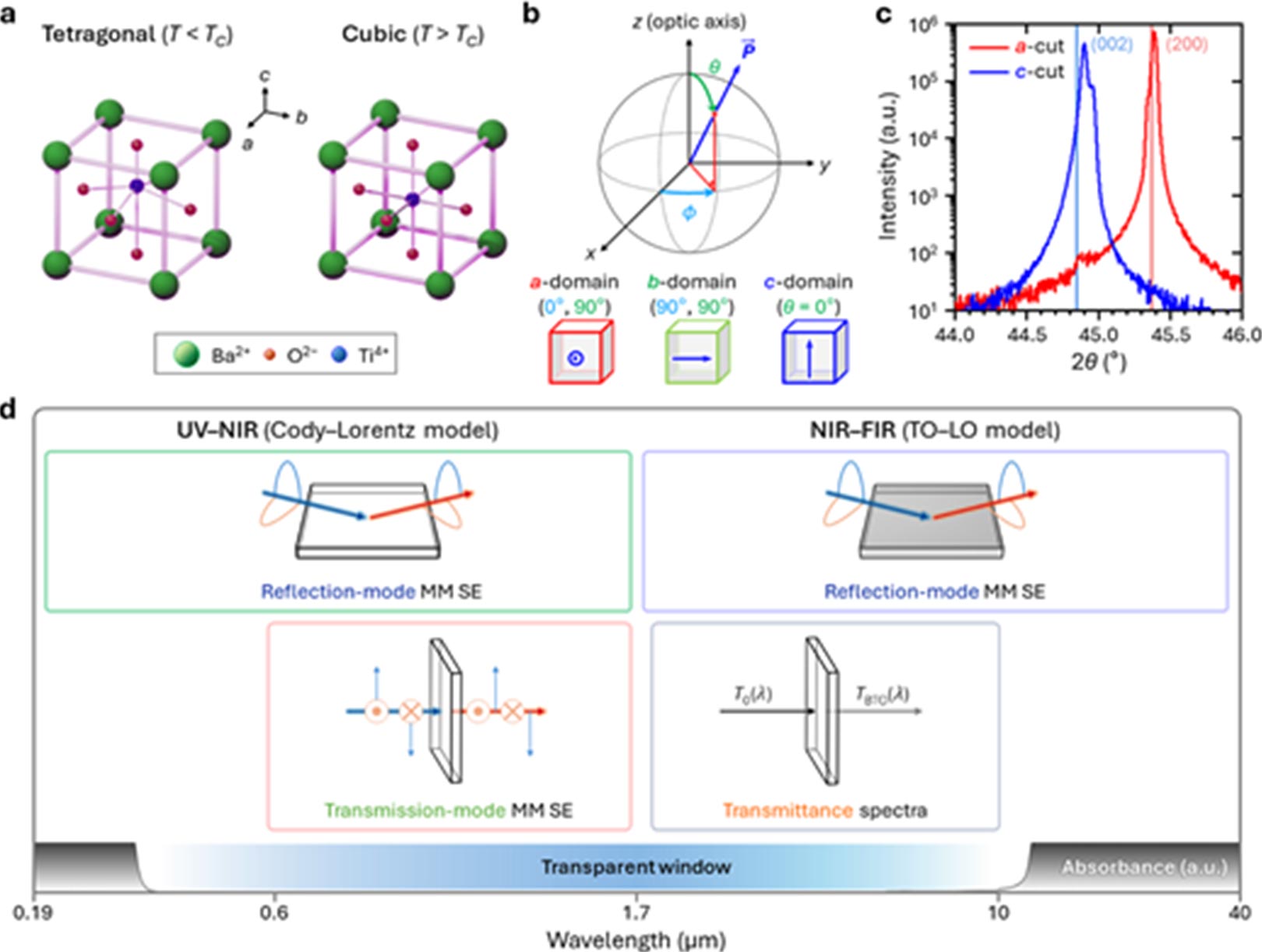
The key to this problem is that the interior of the barium titanate crystal does not always have a completely consistent structure.
Barium titanate crystals may contain many tiny regions called domains. These regions have different crystallographic orientations and polarization directions, and therefore do not respond exactly the same to light. When a measurement device receives signals from multiple regions of different orientations at the same time, what is actually obtained is a mixture of multiple optical responses, rather than the most basic intrinsic optical properties of the material itself.
In order to solve this problem, the research team selected two high-quality single-crystal barium titanate samples with relatively uniform crystal orientation, and used a-cut and c-cut cutting methods to make the structural direction inside the crystal clearer and minimize the interference between different domains.
The researchers used an advanced measurement technique called Mueller-matrix spectroscopic ellipsometry. This method detects changes in the polarization state of light after it is reflected or passes through the material, and can infer the refractive index, absorption characteristics and other optical parameters of the material.
Compared with ordinary optical measurements, the Mueller matrix method can more completely analyze the polarization changes of light, and is particularly suitable for studying materials with complex crystal structures and anisotropic characteristics.
This research covers an extremely wide wavelength range from 190 nanometers to 40 microns, spanning ultraviolet light, visible light, near-infrared light, mid-infrared light, and far-infrared light. Since there are obvious differences in the optical behavior of barium titanate in different wavelength regions, the research team divided the entire measurement range into three spectral regions and used appropriate analysis methods respectively to finally obtain the refractive index and absorption coefficient of the material at different wavelengths and crystal orientations.
The researchers also established a set of mathematical analysis methods that can calculate the comprehensive optical response of the entire crystal based on the orientation and proportion of different domains within the crystal. This means that even if the barium titanate crystal used in the actual device has multiple regions with different orientations within it, engineers can predict its overall optical behavior through the model.
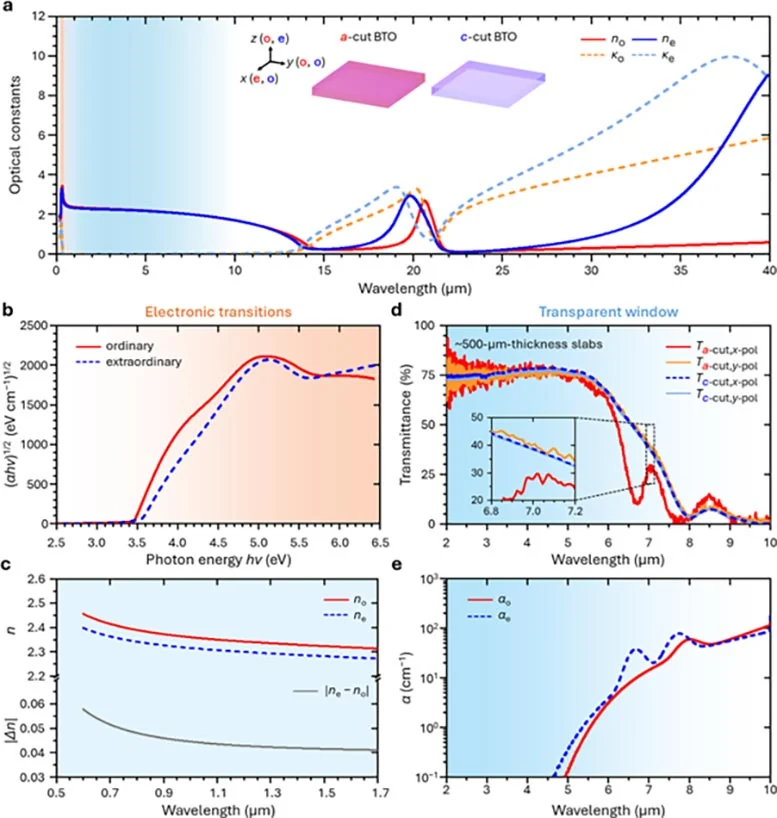
Another important breakthrough is that the research team successfully measured the extremely weak light absorption of barium titanate in the nearly transparent band.
In optical communication devices, when optical signals propagate through materials, even a small amount of absorption may accumulate into significant signal loss during long-distance transmission or multi-level device connection. Therefore, accurately grasping the absorption coefficient of materials is crucial for designing high-efficiency optical waveguides and photonic chips.
The researchers combined ellipsometry with independent transmittance measurements to successfully determine the extinction coefficient of barium titanate in the wavelength range of 2 to 10 microns, down to about 10⁻⁵. The extinction coefficient reflects the degree to which a material absorbs light energy. The lower the value, the smaller the absorption loss when light propagates inside the material.
With this data, engineers can more accurately predict how light will propagate in waveguide structures of different sizes and shapes and how much energy will be lost as it passes through the material, allowing for more reliable designs and simulations before actually building the device.
The research team believes that these results are expected to be applied to high-speed optical communication modulators, optical devices capable of generating new wavelength optical signals, and photonic integrated circuits that use light to process quantum information.
Among them, optical communication modulators are one of the most direct potential applications. In the future, data centers and communication networks will need to handle increasingly large data traffic, and traditional electronic interconnections will gradually face limitations in terms of power consumption, transmission distance, and bandwidth. Using photonic devices to transmit and process data can reduce the energy consumption and delay caused by electrical signal transmission to a certain extent.
With its strong electro-optical response, barium titanate is expected to help create optical modulators with faster response times and lower energy consumption. The precise optical parameters provided by this research can reduce the cost of designers repeatedly manufacturing and testing different structures, and speed up the process of related devices from the laboratory to practical applications.

Professor Jang Min Seok of KAIST said that this research reveals the optical response of barium titanate that has not been fully understood for a long time, providing reliable reference data for understanding the interaction between this material and light. He believes that relevant results are expected to promote the development of low-loss, high-speed optical communication devices, and also provide basic support for quantum photonic devices that require precise control of optical signals.
It should be noted that this research itself did not create new high-speed Internet equipment, nor did it directly demonstrate improvements in network transmission speeds. It solves the long-term problem of unclear basic optical parameters of a key material. To truly transform these data into faster optical communication systems, subsequent device design, manufacturing and performance verification are required.
However, for photonic chips and next-generation optical communication technology, accurately grasping the characteristics of the material itself is often an important prerequisite for achieving engineering breakthroughs. This research reduces a long-term uncertainty in the design of barium titanate devices and provides a new basis for the future development of higher-speed, more energy-efficient optical computing and communication devices.
Comments