
Abstract:
The latest analysis report from research institute Bernstein states that the global semiconductor industry is experiencing a structural explosion led by memory chips.
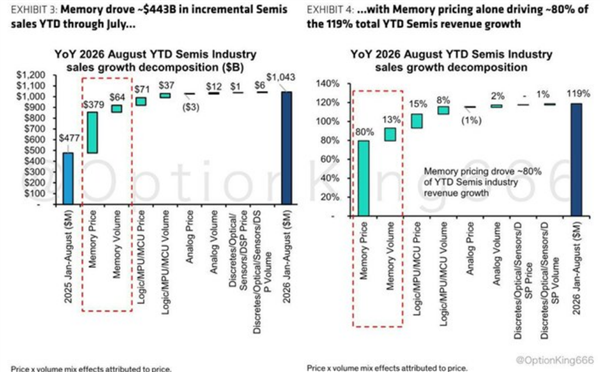
As of August 2026,global semiconductor revenue has surged 119% compared with the same period last year. The rising price of memory chips is the core driver, alone contributing about 80% of total revenue growth.
Bernstein data dismantling shows that the overall global semiconductor revenue in the first eight months of 2026 has climbed from US$477 billion in the same period of 2025 to US$1.043 trillion, more than doubling in scale. Among the new revenue, the storage field created approximately US$443 billion in new sales, which is the absolute main force in the growth of the semiconductor market.
What is more noteworthy is that this wave of growth is highly biased towards “price increase driven” rather than “shipment growth”.
Data shows that
the amount contributed solely by the increase in memory chip prices is as high as US$379 billion, while shipments only contributed US$64 billion in growth, accounting for 13% of new revenue. This means that the current prosperity of the memory chip market is essentially the ultimate display of the strong pricing power of the original storage manufacturers.
Except for storage, the rise in logic/MPU/MCU chip prices contributed $71 billion to growth, and the increase in shipments contributed about $37 billion. Analog chips showed an increase in volume and a fall in prices. The decline in prices led to a decrease in revenue of $3 billion, and the increase in shipments contributed $12 billion in revenue growth. The prices of discrete components/optics/sensors/DSP increased slightly by $1 billion, and the increase in shipments brought a growth of $6 billion.
The Bernstein report pointed out that due to the continued shortage of supply in the entire industry, the contract price of memory chips in the third quarter of 2026 will still surge by nearly 20% compared with the previous quarter.
This round of price increases covers major product lines such as DRAM and NAND. Although the increase in the third quarter has slowed down from the second quarter, it is still well above the historical norm.
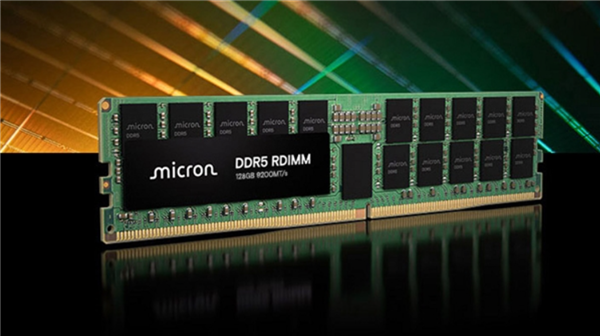
As for the fundamental reason for the continued tight supply, Bernstein pointed to the strong demand for artificial intelligence (AI) applications and AI infrastructure, and market demand continues to exceed the available supply of existing memory chips.
The high cost of memory chips not only increases the construction costs in the AI field, but also puts serious financial pressure on downstream customers of non-AI applications, creating a cost transmission effect across the entire industry chain.
Bernstein expects the supply shortage to extend into 2027 and continue to push up storage contract prices in the fourth quarter of 2026. However, the report also reminds that the room for further price increases in the future may converge over time.
Bernstein pointed out three major constraints: First, the long-term supply agreements (LTA) signed by some customers have price ceilings, which will block some room for price increases at the contract level; second, the high cost of memory chips has brought financial burdens to overall customers, and the demand-side endurance is approaching the limit; third, as new production capacity is gradually released, supply pressure is expected to gradually ease.
Comments