
Abstract:
The cost of acquiring artificial intelligence capabilities is falling at an unprecedented rate. Researchers found that since 2023, the cost required to achieve the same level of AI performance has dropped by an average of about 47% per quarter, which is equivalent to a reduction of about 13 times per year. The decline exceeds that of computer computing power, DNA sequencing, battery technology, and electricity. Many other transformative technologies in history.
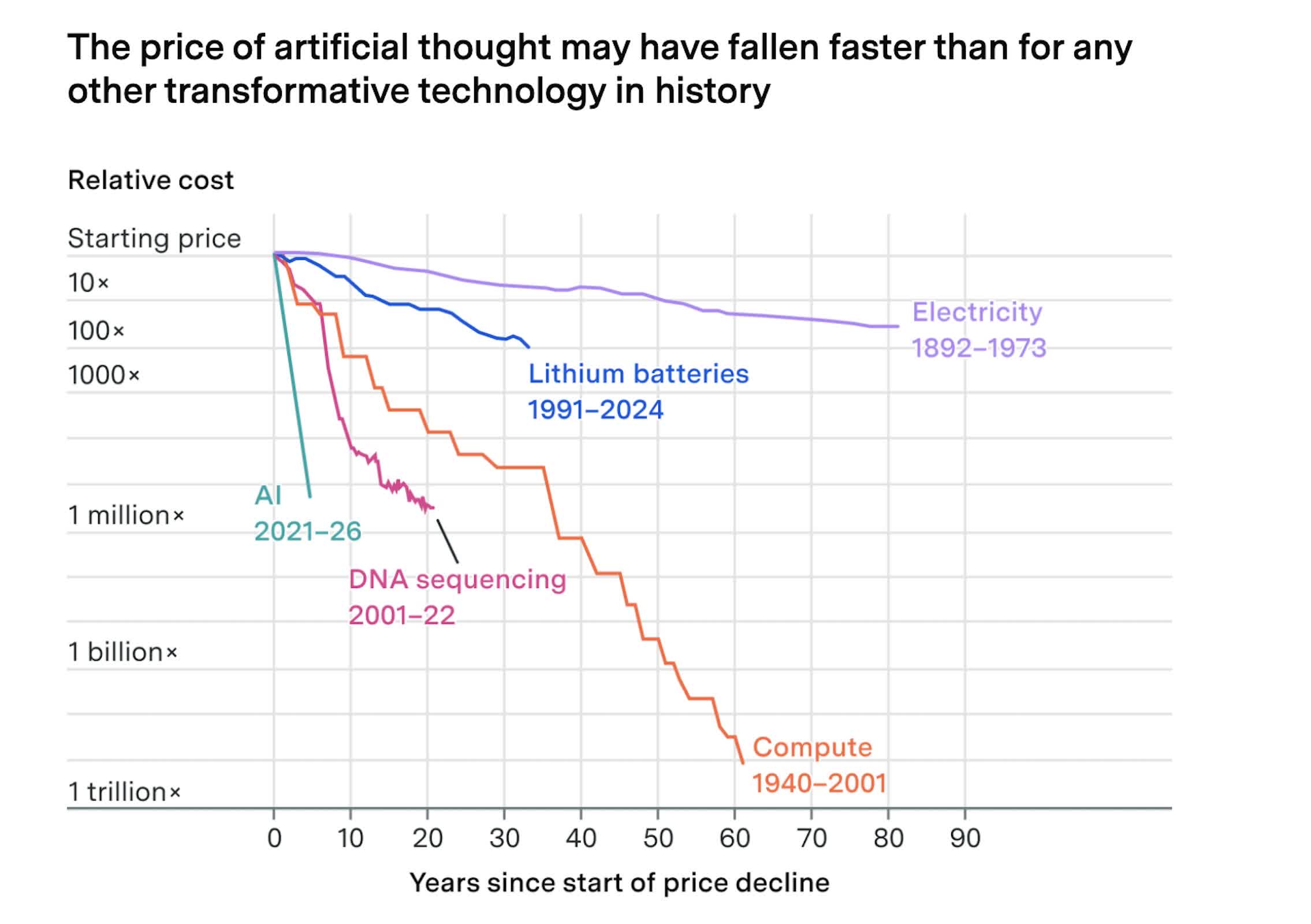
The report, published by research firm Epoch AI, calls this phenomenon a "plummet in the price of ideas." Researchers pointed out that if the same ability level is used as a measure, the cost for today's users to obtain advanced artificial intelligence capabilities is falling rapidly at a rate rarely seen in the history of technology.
The report shows that the cost of AI is falling far faster than the development curve of other key technologies. By comparison, DNA sequencing costs are falling at about one-quarter the rate of artificial intelligence, computing performance costs are falling at about one-sixth of artificial intelligence, and lithium battery costs are falling even more slowly. Researchers believe that of all known general-purpose technologies, artificial intelligence may be the one with the fastest price decline.
The study found that there are differences in the price reduction speed of AI capabilities in different fields. In the field of mathematical reasoning, the cost of related capabilities fell by about 50% to 52% quarterly; in tasks such as games and puzzles, the cost reduction was slightly lower, about 39% to 43%.
The research also found a significant pattern: when a certain capability has just reached the industry-leading level, its cost drops the fastest. When a capability becomes the industry's most advanced level for the first time, related costs can drop by an average of 66% per quarter, which is equivalent to a reduction of about 75 times within a year. Two years later, the rate of price reduction for the same capabilities will slow down significantly, with the quarterly decline falling to about 32%.
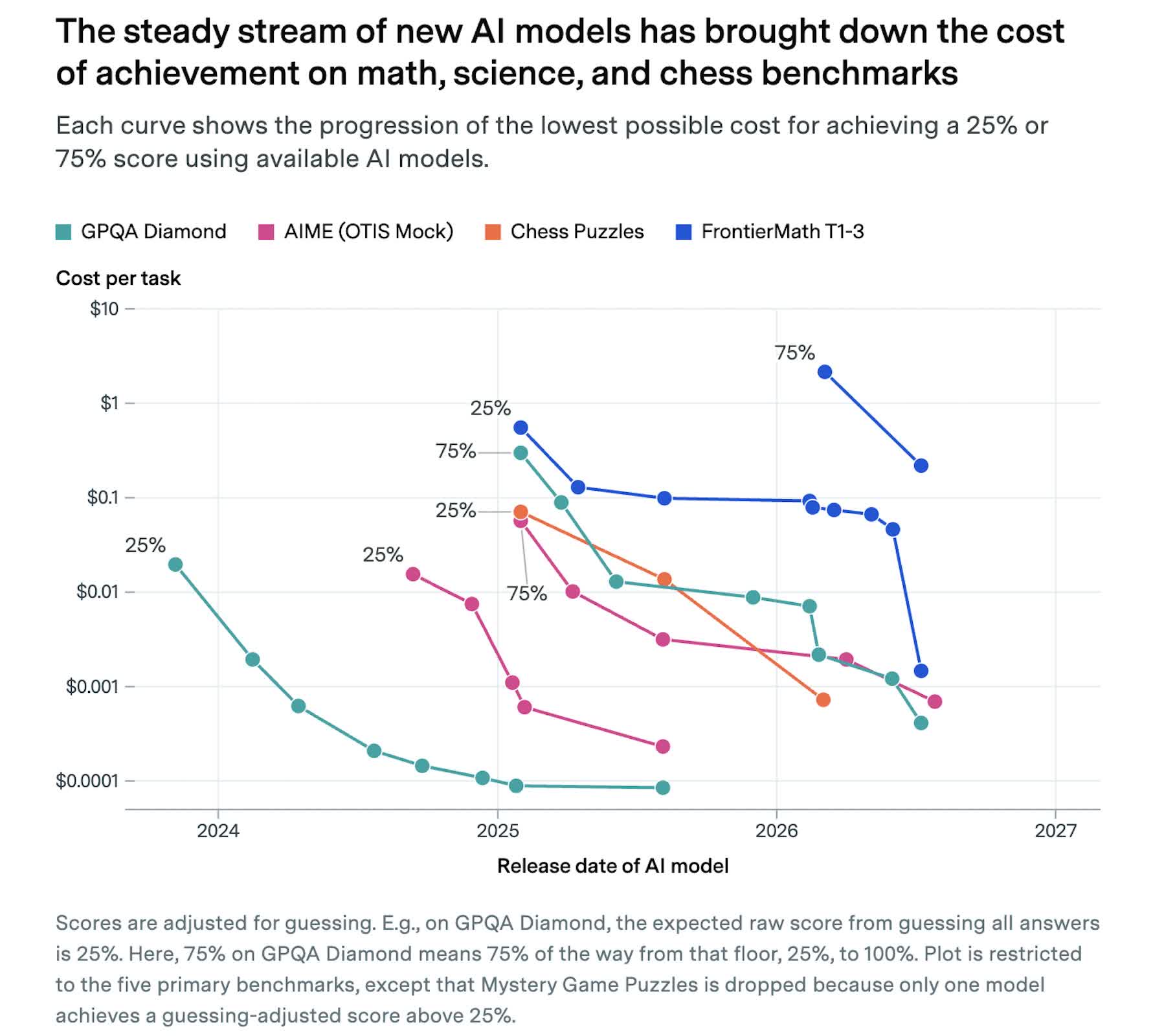
Analysis believes that this means that the leading advantage of cutting-edge models may last shorter and shorter. A capability that originally required a high cost to implement often quickly becomes popular within a few months or even less and becomes an industry standard configuration.
Researchers pointed out that the factors behind the plummeting price are not only the improvement of chip performance and hardware efficiency, but also the optimization of model architecture, improvement of training technology, improvement of reasoning efficiency, and the price war caused by fierce competition among AI service providers. As more and more manufacturers launch model products with similar performance, service pricing continues to drop, further accelerating the popularization of AI capabilities.
However, the report also pointed out that falling costs does not mean that all AI services will become cheap. Although the cost of achieving a given performance level is decreasing significantly, state-of-the-art models often consume more computing resources in pursuit of higher accuracy and stronger inference capabilities. Therefore, the actual operating costs of industry-leading models are still likely to remain high.
Research believes that artificial intelligence is gradually showing a development trajectory similar to computers and the Internet. As capabilities continue to improve and prices drop rapidly, more and more AI applications that were too costly in the past will become commercially viable and further penetrate into fields such as education, scientific research, medical care, manufacturing, finance, and software development.
Researchers said that in the past few years, artificial intelligence has been mainly limited by high training costs and scarce computing resources, and the current phenomenon of "capacity price collapse" may become an important turning point in promoting AI to enter a wider application stage, and have a profound impact on the future industrial structure.
Comments