
Abstract:
A scientific research team at North Carolina State University in the United States has successfully developed a miniature soft bouncing robot with an extremely streamlined structure. The robot does not contain any traditional motors, gears, batteries or electronic control chips, and is thinner than a coin. It can independently convert light and heat into mechanical torsional elastic potential energy under continuous infrared light irradiation, completing an infinite continuous bounce cycle from taking off, resetting in the air, and charging up to take off again.
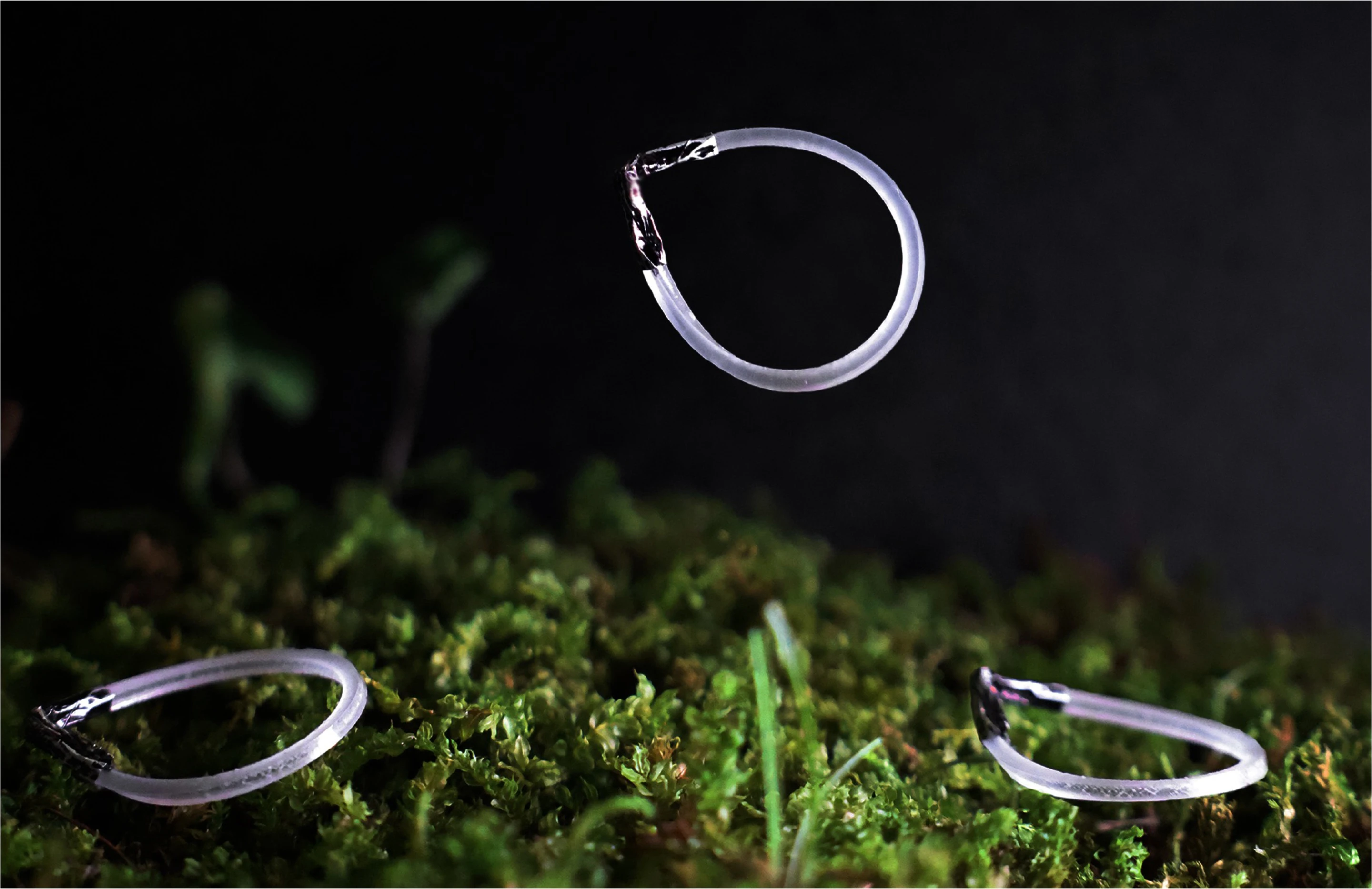
According to research details published in academic journals, the soft robot named "Ring Leaper" is mainly composed of two key structures: a circle of drop-shaped flexible polymer strips made of liquid crystal elastomer (LCE), and a V-shaped micro aluminum rigid sleeve fixed at the tip of the drop. Liquid crystal elastomer has thermal shrinkage properties. When infrared light irradiates the surface of the robot, the molecular chains on the heated side shrink and try to generate spontaneous rotation. At this time, the hard V-shaped aluminum tube at the front end hinders the free rolling of the polymer, forcing the polymer belt to continuously twist inward like clockwork, thus accumulating a large amount of elastic deformation potential energy. When the torsional stress breaks through the critical threshold, the V-shaped aluminum tube instantly slaps downward on the ground, instantly releasing the accumulated energy and ejecting the entire robot high into the air.
The research team found that the robot can rely on its own material elastic memory to automatically recover and untwist in the air during the flight process. After landing, it can immediately enter the next cycle of absorbing light and heating without any manual intervention or mechanical reset device. As long as the external infrared light source remains illuminated, this "energy storage-bouncing-self-resetting" process can continue for hundreds of times.
The experiment further confirmed that the movement form and gait of the robot can be directly controlled by just fine-tuning the opening angle of the V-shaped aluminum tube: when the angle is adjusted to 120 degrees, the robot squirms and crawls close to the ground; when the angle is reduced to 90 degrees, the robot jumps forward; and when the angle is further tightened to 50 degrees, the robot shows a strong ability to jump vertically into the sky, with a maximum jumping height that can even reach more than 80 times its own size. In addition, by adding a small amount of weight to its round end to adjust the center of mass, it can effectively suppress rolling in the air and greatly improve the stability and distance of forward jumping.
In the penetration test on a variety of complex terrains, the micro-robot successfully climbed over grass, sand, gravel beaches, gentle slopes, and obstacle roads scattered with thumbtacks, demonstrating its strong ability to adapt to irregular terrain. Researchers pointed out that although the system still relies on external infrared light sources to provide energy, and there is no immediate commercial product, this fundamental breakthrough in using geometric structures and smart materials to achieve self-propelled cycles has completely broken the technical bottleneck of traditional micro soft robots relying on bulky energy storage reset mechanisms, and provides new design ideas and hardware references for future environmental detection, swarm micro robots, and unstructured disaster ruin search and rescue.
Comments