
Abstract:
A research team at NYU Tandon School of Engineering has developed an amphibious wave robot called WorMa that changes its center of gravity by pumping water between its head and tail, allowing the same machine to climb hills, step over steps, and swim in the water. The study was published in "Advanced Robotics Research". Researchers said that this is the first time that a wave robot has demonstrated the complete terrain transformation ability from land to water and then from water to climb ashore.
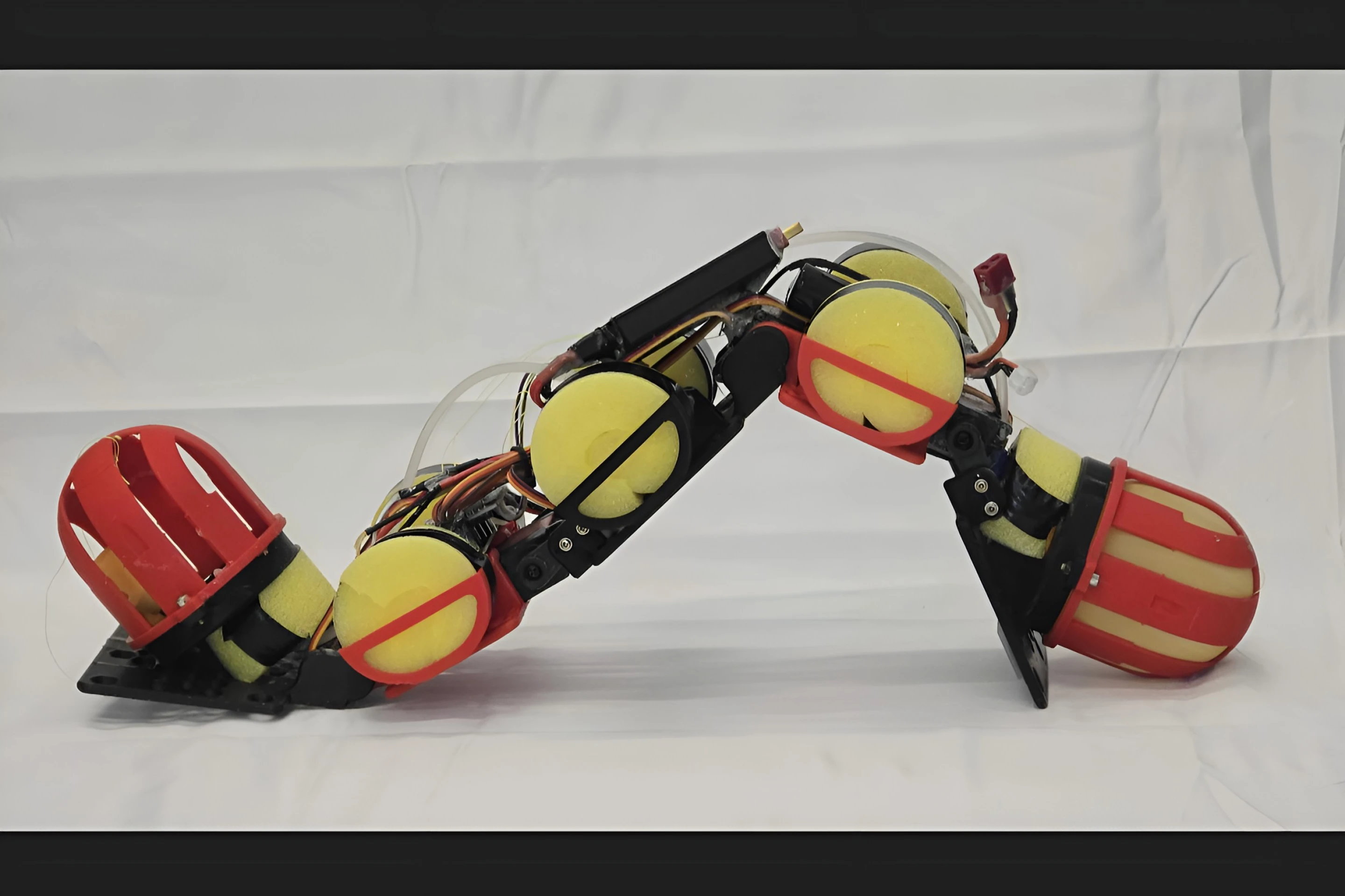
WorMa is 50 cm long, 13 cm wide, 10 cm high and weighs about 1.063 kg. It is composed of five rigid connecting rods and four joints. Each is equipped with a latex balloon water bladder at the head and tail, and a 12-volt peristaltic pump in the middle, which can transfer about 300 grams of water between the two ends, equivalent to 28% of the total weight of the robot. Foam floating materials are installed on both sides of the fuselage, and there are silicone friction pads on the bottom. The research team allowed it to maintain basically the same undulating gait on different terrains, mainly changing the ground pressure and buoyancy state by adjusting the position of the water.
When climbing a slope, water is pumped toward the head, increasing the pressure and friction between the front end and the ground. In the experiment, the head-heavy configuration allowed the robot to successfully climb a 19.5-degree slope, which was the only solution in the test configuration that could pass the steepest slope; its energy consumption per unit movement distance was also at least 33% lower than other center-of-gravity configurations. The opposite is true in water, where moving the water to the tail allows the robot to swim faster, with a top speed 26% faster and 52% more efficient than a head-heavy configuration. Only the head-heavy configuration provided adequate front-end traction when climbing up slopes from the water.
The steps require continuous adjustment of the center of gravity, and a fixed head-weight or tail-weight configuration cannot be used to climb alone. The robot first moves the water to the head to increase the grip, then moves the water to the tail, raises the head and lets the tail push the body forward; after the head and neck joints touch the edge of the step, it pumps the water back to the head and pulls the tail to cross the obstacle. With the help of this sequence of movements controlled remotely by the researchers, WorMa climbed steps up to 15 centimeters and completed a course consisting of flat ground, steps, slopes and open water.
Currently, it is still a laboratory prototype and does not have the ability to autonomously identify terrain and select its center of gravity. The complete transfer of water takes about 110 seconds, and adjustments can only be performed as slower discrete operations rather than real-time responses. The movement performance in the research report does not include the time spent transferring water volume; the robot has not yet solved problems such as lateral drift in the water. The team is considering increasing pump speeds and adding sensors and closed-loop controls. In the future, this design, which uses internal fluids to redistribute the center of gravity, may be used for environmental monitoring and facility inspections on coasts, wetlands, or flooded areas, but these uses are still envisioned.
Comments