
Abstract:
The research teams of the Helmholtz Zentrum Rosendorf (HZDR) in Dresden, Germany, and the SOLEIL Synchrotron Radiation Center near Paris, France, recently announced that they have made an important breakthrough in the development of a new generation of compact free electron lasers. For the first time, researchers have achieved stable and reproducible operation of a laser plasma free electron laser in a high-gain operating state, paving the way for the construction of smaller and lower-cost free electron laser devices in the future.
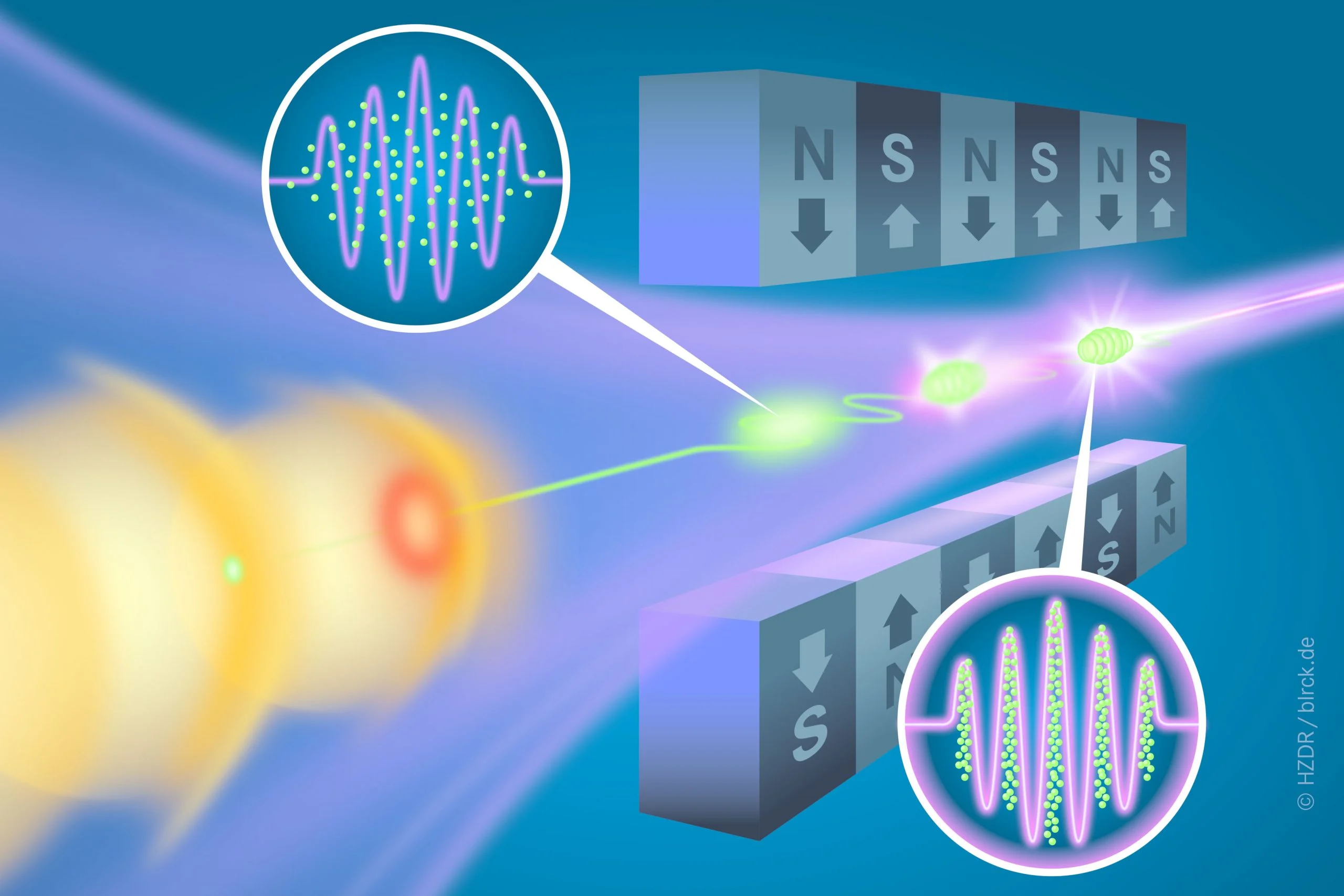
Free electron lasers are an important tool for modern scientific research. They can produce extremely short and high-intensity light pulses and are widely used to study atoms, molecules and new materials. However, most current free electron laser facilities around the world are large and expensive, leaving researchers with very limited experimental time, so researchers have long hoped to develop more compact and economical alternatives.
Traditional free electron lasers require the use of large accelerators with a length of up to two kilometers to accelerate electrons to close to the speed of light. The electron beam then enters an undulator composed of magnets, which releases highly coherent pulses of intense light as it continuously oscillates.
New laser plasma free electron lasers take a completely different approach. Researchers use lasers to generate special waves in the plasma, allowing electrons to "ride" on the plasma waves quickly like surfing. With this mechanism, the energy level that originally required hundreds of meters or even thousands of meters of acceleration distance can now be achieved in just a few millimeters, and the overall acceleration distance is shortened by about a thousand times.
Despite its significant advantages, this technology has long suffered from insufficient stability. For scientific experiments, laser output must be of consistent quality for hours or even days, a standard that laser plasma free electron lasers have struggled to meet in the past.
The key to this breakthrough is that the research team successfully achieved precise control of the interaction process between laser and plasma. Scientists use HZDR's high-performance DRACO laser system to emit infrared laser pulses into a gas flow only a few millimeters thick, generate a stable plasma environment, and precisely adjust the laser parameters to optimally match the plasma conditions.
After completing the acceleration, the electron beam is sent to the undulator system. The researchers further introduced the interaction mechanism between laser pulses and electron beams to enhance the intensity of free electron laser radiation and obtain higher energy output.
The experimental results showed that the team successfully generated high-energy ultraviolet light pulses with a wavelength of 272 nanometers. More importantly, the laser power showed the unique exponential growth characteristics of the high-gain state for the first time, proving that the system has entered a strong amplification operation mode. This state is regarded as an important sign of high-performance operation of free electron lasers.
The researchers said that compared with the results published by the team in 2023, this experiment achieved significant improvements. Laser plasma free electron lasers, which were difficult to ensure stable and repeated operation in the past, are now able to continuously and stably produce high-quality radiation, creating possibilities for practical scientific research applications.
The scientific community generally believes that this achievement is expected to promote the miniaturization and popularization of free electron laser technology. In the future, relevant equipment will no longer need to be built in large national laboratories, but will have the opportunity to be reduced to a scope that universities or medium-sized research institutions can afford, thereby providing advanced light sources to more scientific research teams.
The researchers pointed out that the current system still produces ultraviolet band light sources, but through further upgrades and optimization in the future, it is expected to shorten the wavelength to less than 100 nanometers. By then, this type of compact free electron laser will show greater application value in fields such as materials science, chemical reaction observation, biomedical research, and nanotechnology.
This result has been published in the journal "Physical Review Letters" and is regarded as an important milestone in the development of miniaturization of free electron lasers. It also provides a realistic basis for the future construction of more economical and easy-to-deploy advanced light source facilities.
Comments