
Abstract:
A basic chemical reaction that supports photosynthesis, metabolism and numerous energy conversion processes has recently been completely captured by scientists with unprecedented precision. For the first time, researchers simultaneously observed changes in the electronic structure inside the molecule and the reorganization process of the surrounding water molecular network, providing a new perspective on understanding key reaction mechanisms in life and energy systems.
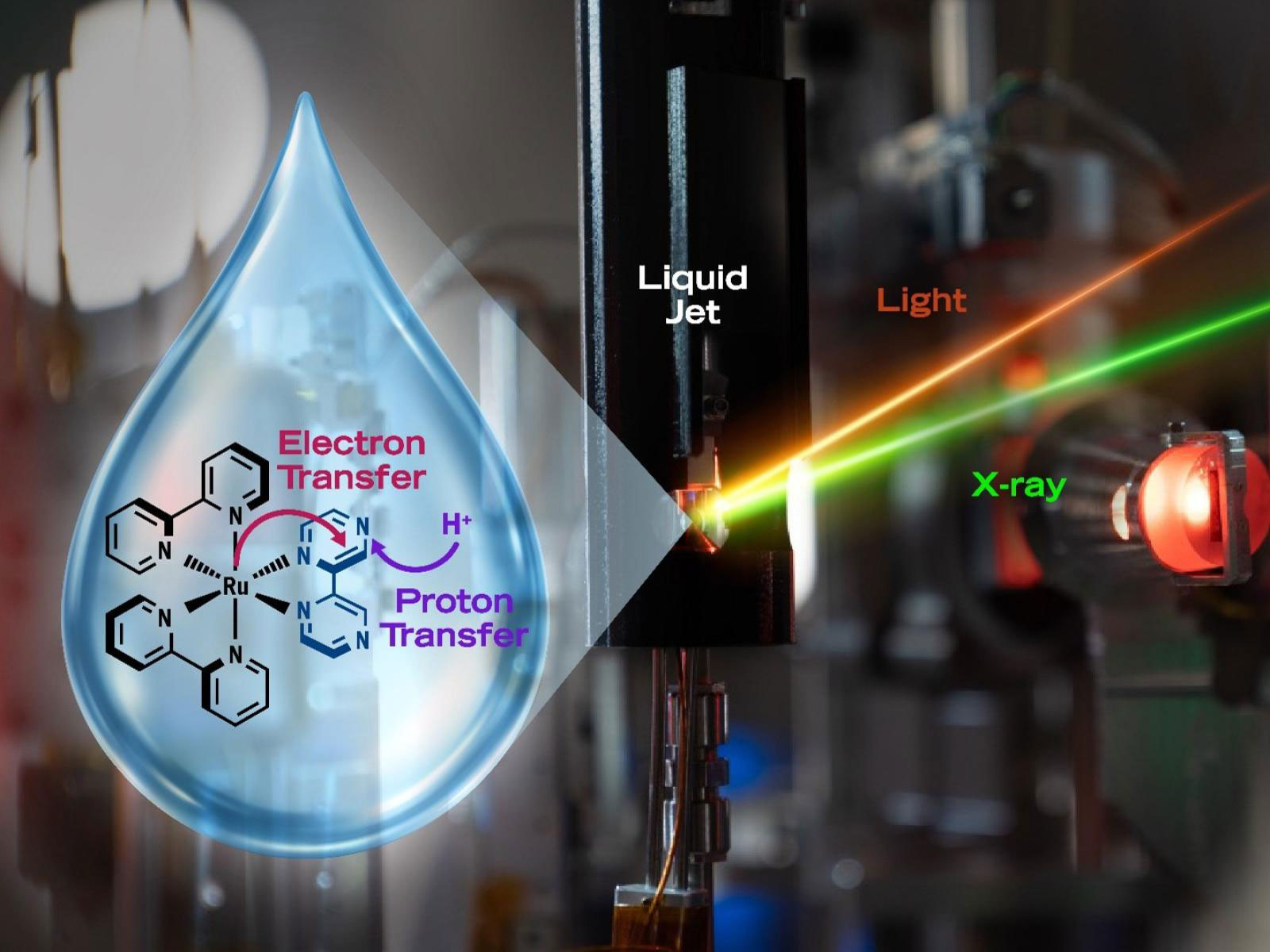
This research was completed by the Pacific Northwest National Laboratory in the United States, the Stanford Linear Accelerator Center, and a number of scientific research institutions. Research results show that when an important energy transfer reaction occurs, the molecules participating in the reaction and the surrounding solvent environment do not change independently, but evolve together in a highly coupled manner.
The research object is a process called "proton coupled electron transfer" (PCET). In this reaction, positively charged protons and negatively charged electrons move simultaneously, completing energy transfer. Numerous key biochemical activities in nature rely on this mechanism, including plants' use of sunlight for photosynthesis and the metabolic processes by which organisms convert food into energy.
Scientists say that the coordinated movement of protons and electrons can help molecules bypass some energy-consuming intermediate steps, thus making chemical reactions faster and more efficient. In addition to life activities, similar mechanisms are also widely found in energy technologies such as catalysts, fuel cells, and flow batteries.
However, this reaction has long been difficult to observe directly.
Electrons move extremely fast, and protons move at very similar speeds. At the same time, the network of water molecules around the reacting molecules will continue to reorganize within the same extremely short time scale. Past experiments were able to capture some of these processes, but were unable to simultaneously record the connection between changes in the electrons and changes in the solvent environment.
In order to overcome this problem, the research team used the Linac Coherent Light Source free electron laser device at the Stanford Linear Accelerator Center in the United States to observe the entire reaction process through two complementary ultrafast X-ray technologies.
In the experiment, the researchers first used light to excite a special molecular system, and then continuously used X-rays to detect its structural changes in a very short time. At the same time, the research team also combined quantum chemical calculations and molecular dynamics simulations to analyze and reconstruct the experimental data.
The final results show that when a molecule acquires a proton, its internal electron distribution will change significantly at specific positions, and the surrounding network of water molecules that were originally stably arranged will also be reorganized simultaneously. In other words, changes in the molecules themselves occur simultaneously with changes in the environment, rather than independently of each other.
Elisa Biasin, one of the project leaders, said that this is the first time that scientists have directly observed how the changes in electronic structure associated with proton transfer are coupled with the reorganization of the surrounding solvent environment. This result provides a new research method for understanding how molecules and the environment co-evolve.
In order to simplify the analysis, the research team chose a photosensitive molecular system with ruthenium as the core as the research object. This system can separate electron transfer, proton transfer and water environment changes to avoid interference caused by complex chemical processes.
Although the experiment cannot directly capture the motion trajectory of the proton itself, researchers can still reconstruct the entire reaction process through changes in the electronic structure and surrounding atomic arrangement.
The researchers believe that this result will not only help explain the energy conversion mechanism in nature, but may also promote the development of the next generation of energy technology. By gaining a deeper understanding of how protons and electrons transfer together, scientists may be able to design more efficient catalysts, fuel cells, and energy storage systems in the future.
With the new generation of LCLS-II free electron laser facilities gradually put into use, the research team expects to be able to observe more complex chemical reaction processes with higher time resolution in the future, and even directly study key energy transfer steps in real photosynthesis systems.
Industry insiders pointed out that the significance of this achievement lies not only in seeing a specific reaction, but also in establishing a new observation method. In the past, scientists could usually only study electronic changes or molecular structure changes separately, but now they can observe the co-evolution of the reaction center and the surrounding environment simultaneously, which opens a new window for future research on life processes and energy conversion mechanisms.
Comments