
Abstract:
For a long time, scientists have generally believed that in the process of partial oxidation of methane to synthesis gas, it is the metal nickel nanoparticles that really play a catalytic role. However, a new study suggests that this widely accepted belief may not be accurate. Researchers from the Dalian Institute of Chemical Physics, Chinese Academy of Sciences and other institutions found that
nickel catalysts undergo dynamic reconstruction during high-temperature reactions. The truly efficient active center may not be metallic nickel in the traditional sense, but a special atomic structure formed directly on the surface of nickel oxide during the reaction.
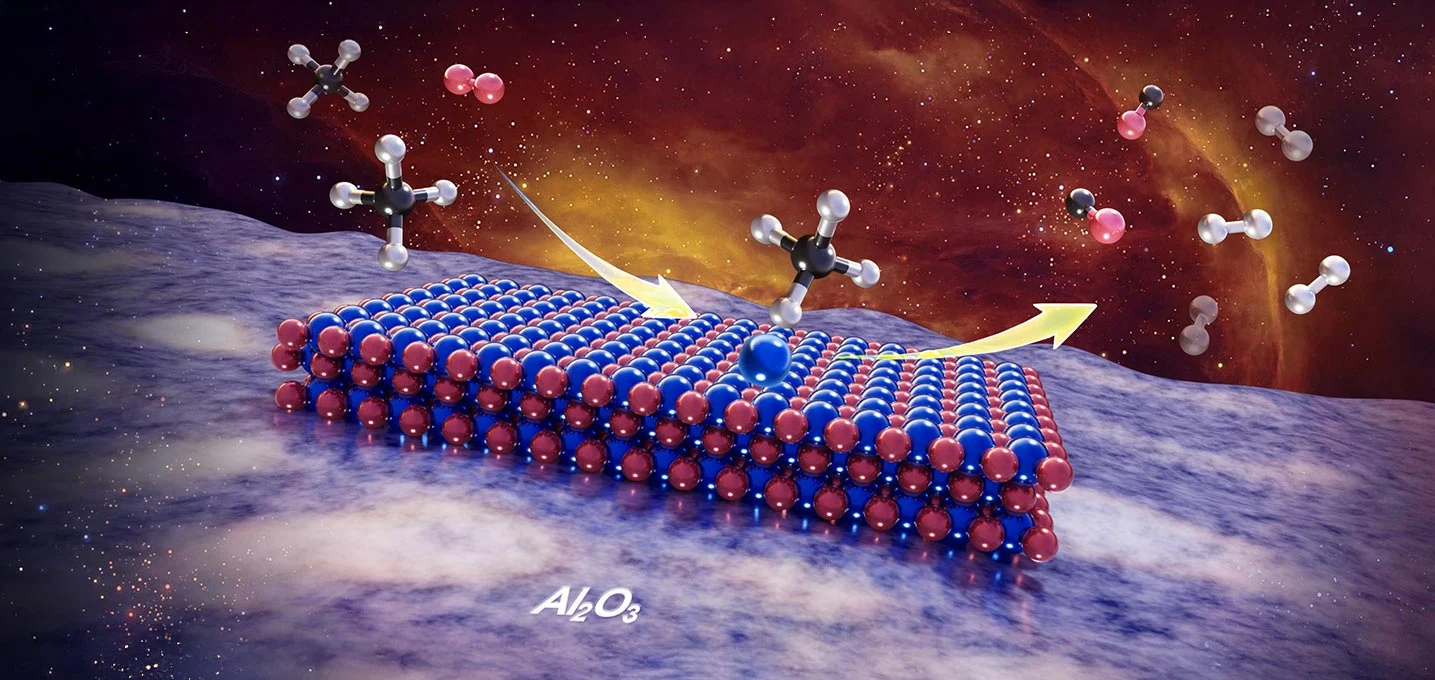
This study was published in "Nature Catalysis". The researchers focused on the partial oxidation reaction of methane, also known as POM. This reaction can convert methane into syngas. The main products are carbon monoxide and hydrogen. Syngas is an important raw material for the production of fuels and various chemical products. Therefore, how to use methane more efficiently to produce syngas has always been an important research direction in the field of industrial catalysis.
The traditional view is that metallic nickel nanoparticles are the main active centers in this reaction. Nickel has a relatively low price and strong methane activation ability, so it has long been widely used as a methane conversion catalyst. However, the researchers also discovered a problem that was difficult to explain: the metallic nickel detected after the reaction was not necessarily the structure responsible for catalysis when the reaction actually occurred.
Under high temperature and redox environment, the state of nickel will continue to change. The metallic nickel present at the beginning of the reaction may be quickly oxidized to nickel oxide, and reduction and rearrangement may occur during the reaction. Because the atomic structure of the catalyst is difficult to directly observe when it is working at high temperatures, it has been difficult for scientists to determine which nickel structure is actually responsible for the catalytic reaction.
This research team discovered through experiments and theoretical calculations that when the catalyst actually works, it will form an active structure that has not been fully understood before. The researchers prepared a Ni/Al₂O₃ catalyst containing only 0.8% nickel by weight and found that even with such a small amount of nickel, the catalyst could still exhibit very strong methane partial oxidation performance.
Under experimental conditions, this low-loading catalyst can achieve a methane conversion rate of 92%, and the selectivity of carbon monoxide and hydrogen reaches 87.0% respectively, while the molar ratio of hydrogen to carbon monoxide remains stable at about 2.0. This ratio is of great significance for the subsequent industrial utilization of syngas.
What is even more surprising is that after the reaction, the researchers detected almost no metallic nickel. That is to say, although traditional theory believes that metallic nickel should be the main active center, there is almost no metallic nickel in the traditional sense in the samples that actually show strong catalytic ability.
The researchers then compared this low-loading catalyst with a high-loading Ni/Al₂O₃ catalyst containing 8.0% nickel. The latter is prepared by traditional impregnation method, and the nickel content is about ten times higher than the former. However, the performance of the two in the partial oxidation reaction of methane is quite similar.
This means that if the catalytic mechanism discovered by the researchers can be further applied to actual catalyst design, it will be possible to reduce the amount of nickel in the catalyst by an order of magnitude while maintaining similar catalytic performance. This can not only reduce the consumption of nickel resources other than precious metals, but may also further reduce catalyst manufacturing costs.
In comparison, another catalyst that also contained only 0.8% nickel but was prepared by a traditional impregnation method performed significantly worse. Under the exact same reaction conditions, the material primarily promoted complete combustion of methane, rather than the partial oxidation the researchers had hoped for.
This result shows that how much nickel is contained in the catalyst cannot simply determine its catalytic performance. What form the nickel takes, how the atoms are arranged, and how these structures change during reactions may be more important than simply increasing the nickel content.
The researchers then further tracked the changes in nickel during the reaction. At the beginning of the experiment, metallic nickel nanoparticles were indeed present in the catalyst, but they were quickly oxidized in the reaction environment and transformed into the nickel oxide phase. This finding is in clear conflict with the traditional understanding of metallic nickel as the main active center.
However, pure nickel oxide itself cannot explain the experimental results. The researchers specially prepared a preformed pure-phase nickel oxide catalyst for testing, and found that this material had almost no partial methane oxidation activity, but mainly promoted the complete oxidation of methane.
The real key appears on the surface of the nickel oxide.
The researchers found that during the partial oxidation reaction of methane, the NiO surface undergoes atomic-scale structural reconstruction and forms a special [Ni₁O₄Ni₄] structural unit. This structure is not a fixed structure that already exists in the catalyst before the reaction starts, but is formed dynamically in the real reaction environment.
In other words, the actual working state of the catalyst may be completely different from the material the experimenter got in hand before the reaction. A catalyst is not a static solid surface, but rather a dynamic system that continuously reorganizes as temperature, gas composition, and reactants change.
The researchers used density functional theory, also known as DFT calculations, to further analyze the catalytic effect of this special structure. Calculation results show that the [Ni₁O₄Ni₄] structure can significantly reduce the energy barrier required to break the carbon-hydrogen bond in methane.
On this reconstructed structure, the calculated activation energy for methane C-H bond cleavage is only 12.5 kcal per mole, while the corresponding energy barrier on the intact NiO (100) surface is as high as 38.5 kcal per mole.
Even the metal Ni (111) surface, which is traditionally considered to be an efficient active center, has a calculated energy barrier of 15.7 kcal per mole, which is higher than the reconstructed structure discovered this time.
This means that from a theoretical calculation point of view, the [Ni₁O₄Ni₄] structure formed during the reaction is easier to activate methane than the traditional metal nickel surface. Experimental results and theoretical calculations ultimately point to the same conclusion: this dynamically formed atomic structure is likely to be the real key active center of the methane partial oxidation reaction.
The importance of this discovery lies not only in finding a new nickel catalytic structure, but also in that it changes the way scientists observe catalysts.
In the past, researchers usually analyzed the state of the catalyst before and after the reaction, and then inferred its working mechanism based on the material structure. But if the catalyst is constantly changing during the actual working process, then simply observing the material before or after the reaction may miss the most critical active structure.
The research team therefore emphasizes that when studying catalytic reactions, the catalyst must be characterized in situ under real working conditions as much as possible. Only by observing the state of the catalyst at high temperature, high pressure, and in a real reaction atmosphere can we accurately find the active center that actually plays a role.
This concept of "dynamic catalysis" also means that when designing catalysts in the future, it is not necessarily necessary to pursue a fixed structure that remains stable from beginning to end. Instead, materials can be intentionally designed to actively reconstitute under specific reaction conditions and form active structures that are best suited for specific chemical reactions.
For industrial catalysis, this may open up a new design idea. Traditional methods often increase the number of active sites by increasing the metal loading, but this study shows that if the material structure can be controlled so that a very small amount of metal can form a highly active atomic structure during the reaction, it is possible to significantly reduce the amount of metal used while maintaining high catalytic efficiency.
The researchers believe that this mechanism may be used in the future to develop more efficient methane conversion catalysts and reduce reliance on high metal loadings. For natural gas conversion, syngas production and related chemical industries, further industrialization may bring improvements in cost and energy efficiency.
More broadly, this research may also influence scientists' understanding of other catalytic reactions. The researchers pointed out that similar reaction-driven structural reconstruction phenomena may not only exist in nickel catalysts. Other transition metals and even some non-metal catalytic materials may also form active structures that have not been observed before in the actual working process.
Therefore, future catalyst research may pay more and more attention to the question of "what does the catalyst become when it works", rather than just "what is the catalyst originally".
For nickel catalysts, what this research ultimately reveals is not that the traditional metal nickel theory is completely invalid, but that the catalytic process is more complex than previously thought. Metallic nickel may be involved in the process of catalyst formation and reconstruction, but what actually directly undertakes the task of methane activation may be the subsequent atomic-level structure dynamically generated on the surface of nickel oxide.
If this mechanism is verified by more experiments and can be further extended to actual industrial catalysts, the amount of nickel required to produce syngas in the future may be significantly reduced. More importantly, this study once again proves that in the field of catalysis science, what really determines the reaction efficiency may not be the material label itself, but the extremely small and even short-lived atomic structures formed instantly in the material in a real reaction environment.
Comments