
Abstract:
Ruthenium dioxide, once generally considered a non-magnetic substance by the scientific community, exhibits a previously hidden new magnetic state when it is thinned to a thickness of several atomic layers and stressed. A research team led by Ming Yi, a physicist at Rice University in the United States, and composed of the University of Minnesota and the Paul Scherr Institute in Switzerland, recently published a study in the international academic journal Science Advances, confirming for the first time that ultra-thin ruthenium dioxide films exhibit emerging "alternating magnetism" behavior, opening up new ways to develop next-generation computer storage devices that are smaller in size and more energy efficient.
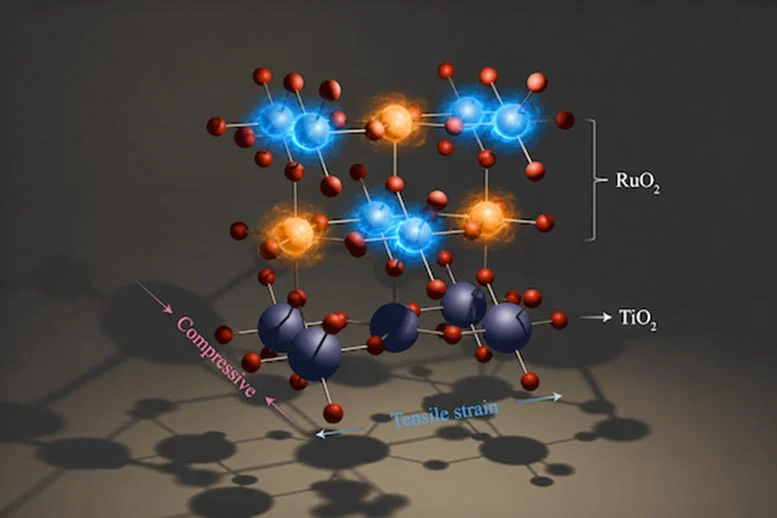
Alternating magnetism is a new type of magnet proposed in the theoretical physics community in recent years, which combines the key advantages of ferromagnets and antiferromagnets. As one of the first quantum materials theoretically predicted to have alternating magnetic properties, ruthenium dioxide (RuO2) has long been controversial in academic circles. Multiple previous experiments have shown that bulk materials of ruthenium dioxide do not exhibit any detectable macroscopic magnetism, and the scientific community once formed a consensus that its bulk materials are not magnetic. However, the multinational research team has found that compression of the material's dimensions may be a key switch in activating its magnetic potential.
In order to explore the microscopic magnetic behavior at the atomic scale, the researchers prepared an ultra-thin ruthenium dioxide film with a thickness of only a few atomic layers and used spin-resolved angle-resolved photoelectron spectroscopy (Spin-ARPES) to accurately measure its electron spin texture. The experimental results are highly consistent with the theoretical calculation model, clearly showing that the tested ruthenium dioxide exhibits an electron spin arrangement consistent with unconventional magnetic characteristics, indicating that under specific external conditions, ultra-thin and bulk ruthenium dioxide have completely different magnetic properties.
Experimental analysis pointed out that lattice strain (Lattice Strain) played a decisive role in the emergence of this strange magnetism. When an ultrathin film is grown on a specific substrate, such as titanium dioxide, the stress on the lattice reshapes its microscopic electronic structure, inducing a spin pattern that is highly consistent with alternating magnetism; this magnetic phenomenon no longer exists when the strain is removed or in the native bulk state. Yichen Zhang, the first author of the study, said that the strain-dependent characteristics mean that lattice stress is expected to serve as a regulatory "knob" for directional induction and control of alternating magnetic states, which has important application value for the design of next-generation spintronics devices and new random access memory (RAM) architectures.
This research not only advances the cognitive boundaries of basic physics of quantum materials, but also provides a feasible experimental paradigm for using epitaxial stress engineering to control low-dimensional quantum states. By precisely controlling mechanical stress at the nanoscale, researchers may be able to more flexibly control electron spin degrees of freedom in the future, promoting further breakthroughs in low-power, ultra-high-density information storage technology.
Comments