
Abstract:
A research team led by the University of California, Los Angeles (UCLA) recently announced a new study on crystal formation. For the first time, scientists used three-dimensional atomic imaging technology to observe the crystal nucleation process atom by atom, and found that there is no clear boundary between the ordered structure inside the crystal and the surrounding disordered material as described by classical theory. The discovery could change fundamental understanding of how crystals form during phase transitions in matter.

For nearly a century, scientists have relied on classical nucleation theory to explain phase change processes such as liquid freezing and gas condensation. This theory holds that some tiny ordered regions, known as crystal nuclei, will first form inside the substance, and then these crystal nuclei will continue to grow, eventually forming complete crystals. The core equations that underpin this theory have been supported by thousands of experiments.
However, when researchers observed crystal formation in three-dimensional space on an atom-by-atom basis, the actual structure of the crystal nucleus was different from what the classical model predicted. The research team used complex alloy nanoparticles composed of multiple metallic elements and developed a method to freeze the crystal nuclei at different stages of formation, allowing them to observe this process, which usually occurs extremely quickly.
The researchers found that the transition from ordered crystals to the surrounding disordered material occurs gradually, rather than suddenly with a clear dividing line. Jianwei "John" Miao, professor of physics and astronomy at UCLA, member of the California Nanosystems Institute, and corresponding author of the paper, said that the crystal nucleus does not have a uniform internal structure and clear boundaries as described by the classical nucleation theory. On the contrary, the central region of each crystal nucleus has the highest crystallinity. The closer to the boundary, the more disordered the atomic arrangement becomes, forming a continuous gradient.
In order to explain this phenomenon, the research team proposed a more complex "gradient nucleation path model." This new model does not overturn the classical nucleation theory, but rather extends it. Miao said that the classical theory can actually be regarded as a special case of the new model: if this special case is plugged into the new equations, you can get exactly the same results as the classical nucleation theory. But in actual experiments, the researchers never observed clear atomic-scale boundaries, instead seeing this gradient structure repeatedly.
The nucleation process widely exists in natural and engineering systems such as cloud droplet formation and industrial manufacturing. Therefore, re-understanding this process may affect multiple research fields and provide reference for the development of new technologies.
To capture the different stages of crystal formation, the researchers first heated the nanoparticles to more than 3,000 degrees Fahrenheit (about 1,649 degrees Celsius) and then rapidly cooled them to room temperature in a few hundredths of a second. Rapid cooling initiates the crystal formation process while causing the crystal nuclei in different nanoparticles to stay in their own different stages of development.
Miao explained that the time required for data collection is much longer than the nucleation process itself, so researchers must first "freeze" the crystal formation process before they can study the nucleation phenomenon at different stages.
The research team then used atomic electron tomography to perform an atom-by-atom three-dimensional reconstruction of each nanoparticle, and used advanced statistical analysis to quantify the degree of order in different regions. The entire data set contains more than 8,000 nuclei, ranging in size from less than 10 atoms to more than 1,000 atoms.
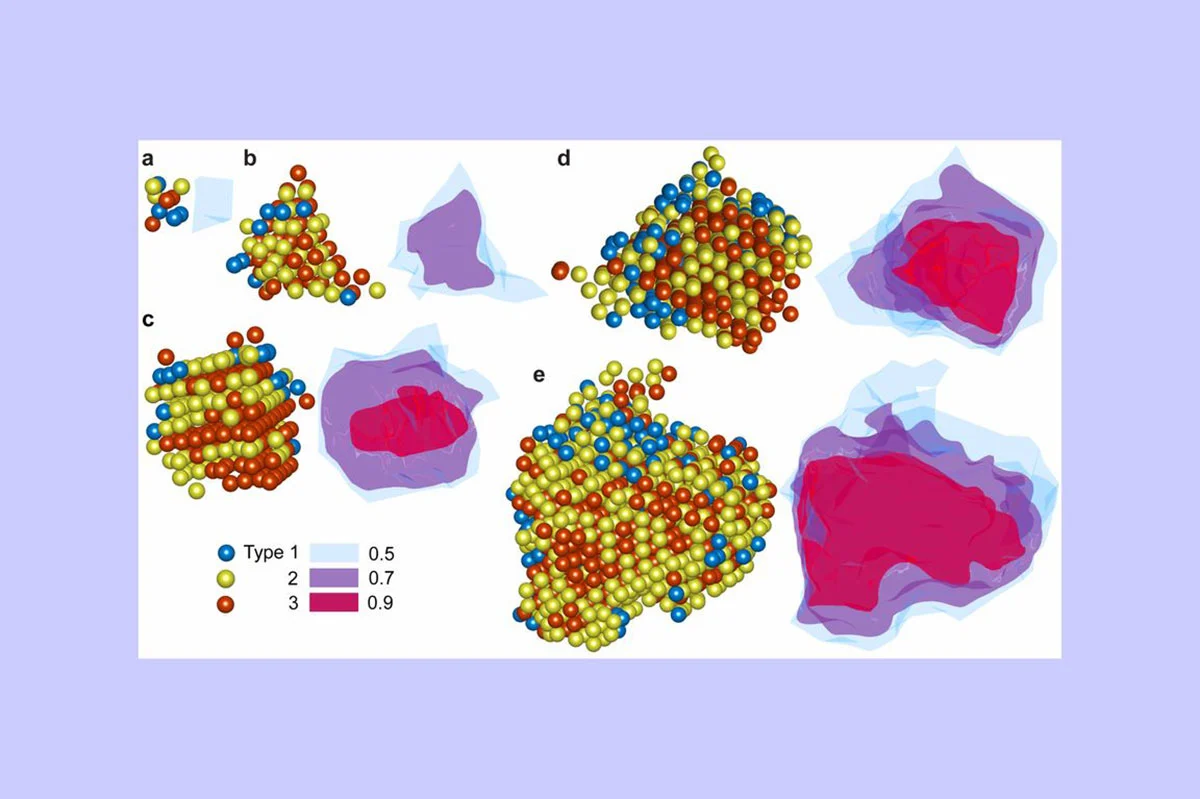
The researchers repeatedly observed the same pattern in these nuclei: the degree of atomic order was highest in the central region and gradually decreased toward the surface. As the crystal nucleus continues to grow, the degree of order in its central region will further increase.
These gradient structures also change researchers' understanding of the energy required to form crystal nuclei. Classical nucleation theory holds that crystal nuclei must overcome a clear minimum energy requirement, a so-called energy barrier. Only a few crystal nuclei with enough energy can cross this "wall".
However, experimental results show that the nucleation process may not cross the energy barrier at once, but is gradually completed through multiple intermediate stages. Miao compared it to climbing a wall: Classic theory holds that the crystal nucleus must climb directly over a wall, but the research results show that nature may have adopted a more efficient way, climbing step by step through a ladder and using multiple intermediate states to overcome energy barriers. The research team believes that the new gradient nucleation path model can describe this process and explain why crystal nuclei can be formed more efficiently.
The complete phase change process also requires different crystal nuclei to combine with each other. The research team also discovered an unexpected phenomenon in this process: many crystal nuclei that are close to each other already have almost the same orientation before merging, which makes it easier for them to finally combine.
Miao said it was surprising that many of the nuclei were already nearly aligned before merging. It may reflect a lower-energy formation path, but also shows that there is still much to explore about the way nature organizes matter.
The high-entropy alloys and medium-entropy alloys used in this experiment only began to appear about 20 years ago. Such materials are made from multiple metallic elements mixed in roughly equal proportions, unlike traditional alloys such as steel where a single primary element dominates. Their highly mixed atomic structure can produce unusual combinations of properties such as strength and flexibility, and may also be used to create more efficient and durable chemical reaction catalysts.
Understanding the nucleation process of these materials can help researchers better design and develop them, Miao said. At the same time, the research team believes that this model can also be widely applied to other nucleation systems.
Because nucleation is a ubiquitous phenomenon in nature and engineered systems, this research could impact fields as diverse as physical sciences, climate modeling, food, pharmaceuticals, semiconductors, and electronics. The atomic imaging method used this time may also provide researchers with a new tool to explore how the nucleation process unfolds.
For Miao, the more important significance of this research is that it may prompt the scientific community to rethink how matter organizes itself during phase changes. He said the research team believes this work will change researchers' understanding of nucleation phenomena and hopes that future textbooks will eventually reflect this new understanding.
This research, titled "Crystal Nucleation and Growth in High-Entropy Alloys Revealed by Atomic Electron Tomography," was published in the journal Nature Materials on August 25, 2026. The research was mainly supported by the Materials Science and Engineering Division of the Basic Energy Science Program of the Office of Science of the U.S. Department of Energy.
Comments