
Abstract:
According to Nikkei Asia, researchers are trying to install artificial intelligence, sensors and communication equipment on insects, taking advantage of their small size, sensitive perception and low energy consumption to perform search and rescue missions in disaster areas. A latest system can analyze the heartbeat, nerve signals and body movements of cockroaches, identify the surrounding environment and guide them to escape from dangerous areas, with a maximum recognition accuracy of 93%.
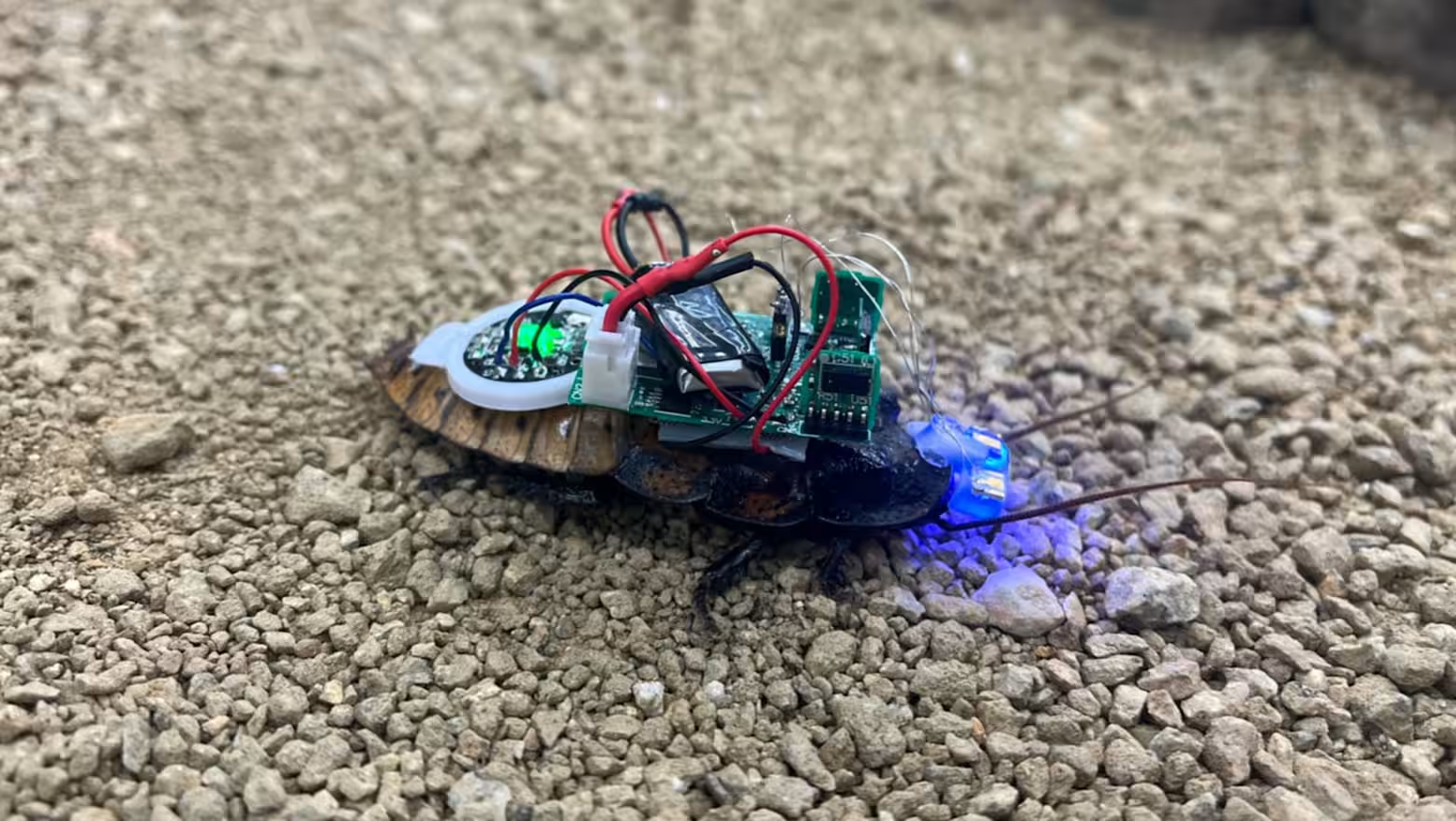
An insect is equipped with an insect collaborative circuit developed by Professor Keisuke Okamoto’s team.
Traditional "cyberinsects" are usually directly controlled by outsiders. After installing electrodes, sensors and communication equipment on the insect, the operator can remotely change its movement direction and collect on-site information, allowing it to enter narrow spaces that are difficult for humans and conventional robots to reach.
An international research team led by Keisuke Morishima, a professor at Osaka University in Japan, has developed an "insect cooperative loop" in the hope of reducing reliance on artificial control. The researchers installed backpack equipment on cockroaches to measure heartbeats, nerve signals and body movements. AI then analyzed these data to determine what environment the cockroaches might be in, and guided their actions based on the insect's own movement responses.
The research team put the cockroaches equipped with this system into five different environments, including ultraviolet radiation, chemical exposure and high temperature environment. The best-performing AI model achieved a recognition accuracy of 93%, and the researchers also successfully guided cockroaches to escape from the maze. Relevant results were published in the "Robomech Journal" in May this year.
This technology is targeted at disaster sites such as earthquakes and fires. There may be toxic gases or high-temperature areas in collapsed buildings. Cockroaches can sense and avoid danger through their own reactions after entering. Keisuke Morishima said that the team hopes to study whether the internal state information of organisms can be used to detect and judge the external environment.
Insect search and rescue has entered the testing stage in actual disaster areas. The cyberinsects developed by Professor Hirotaka Sato of Nanyang Technological University in Singapore and others were put into testing after the March 2025 earthquake in Myanmar. They are able to enter tight spaces blocked by rubble, but are of limited use in areas with standing water.
To solve this problem, a team composed of Hirotaka Sato and researchers from Waseda University in Japan developed a device that can directly supply oxygen to insects. The insects in the experiment can stay underwater for up to three hours. Relevant research was published in the June 2026 issue of "Nature Communications". Researchers believe that by continuing to improve the oxygen supply system, the time insects can work underwater can be extended.
Onsite deployment also exposes communication limitations. After cyber insects enter reinforced concrete buildings, signals tend to become unstable. Sato Hirotaka said the team is continuing to improve the system based on issues discovered through field testing.
In addition to directly modifying living insects, a team led by Daigo Teruzuki, associate professor at Shinshu University in Japan, also installed silk moth antennae on drones to be used as odor sensors. Silk moth antennae can detect very small amounts of pheromones released by female moths, and their sensitivity is thought to be higher than that of semiconductor sensors.
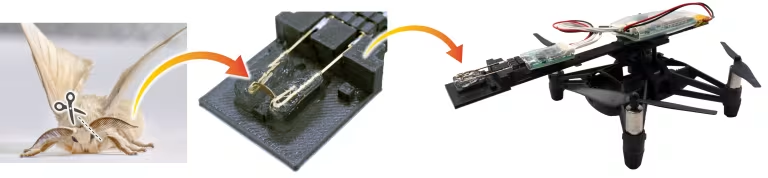
The antennae of a silkworm moth were fixed to gel electrodes and mounted on a drone as an odor detection sensor.
The researchers used gel electrodes to read the electrical signals produced when the antennae sense odors. The sensor equipped with the gel electrode can still maintain more than 90% of its peak performance after working for more than 7 hours. The performance of previously used metal electrodes dropped by more than half within three to four hours.
Daigo Teruzuki said that this technology can extend the working life of the antenna sensor and is expected to be used in other insects. The team is currently working on mosquito antennae that respond to human odor and plans to install them on drones within the next two to three years for use in searching for people.
Comments