
Abstract:
Qualcomm has announced some technical details of the next-generation Adreno GPU installed on the next-generation Snapdragon top mobile platform.
On the basis of continuing the three-slice architecture, the new GPU further increases the operating frequency, and introduces for the first time on-chip high-performance cache, Matrix Cores dedicated AI computing unit and Adreno Neural Fusion architecture, aiming to optimize sustained graphics performance and power consumption efficiency from the architectural level.
The new generation of Adreno GPU continues to use a three-slice architecture design, and the operating frequency of each slice is increased by 250MHz compared with the previous generation, from 1.2GHz to 1.45GHz.
Qualcomm said that this generation of GPU has undergone major adjustments at the architectural level, focusing on improving sustained graphics performance and power consumption efficiency. Complete performance data will be announced later.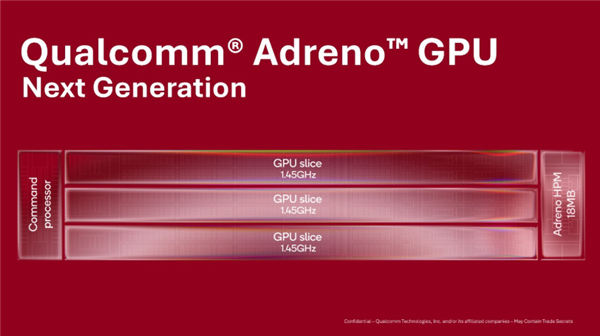
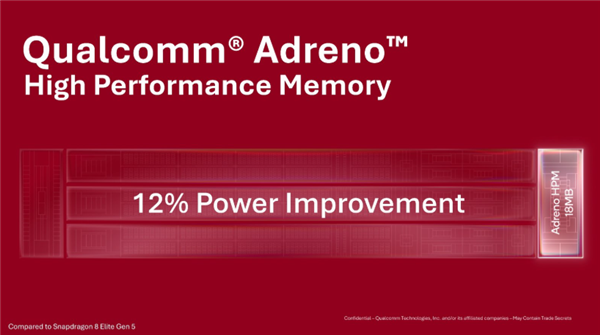
In order to reduce the GPU's frequent access to system memory, the new platform is equipped with 18MB Adreno High Performance Memory (HPM).
This is a high-speed storage space located inside the chip specifically for graphics processing and can be used as a configurable graphics workspace.
During the rendering process, Adreno HPM can save the Render Target, depth and color buffers, textures and other intermediate data generated in previous rendering stages.
Developers can flexibly call on-chip storage according to different graphics loads, thereby reducing the delay and power consumption caused by repeated data transfer to the system DDR memory. Data released by Qualcomm shows that this design can bring about a 12% improvement in power consumption performance.
The new generation of Adreno GPU introduces Qualcomm Matrix Cores for AI computing for the first time. This type of dedicated computing unit can run AI models directly within the GPU graphics pipeline, enabling matrix acceleration capabilities to cover major computing units such as CPU, NPU, and GPU, while reducing the migration overhead of neural network tasks between different processing units.
Based on Matrix Cores, Qualcomm further launched Adreno Neural Fusion technology to more directly integrate AI computing into the graphics rendering process.
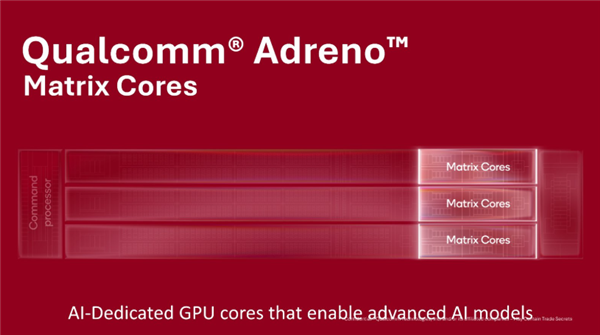
This technology is mainly aimed at scenarios such as neural rendering, AI super-resolution and frame generation. It uses the AI computing power inside the GPU to improve image quality and rendering efficiency, while maintaining high graphics performance while reducing power consumption and enhancing continuous operation capabilities.
Among them, AI super-resolution will become one of the first key capabilities of Adreno Neural Fusion.
Qualcomm said that this solution has been supported by mainstream game engines such as Unity and Unreal Engine, and developers can directly integrate and deploy it. The first batch of games that support this technology are expected to be commercialized this year.

Currently, the specific model, complete operating frequency, graphics performance improvement and the first list of games supported by Neural Fusion of the new generation Adreno GPU have yet to be further announced.
Comments