
Abstract:
In a quiet neighborhood in Bellevue, Washington, the basement of Gary Fleck's modern home is decorated like a fully functional men's leisure space: a comfortable sofa is placed among the large-screen monitor and digital projector, and there is also a spinning and rowing machine. But the real highlight of this room is a custom-made host that looks like a giant assembled model, with seven Nvidia high-performance graphics cards hanging on the rack.
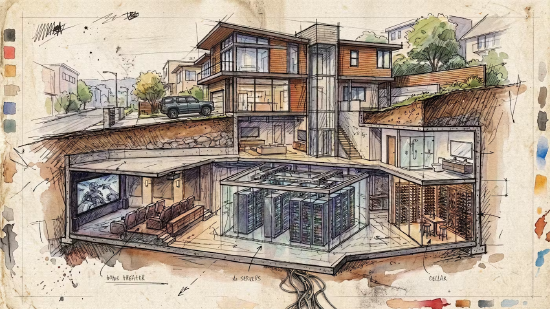
Technology enthusiasts assemble a high-performance AI host at home, and what follows is a thorny heat dissipation problem
Flake previously worked at Microsoft and is also the founder of several start-up companies. He built the machine to train custom AI models based on terabytes of electroencephalogram data, which records electrical signals in the brain, as part of a startup he no longer pursues.
To train the AI model, he could have rented industrial-grade GPU computing power in the data center from a cloud service provider. But he said it's much more cost-effective to install it yourself with discounted components. The total cost of the entire equipment is less than $6,000, which is far less than paying a monthly fee to Amazon Cloud or Microsoft Cloud.
Even if you include the cost of electrical modifications and a new HVAC system (a total of US$1-20,000) to dissipate heat in the basement and offset the huge heat generated by the AI host, it is still cost-effective to install it yourself. "I want the computing power in my own hands," said Flake, who plans to reuse the machine in the coming months to start new projects. "I don't want to rent other people's computing power."
Running AI workloads locally in attics, basements, and home offices has become an unexpected phenomenon in this round of AI craze. Major major AI companies train and run large models in large remote data centers filled with tens of thousands of GPUs to meet the demand for massive computing power.
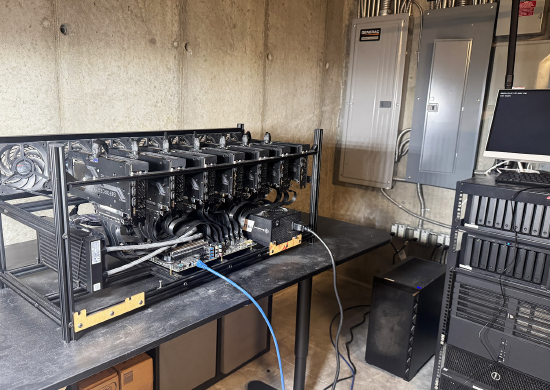
GPU equipment at Gary Fleck's home
At the same time, there is a
wave of local AI
is emerging. A large number of small developers and hardware enthusiasts choose to run AI on their home devices due to cost, privacy, and ease of use. Some developers who believe in the concept of freedom believe that local AI can avoid future government restrictions and cut off their permission to use AI technology. Local agent platforms such as OpenClaw can directly call native applications and local files to complete complex tasks, which has also contributed to this trend.Sometimes, home AI devices are simply cool home features. Last month, Shopify CEO Toby Lütke went viral on social platforms after showing off three sets of vertical server cabinets in his home. The cabinets were wrapped with pink LED light strips. The equipment includes a Dell host equipped with Nvidia's high-end graphics card, which the manufacturer calls the "ultimate desktop supercomputer." Luedtke also cleverly solved the problem of equipment heat dissipation.
The rise of home AI consoles is an unexpected benefit to hardware manufacturers. Mac mini and Mac Studio are very popular among smartphone developers, and sales are rising; Dell also said that the market for home AI enthusiasts is experiencing explosive growth.
Mark Hammons, senior distinguished engineer at Dell, said: "This is the trend of the times. After the advent of OpenClaw this year, the demand for related hardware has skyrocketed."
Placing high-performance hosts at home is nothing new, and "homelab" enthusiast communities have already flourished on platforms such as Discord and Reddit. At the beginning of the 21st century, audiophiles built servers at home, mounted massive hard drives, and stored downloaded MP3 music and videos. Later, the cryptocurrency mining boom drove demand for high-performance GPUs for home use.
Hitten Shah was a cryptocurrency player back then. In 2020, he installed eight GPUs on the server rack at home to mine Ethereum. Today, Shah, CEO of the software startup Crazy Egg, has turned to AI development and greatly expanded the computing power armament at his home in Redwood Shores, California, to a total of 18 devices, including 14 Mac minis and Mac Studio.
Shah said that local computing power allows him to control the performance of the website optimization software he developed. It is normal for large cloud models to experience frequent downtime and lag. "Whenever a large model is updated in the cloud, the system will be unstable for several days and failures will occur frequently."
But the price is that the living comfort is greatly reduced. All the computing equipment is placed in his home office, and the heat dissipated by the machines often causes the indoor temperature to soar to 85 degrees Fahrenheit (about 29.4 degrees Celsius). He often can only stay in the room wearing shorts. "I should install an air conditioner," Shah said.
Many local AI enthusiasts have become internet celebrities in the industry. An Austin-based YouTuber who requested anonymity and only goes by the channel name Digital Spaceport. He built what he calls a "home data center" in his garage. The hardware includes five AMD graphics cards, plus a large number of network and storage devices. Currently, he is running the large domestic open source model Tongyi Qianwen Qwen-3.8-27B on this machine to edit and analyze his own YouTube videos.
Another Polish tech consultant and YouTuber, also anonymous, uses the channel ID 0xSero. As he bought more and more hardware, he had to move the AI host around his home. Four NVIDIA 6000 graphics cards were originally placed in his home office, but they made a lot of noise, generated extremely high heat, and dried out the air in the room. He believed this was the cause of his illness last year. So the whole set was moved to the attic.
0xSero was the first to use cloud AI models. The turning point came at the end of 2024: the price of the AI programming tool Cursor increased. "At that moment I made up my mind to develop local AI."
He insists on a point of view: the ownership and control of AI systems should be in the hands of users. In the future, there may be government control and restrictions on AI access rights. “I really love AI and I want to continue to have the right to use it.”
Comments