
Abstract:
When an extreme astronomical event occurs in the universe in which two black holes collide and merge, the newly formed, larger black hole will tremble like a struck brass bell or a plucked guitar string, and release gravitational wave ripples as it gradually levels off. For a long time, the astronomical community has been limited by observation and analysis methods, and can often only capture the loudest main tone, while the weak reverberations that follow it are hidden in the noise.
Recently, a research team from the University of Cambridge in the UK published their latest results in Physical Review Letters. They developed a new technology that can identify and catalog the "ringing" characteristics of black hole mergers with high precision, opening up a new way to test Einstein's general theory of relativity in the most extreme gravitational environment in the universe.
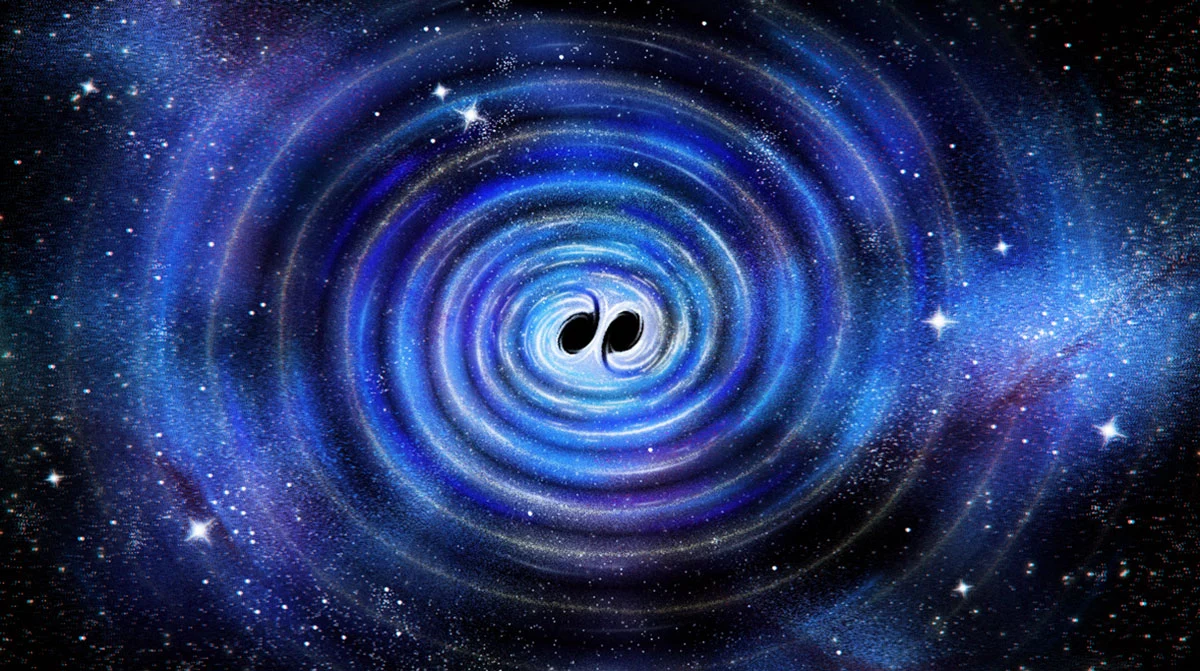
In physics, the characteristic vibrations emitted by black holes in the "Ringdown" stage after collision are called "Quasinormal Modes". These tremor frequencies are determined entirely by the new black hole's mass and spin, equivalent to the black hole's unique "gravitational wave fingerprint." By accurately measuring these patterns, scientists can not only reconstruct the basic properties of the merged black holes, but also verify the applicability of Einstein's theory under the limit of strong gravitational fields. However, in addition to fundamental frequency vibrations, many rapidly attenuating and weaker harmonics have been extremely difficult to directly identify, and academic circles have long disagreed on the existence time and specific composition of these modes.
In order to overcome this problem, the first author Richard Dyer from the Institute of Astronomy at the University of Cambridge and his collaborator Dr. Christopher Moore built a systematic data-driven analysis framework based on Bayesian statistical analysis. This method systematically evaluates various types of data evidence to determine the most reasonable physically plausible explanation for the observed signal. The research team applied this technology to a highly precise public data set of numerical simulations of black hole mergers. At the theoretical boundary that can clearly measure gravitational waves, they successfully conducted a comprehensive investigation of various black hole collision modes under different mass ratios and spin configurations.
The analysis results show that this method not only successfully extracted the fundamental frequency of black hole ringing and the rapidly disappearing "overtones" (Overtones), but also keenly captured the "nonlinear mode" that was previously difficult to find. This mode is a composite vibration produced by the interaction of two or more fundamental frequencies. The physical effect is similar to the complex overtones played by an electric guitar under heavy distortion.
The research team pointed out that the bell-fall stage is one of the most powerful windows for humans to directly detect the nature of black holes. This new technology not only provides a clear theoretical benchmark for resolving long-standing controversies in pattern recognition, but will also significantly improve the data interpretation capabilities of existing gravitational wave detectors (such as LIGO and Virgo) and next-generation space and ground-based observatories (such as the European Einstein Telescope and the LISA mission). By identifying the precise waveform frequencies that should be searched for in different collision scenarios, physicists will be able to test at a more demanding scale of accuracy whether the merger products strictly follow the predictions of the equations of general relativity.
Comments