
Abstract:
A number of scientific research teams in Austria have recently proposed and are verifying a breakthrough technical solution: by directly integrating a small ion trap quantum computer into an electron microscope, the quantum entanglement effect is used to fully extract the quantum information carried by the electrons, thereby significantly reducing radiation damage to fragile samples while significantly improving the clarity of microscopic imaging.
This project, jointly carried out by the Technical University of Vienna, the University of Vienna, the Johann Kepler University Linz and the University of Innsbruck, is expected to completely break the imaging difficulties faced by traditional electron microscopes when observing fragile samples such as biological macromolecules.
In conventional electron microscopy imaging, researchers often face irreconcilable contradictions. Obtaining clear images with high contrast and low noise often requires increasing the electron dose penetrating the sample, but this can easily damage extremely sensitive biological materials such as protein molecules. If the amount of electron bombardment is deliberately reduced in order to protect the sample, the weak imaging signal will easily be overwhelmed by random noise. Traditional microscopes only treat electrons as counting particles hitting a detector, directly discarding the large amount of additional quantum information carried by the electrons themselves.
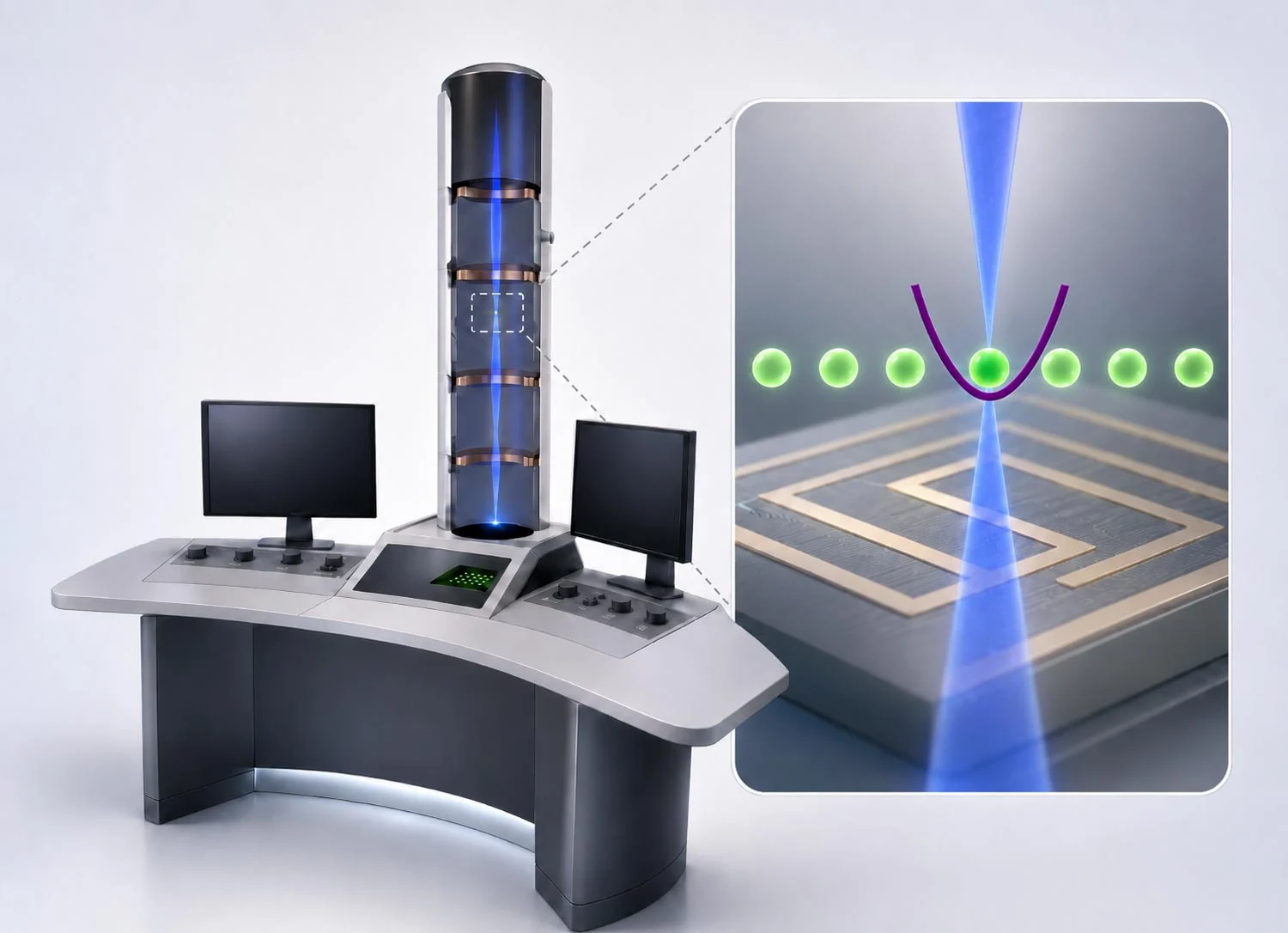
In order to solve this physical limitation, the research team designed a new quantum coupling mechanism. When the electron beam passes through the microscope and travels in the optical path, the researchers guide them to have a controlled interaction with the ions that have been captured and fixed in advance, so that the electrons penetrating the sample are quantum entangled with the ion trap quantum computer, and the sample state information carried by the electrons is completely preserved in the ions. When subsequent electrons pass through one after another and become entangled with the system again, the quantum computer will execute specially designed algorithm operations to optimally combine the quantum information from multiple electrons, converting the weak signals that were originally unrecognizable under classical statistical measurements into effective images with high contrast, thereby breaking through the statistical limits of traditional electron microscopes at the mathematical and physical levels.
The theoretical advantages of this scheme have previously been confirmed through rigorous mathematical proofs. Currently, the research team is constructing and experimentally verifying the first prototype system at the University Service Center for Transmission Electron Microscopy at the Technical University of Vienna, precisely integrating the ion-based quantum computer hardware developed by the University of Innsbruck with the transmission electron microscope entity. If subsequent experimental verification meets theoretical expectations, this fusion technology will make it possible to observe the fine structure of single fragile proteins and biological samples in a non-destructive state, opening up a new microscopic observation path for structural biology and nanomaterial science.
Comments