
Abstract:
When the catastrophic eruption of Mount Vesuvius in AD 79 engulfed Pompeii, it also buried a luxurious villa in the neighboring ancient city of Herculaneum and its numerous ancient scrolls underground. These papyrus scrolls, which have been carbonized by volcanic ash and high heat and sealed underground for nearly two thousand years, are extremely fragile. Any attempt to physically peel and flatten them will cause them to instantly turn to ashes.
Now, a joint team of scientists and computer experts from many countries is using cutting-edge non-destructive imaging technology and artificial intelligence algorithms to gradually decipher the internal texts of these scrolls, hoping to re-read these long-lost ancient Greek and Roman documents without damaging the cultural relics.
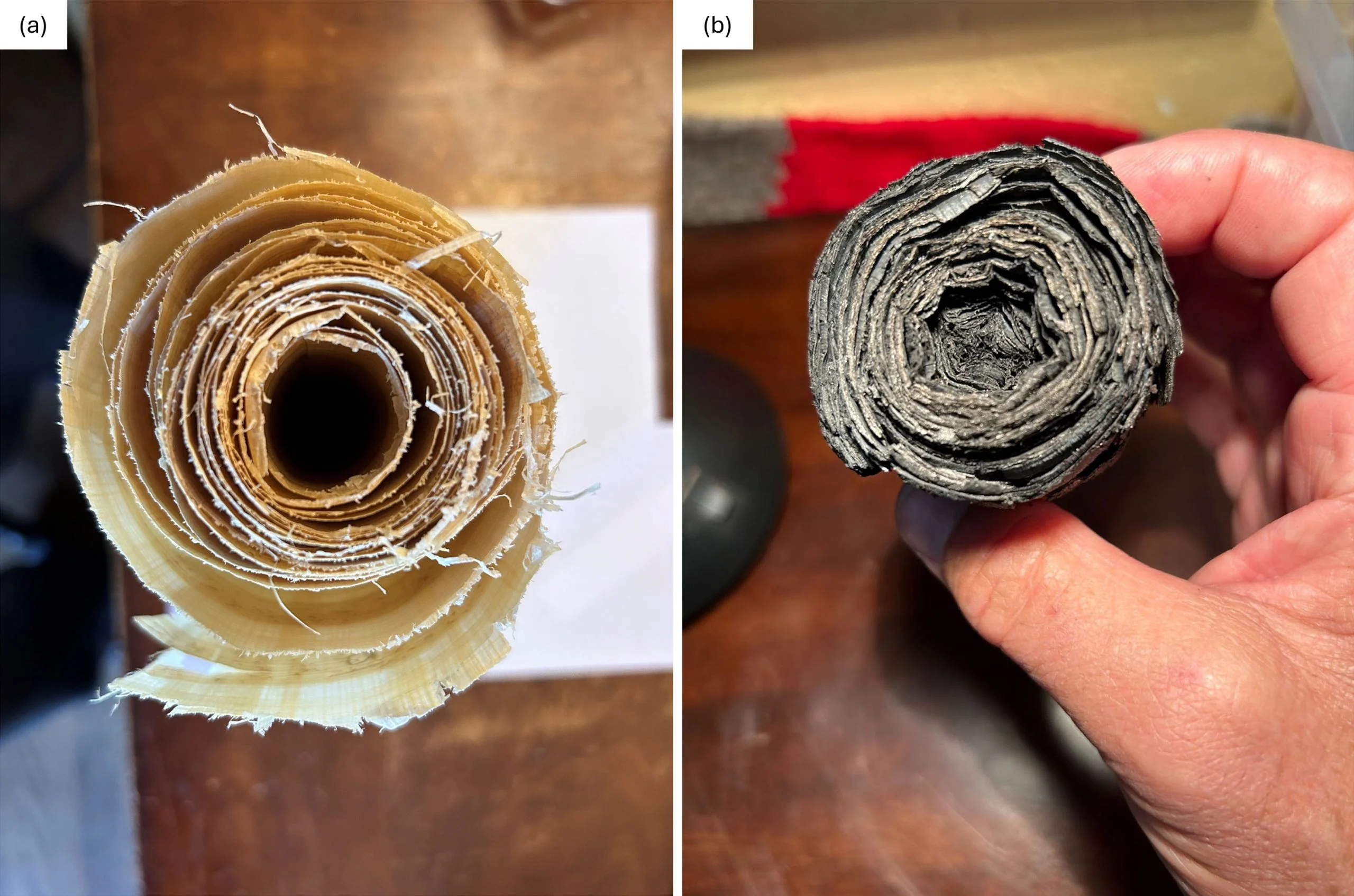
These precious carbonized scrolls were discovered by archaeologists in the 18th century and are the only complete remains of a private library from the ancient classical era that have survived to this day. Since the interior of the scroll is stacked and adhered after being carbonized by heat, and the ink component is mostly carbon black, which is almost indistinguishable in density from the carbonized papyrus base, it is extremely difficult to distinguish the text tracks in it using traditional X-ray imaging. In order to overcome this century-old problem in the fields of materials science and history, the scientific research team used high-energy X-rays emitted by the Synchrotron to conduct high-resolution 3D scanning, and established a complex morphological three-dimensional model inside the scroll through tiny differences in structural density.
Based on obtaining high-precision scanning data, the research team introduced computer vision and machine learning technology. With the help of a specially developed dotted line layering algorithm, AI can automatically identify and draw the heavily curled and folded papyrus layers inside the scroll, and unfold them flatly in virtual space. The deep learning model was then used to identify the extremely small physical deposition traces left by the ink on the papyrus fibers, and then render and present the letters and phrases originally hidden deep in the airtight carbonized structure one by one.
Recently announced deciphering results show that researchers have successfully read several unpublished treatises involving the philosophical thoughts of the Epicurean school of ancient Greece, reawakening this text memory that had been sealed in volcanic ash for two thousand years. Academics generally believe that with the continuous improvement of virtual unfolding technology and artificial intelligence recognition accuracy, this project will not only completely unlock hundreds of unread scrolls in the Herculaneum Library, but may also bring revolutionary new discoveries to the study of classical literature, philosophy and ancient history, and reshape mankind's understanding of ancient Mediterranean civilization.
Comments