
Abstract:
For a long time, the scientific community has generally believed that comets brought key chemical raw materials needed for the formation of life to the Earth, creating conditions for the birth of early life. However, a new study led by the University of Cambridge in the UK has challenged this classic theory. Researchers have found through advanced computer simulations that the likelihood of a comet successfully delivering life precursor molecules to the Earth's surface is far lower than previously thought, and can even be said to be extremely rare.

Comets are rich in organic compounds composed of carbon, nitrogen and other elements, including important prebiotic molecules such as hydrogen cyanide (HCN). Hydrogen cyanide is thought to be involved in a series of chemical reactions that ultimately form the building blocks of life. Therefore, for nearly a century, comets have been regarded as important carriers for the "transport" of the chemical raw materials of life across the solar system.
The first author of the study, Dr. Richard Anslow of the Institute of Astronomy at the University of Cambridge, said that in the past, scientists believed that comets carried large amounts of carbon- and nitrogen-containing molecules, like large "space snowballs" that directly delivered the raw materials for life to young planets. This idea was very attractive, but the latest research results show that this scenario is extremely unlikely to happen.
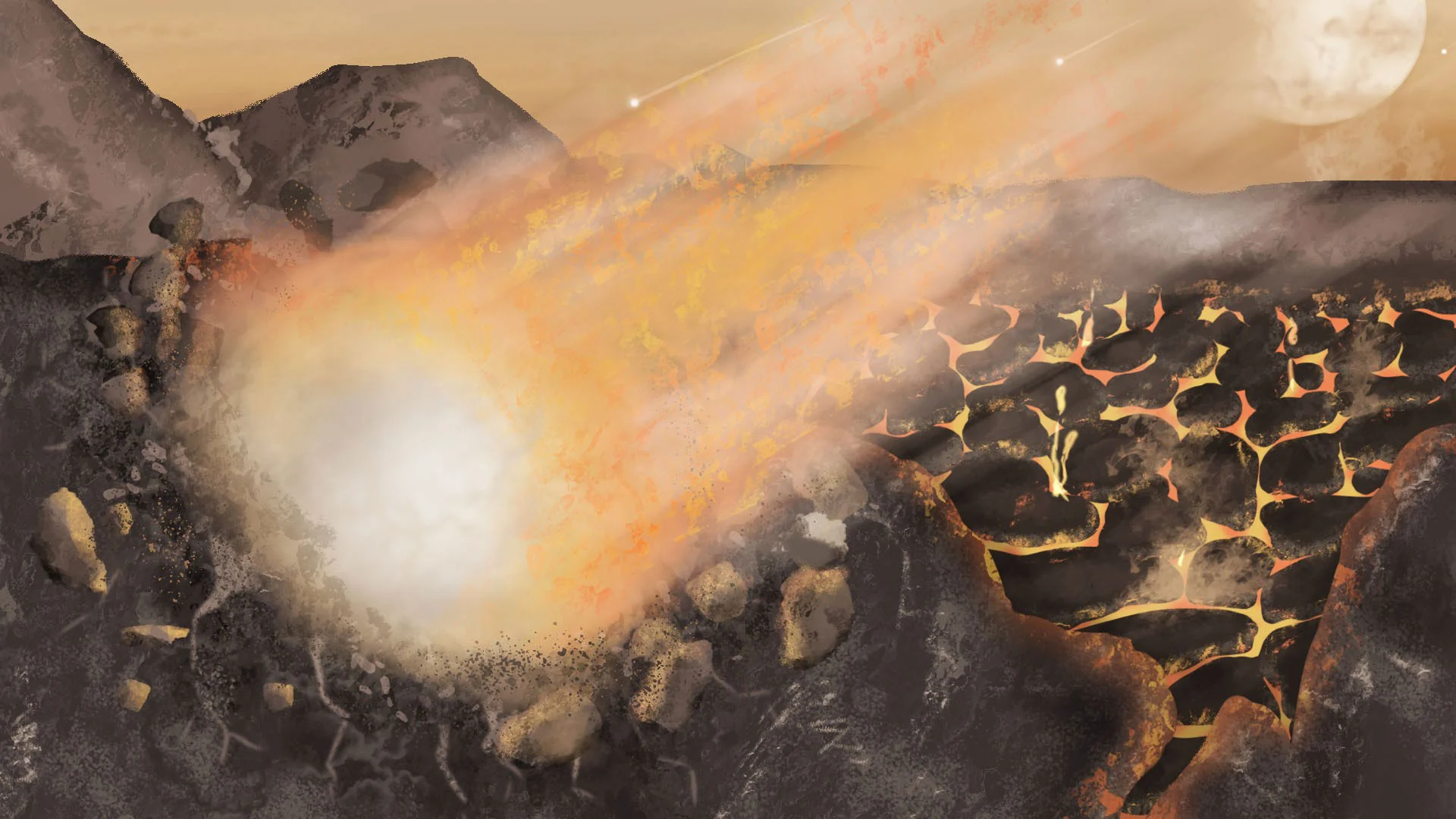
The problem lies mainly in the comet impact process itself. The team's simulations show that most comets enter Earth at extremely high speeds and at less-than-ideal impact angles. Under such violent collision conditions, almost all the fragile organic molecules carried would be completely destroyed by high temperatures and shock waves, and would not be able to reach the surface intact.
The researchers conducted a systematic test of this long-standing hypothesis by combining the latest comet impact simulations, comet-atmosphere interaction models, and studies on comet origin and evolution dynamics. The results show that although the possibility of some molecules surviving and successfully reaching Earth cannot be completely ruled out in theory, such a situation can only be regarded as an extremely rare event.
Anslow and his collaborators have previously proposed the idea that in planetary systems where the planets are relatively close to each other, comets may gradually reduce their speed by repeatedly passing and "bounce" between multiple planets, thereby more safely transporting organic material. This study further explores whether this mechanism may have occurred in the history of the solar system. However, the results show that even under the most favorable conditions, this situation is still very rare.
The study paid special attention to the key molecule hydrogen cyanide. Simulations found that the conditions required for a comet carrying hydrogen cyanide to hit Earth at just the right speed and angle, while allowing the molecules to survive the impact, are extremely demanding.
The research team believes that if the raw materials for the origin of life really come from comets, then this is more likely to be an extremely accidental "one-in-a-million event" rather than a stable supply process that has continued to come to the earth for millions of years. Anslow pointed out that to realize this process, not only the collision parameters need to be completely suitable, but also the subsequent chemical reactions need to unfold quickly and reach sufficient concentration to ultimately promote the origin of life.
In addition to Earth, researchers also examined conditions on Mars. The results show that compared with Earth, Mars has a relatively weak destructive effect on organic molecules due to its lower gravity. Therefore, theoretically, the success probability of comets transporting prebiotic molecules to Mars may be slightly higher.
However, researchers emphasize that even Mars has a very limited possibility of successfully receiving the chemical raw materials for life. Anslow said that this does not mean that life must have obtained the raw materials delivered by comets on Mars, but if this process is extremely rare on Earth, then the probability of it happening on Mars may be slightly higher, but it is also far from common.
As the theory of comets seeding life is challenged, scientists are beginning to re-examine other possibilities. One view is that key molecules required for the formation of life may have been formed directly on the young Earth itself; another view is that asteroid impacts may be the truly important source. Asteroid impacts occur more frequently and may be less damaging to organic molecules than high-velocity comets.
The researchers said that this result does not completely deny the role of comets in the origin of life, but it shows that comets are not the main channel for continuously delivering the raw materials of life to the earth as thought in the past. This research, published in Scientific Reports, is pushing the scientific community to rethink a core question that has existed for nearly a century: where did the first chemical materials for life on earth come from.
Comments