
Abstract:
The latest statistics recently released by the well-known hardware detection tool CPU-Z show that the proportion of 16GB system memory configurations in the user group is expanding again, while the 32GB and 64GB configurations that have continued to grow in recent years have declined to varying degrees. This change reflects the new adjustments taking place in the PC market in terms of hardware upgrade strategies.
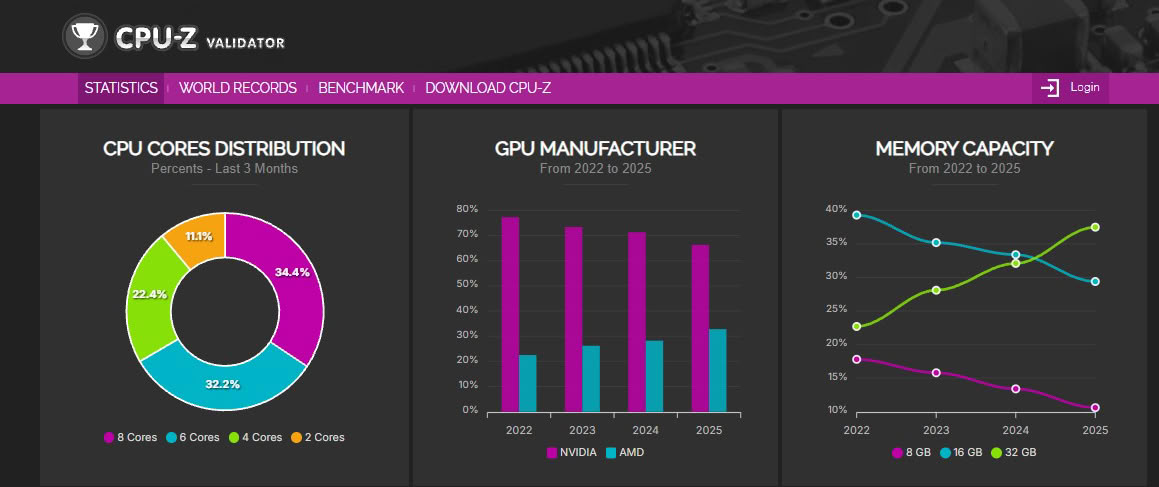
According to data collected by CPU-Z, 16GB memory is still the most mainstream capacity choice, and its market share has further increased in recent times. At the same time, the user share of 32GB memory, which was originally regarded as a high-performance mainstream configuration, has declined; the share of larger capacity configurations such as 64GB has also decreased.
Analysts believe that memory prices have continued to fluctuate in recent years, and many users' daily application needs can be met by 16GB capacity, making more consumers choose more cost-effective solutions when upgrading their computers. For web browsing, office software, multimedia playback, and most mainstream games, 16GB of memory can still provide a smoother experience.
At the same time, as the prices of new generation processors and graphics cards remain at a high level, many installed users prioritize their budgets on hardware such as CPUs and GPUs instead of continuing to increase system memory capacity. For many gamers, upgrading to a stronger graphics card can often bring more significant performance improvements than upgrading from 16GB to 32GB of memory.
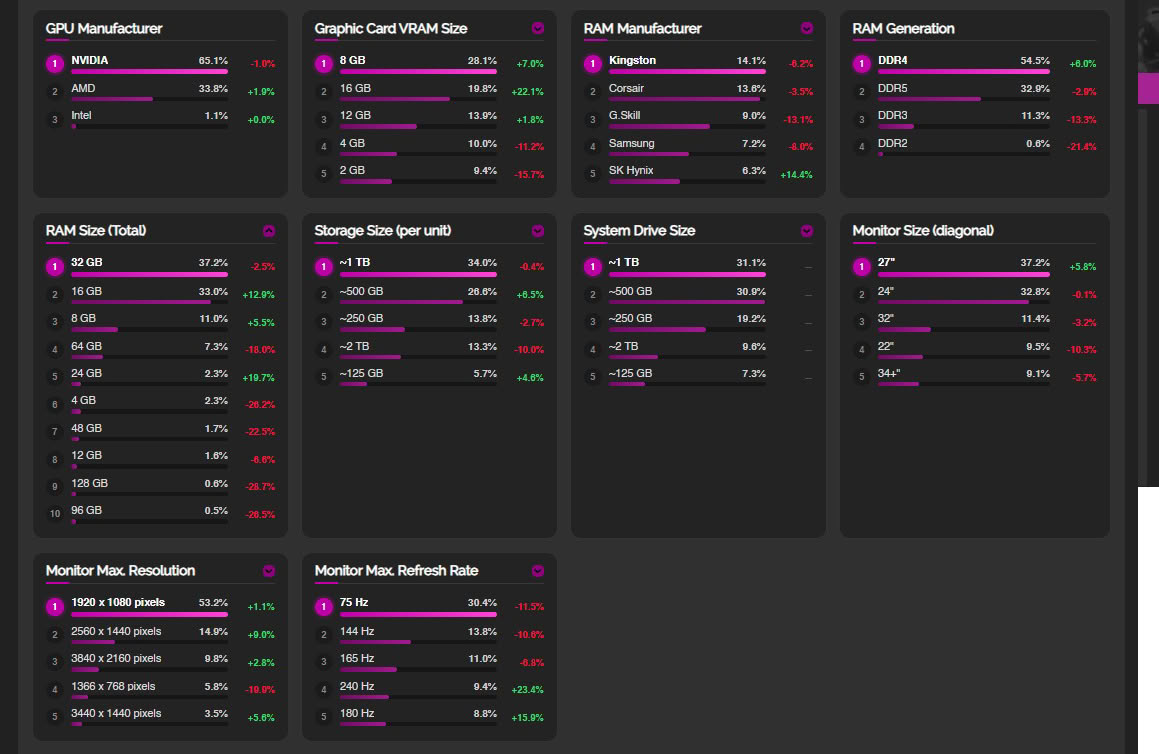
Statistics also show that the popularity of DDR5 memory continues to advance. As AMD and Intel's new platforms fully shift to the DDR5 ecosystem, more and more new installed users are beginning to adopt DDR5 products. However, since a large number of active computers still use the DDR4 platform, DDR4 still maintains a considerable user base.
In the processor market, AMD has continued to expand its influence in recent years, especially in the desktop platform field. At the same time, Intel still maintains a huge installed base, and the competition between the two manufacturers is still very fierce. The trends reflected in the CPU-Z database also show the changes in user choices in the current PC hardware market.
It is worth noting that CPU-Z statistics come from user groups who actively run and submit hardware information, so they are not completely equivalent to the true proportion of the entire global PC market. However, due to the large sample size, it has long been regarded by the industry as one of the important reference indicators for observing hardware development trends.
Judging from this statistical result, although artificial intelligence applications, content creation, and large-scale games continue to increase system resource requirements, for the vast majority of ordinary consumers, 16GB of memory is still considered a more balanced choice between performance and cost. Although capacity configurations of 32GB and above are still popular among enthusiasts, professional creators, and heavy multitasking users, their growth momentum has slowed down compared to before.
Comments