
Abstract:
Google officially launches Gemini 4 Neon, a new member of the Gemini 4 series. This model is positioned for complex programming, analytical reasoning, and multi-step task execution, trying to strike a balance between high levels of intelligence and operational efficiency. Google says that in early testing, the Neon's overall quality meets or exceeds the flagship model Gemini 4 Carbon, but tasks are performed three times faster and the same task costs only 60% of the Carbon.
Previously, Google has launched Gemini 4 Carbon and Gemini 4 Hydrogen for daily tasks. Carbon is mainly aimed at complex, long-term and difficult tasks, while Hydrogen emphasizes quick response and daily use. The Neon launched this time fills the positioning gap between the two, focusing on serving work scenarios that require strong reasoning capabilities but are sensitive to execution speed and cost.
Gemini 4 Neon scored 61 points in the Artificial Analysis Intelligence Index evaluation, ranking third when turning on the highest level xhigh thinking mode, second only to some larger and slower models. In the Vals Index review, it ranked second with a score of 70.9%. In addition, Google also stated that Neon has outstanding performance in multi-step instruction execution, complex constraint processing, and adaptability when users modify task requirements midway.
In the field of software development, Neon places particular emphasis on long-running intelligent agent workflows. It handles code debugging, refactoring, and project modifications across multiple files and reduces repeated file reads during execution while continuously reporting task progress. Google hopes that through these improvements, the model can not only generate code, but also complete complex work independently in an environment closer to real software development.
In the test results announced by Google, Neon scored 58.6 points on the Artificial Analysis Coding Agent Index, Terminal-Bench 4.1 scored 65.2%, and FrontierCode 2.0 scored 46.2%. In the SWE-sweep test, the score was 12.8% when using the mini-SWE test framework, which increased to 39.0% in the GoogleAntigravity environment. This set of differences also shows that the software framework and execution environment used by intelligent agents may have a considerable impact on the final results.
Neon can also act as a coordinator in Antigravity, splitting complex tasks and handing them over to multiple Gemini 4 Hydrogen sub-agents for parallel execution. In this way, the model can process different code modules or work steps simultaneously, and then integrate the results of each sub-agent. For development tasks involving multiple files and multiple functional modules, this collaborative approach is expected to reduce the overall execution time.
In terms of enterprise knowledge work, Neon supports multi-modal input such as text, images, audio and video, and the unified context window can support up to 1 million Tokens. Users can put spreadsheets, PDFs, charts, audio, video and other materials into the same task, allowing the model to comprehensively analyze and generate structured results.
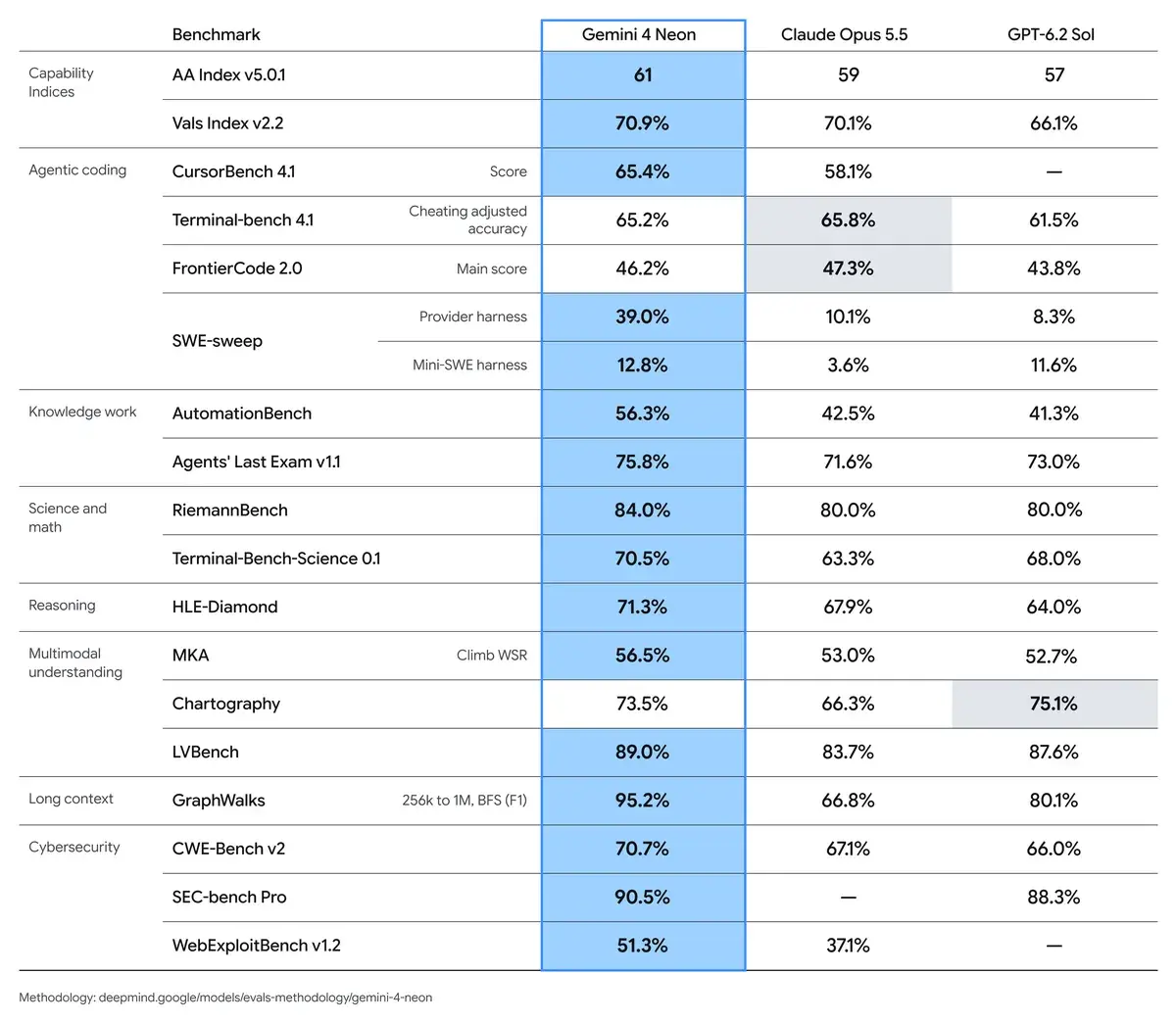
Test data released by Google shows that Neon achieved a score of 70.9% on the Vals Index, ranking first in both the legal research and tax agency tests. In the Zapier AutomationBench automated task test, it scored 56.3%; in Andon Labs' Vending-Bench 2 long-term business simulation, the simulated revenue reached $16,843. Additionally, it scored 73.5% on the Chartography professional chart comprehension test and 75.8% on the Agents' Last Exam v1.1 test.
Scientific and mathematical reasoning are also the abilities that Neon focuses on strengthening. In the Terminal-Bench Science test, it achieved 70.5%; in the RiemannBench math test, it achieved 84.0%; in the HLE-Diamond test, it achieved 71.3%. These results reflect Google's desire to position Neon as a general model not only suitable for programming, but also capable of undertaking complex scientific research, mathematical analysis and technical research tasks.
Cybersecurity is another focus of this release. Google has launched a dedicated version of Gemini 4 Neon for network security work, mainly used for secure code generation, vulnerability discovery, penetration testing verification and code repair. In the AutoBaxBench test, this version achieved a score of 76% on difficult projects; in the WebExploitBench v1.2 test it achieved 51.26%. In the SEC-bench Pro vulnerability discovery test, the score was 90.5%, and in the CWE-bench v2 code hardening test, it reached 70.7%.
Google stated that while Neon has improved its network security capabilities, it still retains severe abuse protection capabilities comparable to Carbon, and has further improved the model's resistance to malicious prompt injection. The network security-specific version will be made available to qualified security defenders in phases through the Fairwind program.
In terms of security and reliability, Google particularly emphasizes Neon’s behavior control when performing long-term, multi-step tasks. The company says the model can better follow user instructions and reduce problems such as fictitious results, unauthorized expansion of task scope and taking shortcuts that do not meet requirements. In internal tests, some of Neon's behavioral indicators were better than those of previous Carbon, but these data mainly come from Google's own evaluation system and still require more independent testing to verify.
In terms of price, the standard price offered by Gemini 4 Neon through the Gemini API is US$3 per million input tokens, US$0.15 per million cached input tokens, and US$15 per million output tokens. In comparison, Carbon’s current promotional price is $2 per million input tokens and $10 per million output tokens, but this offer is expected to last until November 30. Starting from December 1, Carbon's standard price will be adjusted to US$4 per million input tokens and US$20 per million output tokens. At that time, Neon's single token price will be 25% lower than Carbon.
However, simply comparing Token prices does not fully reflect the actual cost of use. Google emphasized that Neon can complete tasks faster and reduce the token consumption to complete the same work, so it has a lower single-task cost under actual workloads. According to data released by Google, in the default High thinking mode, Neon’s cost of completing tasks is 32% lower than Carbon; in higher xhigh mode, Neon still has a cost advantage, but the specific extent will be affected by task type and model configuration.
Gemini 4 Neon is now gradually opening up. Developers can use it through paid services of Google AI Studio and Gemini API, and enterprise customers can access it through Gemini for Business and Antigravity. On the consumer side, Google AI Pro and Ultra subscribers can choose Neon in the Gemini app, and Pro and Ultra users can also experience it in Antigravity.
In general, Neon is not simply pursuing larger model size or higher single test scores, but trying to solve a more important problem in actual use: how to make models with flagship reasoning capabilities complete real work at faster speeds and at lower costs. For users who need to frequently call AI agents, process large code bases, or perform complex office tasks, task completion efficiency may be of more practical significance than pure model parameters and benchmark rankings.
Comments