
Abstract:
Google security researcher James Forshaw recently complained about Microsoft's security vulnerabilities on social media. Forshaw said that he had discovered a ridiculously stupid UAC user account control bypass method. Forshaw satirized that the exploited component seemed to be the product of AI coding. However, Forshaw has not announced the specific affected components, vulnerability exploitation methods and specific affected versions.
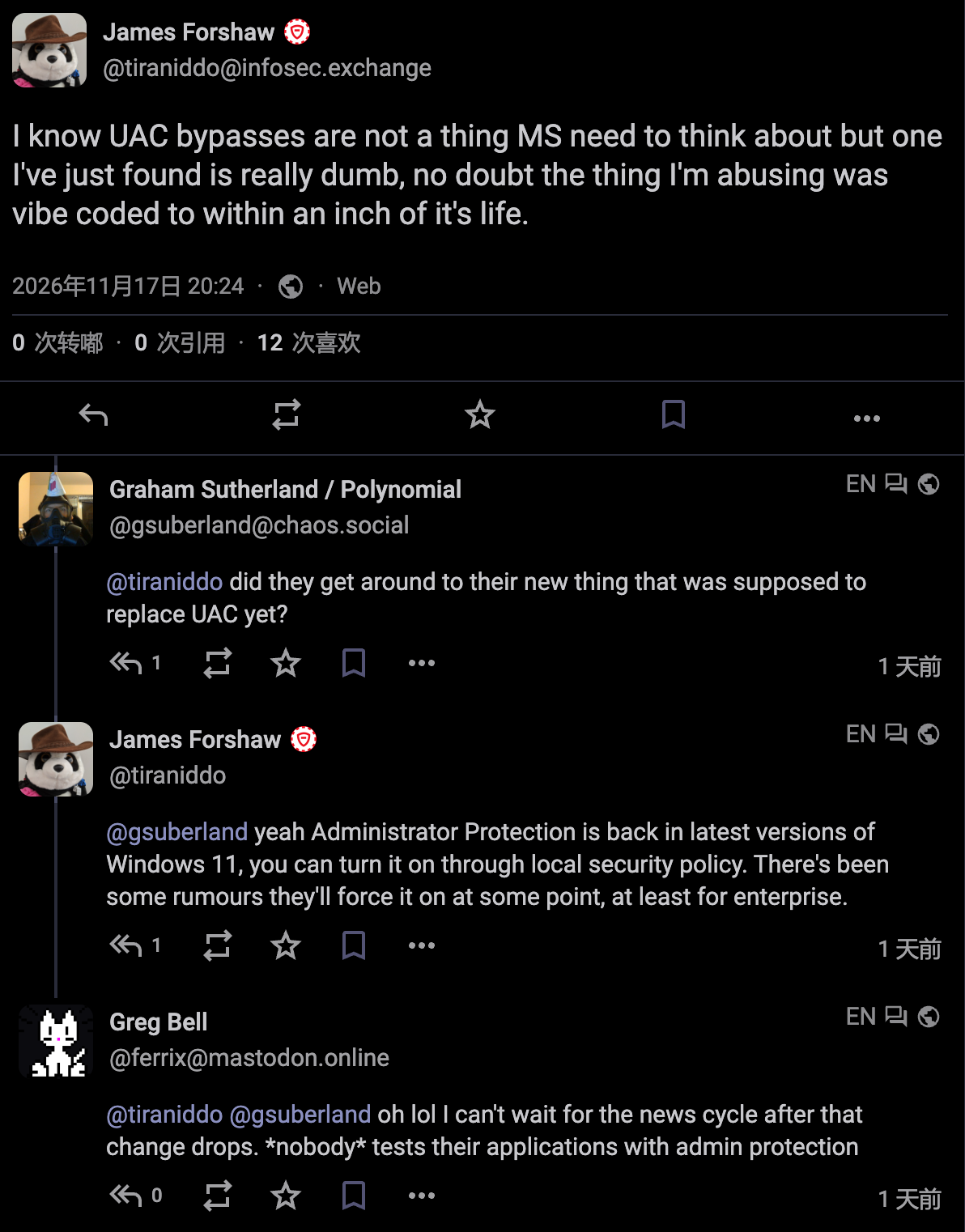
UAC User Account Control is a traditional mechanism for Windows systems to control administrator rights. After the administrator account logs in to the system, daily applications usually run using restricted tokens. When it is necessary to install software, modify system files or change important settings, the system will display a confirmation window for the user to confirm and grant full permissions.
UAC bypass allows malicious programs already running in the local administrator account to skip the pop-up confirmation step and obtain the full administrator token directly. Attackers can then modify system files and registries, turn off security features, or install malicious components that require elevated privileges to run.
Microsoft defines the UAC mechanism as a defense-in-depth feature, rather than a security boundary that must isolate different permissions. According to Microsoft's security services standards, bypassing UAC alone does not qualify for security updates or bug bounties by default.
Microsoft may still modify the abused component in subsequent releases, but typically does not assign a CVE number or issue an emergency security advisory, which is why Forshaw said in the original post that Microsoft does not need to consider UAC bypasses.
The relevant vulnerability has been fixed by Microsoft:
Although there is no CVE number or security bulletin, Microsoft will still fix the vulnerabilities reported by security researchers. Currently, Microsoft has replaced the traditional UAC administrator approval mode with Administrator Protection, which can resist some low-level bypass methods.
Forshaw discovered 9 bypass methods during the preview phase of Administrator Protection, and these bypass issues have been fixed in the official version. Now that the vulnerability has been fixed, it is estimated that Forshaw will also publish a blog detailing the cause of the vulnerability and the proof-of-concept program.
Comments