
Abstract:
Apple's new generation A20 Pro processor has been officially released. According to current test data, this processor scored 4006 points in Geekbench 7 single-thread, setting a new record for mobile SoC single-core performance,
The multi-threading score is 11,460 points, 27.1% higher than the previous generation A19 Pro. Compared with the previous generation A19 Pro (Quick Technology Note: single-core score is about 3249 points), the single-core performance of the A20 Pro has increased by 23.3%, which is Apple’s largest generational performance jump in recent years.
For reference, the single-core improvement of A19 Pro is about 13.6% compared to A18 Pro, and that of A18 Pro is about 7.3% compared to A17 Pro. The frequency increase brought by the N2 process and the architecture improvement have jointly created this intergenerational jump.
Specifically, the A20 Pro is manufactured using TSMC's 2nm N2 process. It is the first 2nm mobile phone chip. The architecture is equipped with 2 super cores and 4 energy efficiency cores, with a maximum frequency of 4.93GHz.
The design of these two super cores is derived from the A19 Pro, and the super core of the A19 Pro adopts the same architecture as the Apple M5 notebook chip: increased front-end decoding bandwidth, new cache hierarchy, and enhanced branch prediction capabilities.
The N2 process allows Apple to put two desktop-level CPU cores into mobile phone chips, which was almost impossible to achieve in the past due to power consumption and chip area.
In terms of memory subsystem, the memory interface bandwidth of A20 Pro is 50% higher than that of A19 Pro. It is suspected to use 96-bit memory I/O. The wider memory channel provides sufficient data throughput guarantee for the nearly 5GHz high-frequency core. This is also one of the key factors that enables A20 Pro to surpass its own M5 notebook chip in single-core performance.
In the mobile phone camp, A20 Pro is crushing its competitors. In the Geekbench 7 single-core test, A20 Pro leads Qualcomm’s fifth-generation Snapdragon 8 Extreme Edition by 31.5%, Xiaomi Xuanjie O3 by 33.7%, and MediaTek Dimensity 9400 by 76%
, leading GoogleTensor G5 by 99%, nearly double. The gap with Huawei Kirin 9050 Pro is the widest, with a single-core lead of 289.7%.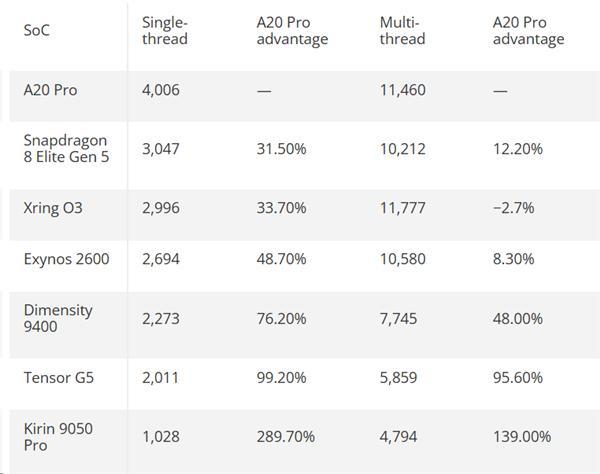
In terms of multi-core, the 6-core A20 Pro is 12.2% faster than the 8-core fifth-generation Snapdragon 8 Extreme, which is roughly the same as the 10-core Xuanjie O3 (slightly 2.7% behind). Compared with the MediaTek 8-core Dimensity 9400, it leads the single-core by 76% and the multi-core by 48%; the multi-core leads the Kirin 9050 Pro by 139%, compared with the Google 8-core Tensor. G5, the advantage is 96%.
It can be seen that despite the overall disadvantage in the number of cores, the multi-core performance of the A20 Pro can still beat or be equal to most Android flagships, and its single-core performance is unmatched.
In cross-category comparisons, the single-core performance of the A20 Pro exceeds the M4 by 19.5% and the M3 by 42.7%. Compared with Intel's latest Panther Lake mobile platform, the A20 Pro single-core leads the flagship Core Ultra X9 388H by 48.7%, the Ultra 5 325 by 74.4%, and the Ultra 5 332 by 87.7%.
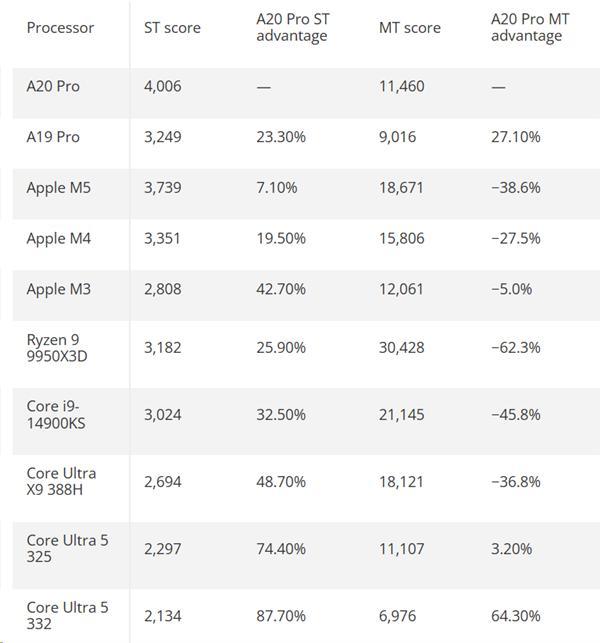
What is more noteworthy is that the A20 Pro six-core design also surpasses the Intel Core Ultra 5 325 (11460 vs 11107) and Ultra 5 332 (11460 vs 6976) in multi-threaded scenarios,
This means that a mobile phone chip can already beat Intel's mainstream thin and light CPUs in terms of multi-core performance.However, limited by the six-core architecture, there is still a clear gap between the A20 Pro multi-threading and high-end desktop and notebook chips. The multi-core lags behind M5 by 38.6%, Ryzen 9 9950X3D by 62.3%, Core i9-14900KS by 45.8%, and Core Ultra X9 388H by 36.8%. The multi-core gap with the eight-core M3 is the smallest, only 5% behind.
This set of data also reflects that on the premise that the number of cores is not dominant, Apple has squeezed the multi-core potential of the six-core architecture to the extreme by increasing the single-core frequency and enhancing the memory bandwidth.
A20 Pro is currently used in the iPhone 18 Pro series and will be expanded to the iPad and entry-level notebook product lines in the future. If Apple devolves the N2 process and super-core architecture to the next-generation M-series chips, with more cores and higher power budget, the performance of subsequent products will be further improved.
Comments