
Abstract:
On September 21, “Xianyu is involved in pornography” topped the list of hot searches on Weibo. According to Hebei Economic Television's report, some products released in the name of normal services, such as model appointments and fitness instruction, are actually just cover-ups for pornographic services. For example, some merchants sell so-called swimming teaching "courses", but they do not complete the transaction directly on the Xianyu platform. Instead, they guide users to other channels and then send the so-called "course schedule." Among them, door-to-door special services are prominently listed, and these service providers even include minors, with the youngest being 14 years old.
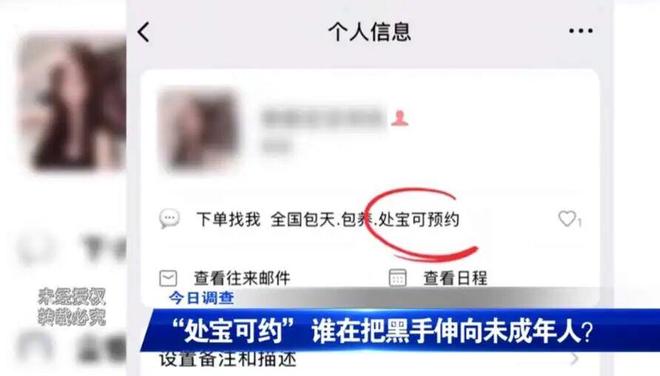
Xianyu later issued a statement in response to the situation mentioned in the report, including the disposal of related products, and also involved the clarification of misunderstandings and false information about some normal products. In particular, regarding the screenshot of "Chu Bao Ke Appointment" that appeared in the report, Xianyu stated that "this information does not appear on any page of the Xianyu platform, product information, or private chat records between buyers and sellers. It is actually corporate WeChat personal information."
At the beginning of the statement, Xianyu pointed out the common problems faced by pornographic traffic management: first, the traffic platform is used as a traffic entrance, while the real pornographic transactions or fraud are completed outside the site; second, black and gray gangs generally use secret codes to stigmatize normal products, and evolve frequently, making platform identification and management more difficult.
To some extent, the problems Xianyu faces today are more complex. What it needs to do is no longer just to check whether there are pornographic service transactions on the platform and then process them, but whether it can identify in advance certain seemingly normal products that may be becoming the entrance to the illegal transaction chain.
Why are normal products always made into "secret codes"
The "secret code" on Xianyu is not a recent phenomenon. In the cases that have been exposed before, bicycles, second-hand air conditioners, mineral water bottles, headphones, card removal needles, coins, etc. have all been accused of being related to pornographic drainage.
Of course there is nothing wrong with these products themselves, but some black and gray production teams will use their names, pictures and other hidden information to give them another meaning, which is the "variant pornographic code" mentioned in Xianyu's statement - they are not static, but constantly introducing new ones.
Just like a coin, it is originally a regular collectible. The year and condition are reasonable information that buyers need to know. However, in the process of sex trafficking, the year becomes the age of the special service provider. A Xianyu user said that because he accidentally discovered that someone uploaded a 5-cent coin from 1990s, he took out the coins at home and took a photo and "randomly marked the price." "I didn't expect someone to actually ask. I originally thought that the other person really planned to collect it, but the more we chatted, the more things went wrong. He directly asked if we could meet, and the time was still that evening."
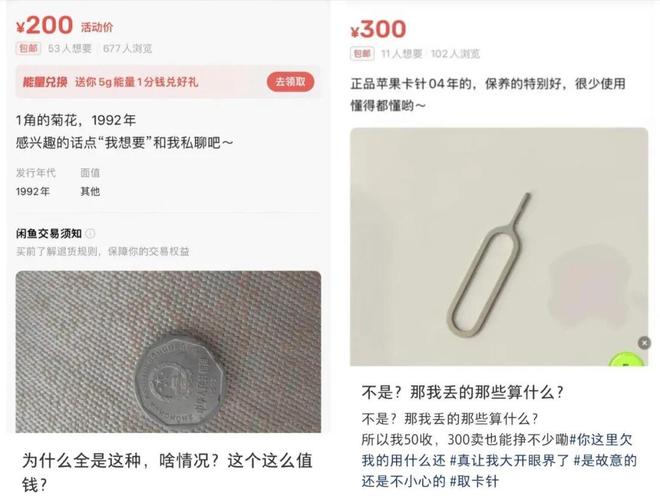
This is also the trickiest part of the platform. The product name itself is not illegal, and a considerable number of users are even trading on the real product itself. The aforementioned Xianyu users would never know that the coins were given a specific meaning if they hadn't encountered buyers who kept asking seemingly strange questions. In other words, in addition to the information conveyed by the product name, whether the pictures, prices and descriptions are related, whether private communication involves adding off-site contact information, etc., may be the key to identifying the existence of illegal transactions.
On September 18, Xianyu disclosed the latest progress in the special management of combating pornography diversion: From January 2026 to the present, the platform has disposed of a total of 98,358 pornographic diversion risk accounts, and through the police-enterprise coordination mechanism, it proactively transferred clues to the public security department, successfully cracking down on 15 pornographic gangs.
Nearly 100,000 accounts have been disposed of. Why do similar problems still appear one after another? The reason is that blocking an account does not mean cutting off customer acquisition. Just as the expression of the password can be updated, the account can also be re-registered, the original traffic drainage model still exists, and transactions can still be directed outside the site.
Judging from public responses and regularly synchronized governance progress, it is not that Xianyu has not taken action. The platform has been strengthening pre-monitoring, keyword and picture recognition, and has also increased manual inspections, and is cooperating with the police and enterprises to process relevant clues.
However, "swimming instruction" can be a normal product, and "home fitness" can also be a real service. A photo of a swimsuit may not necessarily be pornographic content. Only by combining information such as account history, product postings, and private message behavior can it be more likely to determine whether there is an abnormal connection between them.
As risk control deepens, another problem begins to emerge: users who normally publish these products may be accidentally injured. As mentioned earlier, some people just sell bicycles, but they don’t understand why they are asked questions about their age and appearance; some people sell coins, but they don’t understand why ordinary years have become risky information. While the black and gray product gangs are studying how to circumvent the rules, individual users who only sell a few idle items a year may not even fully understand the rules. For Xianyu, this is also part of governance.
In Xianyu, sellers need to learn to “settle accounts”
In addition, in recent years, Xianyu has also been controversial due to charging issues.
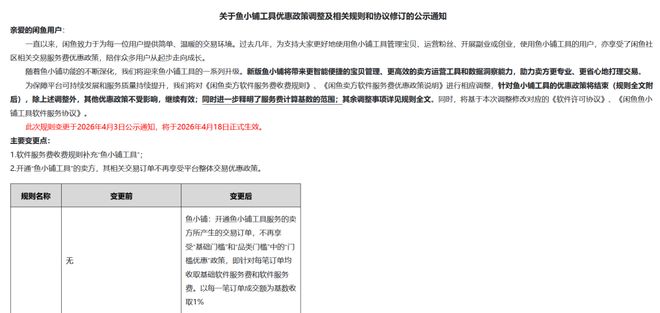
In September 2024, Xianyu officially charged a 0.6% basic software service fee to sellers on the platform; on April 3, 2026, Xianyu announced changes to the software service fee charging rules. Starting from April 18, in addition to the previous 0.6% basic software service fee, a 1% software service fee will also be charged to Yu Xiaopu sellers, that is, the latter's overall rate will be increased from 0.6% to 1.6%. At the same time, the 60-yuan cap policy for basic software service fees for Yu Xiaopu sellers has been cancelled. That is, the commission for high-priced orders will increase simultaneously with the transaction volume, and there will be no cap on billing.
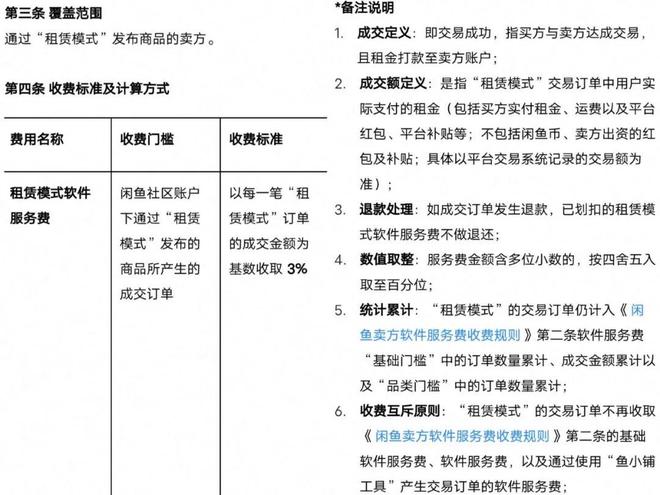
Not only that, starting from September 20, 2026, Xianyu will charge software service fees to merchants who use the "rental model" and directly deduct 3% of the transaction amount of each order. If a refund occurs on a transaction order, the deducted rental mode software service fee will not be refunded. For sellers who have regarded Xianyu as a long-term business channel, the platform costs have become more clear and difficult to ignore.
What’s more, commercial tools are constantly being updated—and they’re not free. Currently, Xianyu provides sales assistance and promotion services such as “worry-free selling” and “super polishing” to qualified sellers and their products on the platform, and collects software service fees from them.
Take "Worry-free Selling" as an example. Xianyu provides sellers with intelligent pricing analysis and traffic weighting support. It is divided into three levels: 14 days, 7 days, and 3 days according to the sales speed of goods. Currently, only the first two levels are online. The corresponding charging standards are 1%-3.5% of the transaction price of the product and 1.5%-7% of the transaction price of the product. The specific ratio is set according to the category and is superimposed with the overall rate of 1.6%.
What is this concept? Take the specialty handicraft category with the highest rate among the 7-day sales of Wuyou Selling as an example. For a product priced at 1,000 yuan, the Wuyou Selling service fee is 70 yuan, plus the basic platform software service fee of 16 yuan. Before calculating the profit, 86 yuan must be excluded first. The selling price here refers to the transaction amount including the actual payment paid by the buyer, freight and platform red envelopes and subsidies.
Thus, it is not difficult to understand the complaints of some Xianyu sellers about charging tips, activation methods and service rules. A Xianyu user said that the worry-free selling window popped up when he uploaded products on the platform. "I didn't know I needed to pay, so I just clicked the agree button." The next day after hanging out, the product link was photographed, and the user was deducted nearly 120 yuan in Wuyoumai software service fees. "The typeface of the charging statement is very small. I really didn't see it at the time. I hope the platform can write similar charging standards more clearly." The user said.
If you look at these adjustments together with the previous risk control and governance issues, what Xianyu is going through is actually the same kind of transformation.
In the past, it was a platform for dealing with idle items at home. Many sellers occasionally sold old mobile phones and old appliances and did not identify themselves as "merchants". Nowadays, with the growth of professional sellers and the platform gradually becoming community-based, Xianyu has invested more resources to combat black and gray products on the one hand, and added business tools such as fish shops and worry-free sales on the other hand, and the degree of commercialization is getting higher and higher.
To play different roles, you must face different requirements from users. The platform not only needs to tell users that certain products cannot be sold, but also needs to give specific explanations for actions such as delisting, blocking, and traffic restrictions. It can not only help sellers improve transaction efficiency through paid tools, but also fully solicit opinions to make charging standards clear enough.
Therefore, after disposing of nearly 100,000 accounts, what Xianyu really needs to prove is not just how many more accounts it handles, but whether it can identify new traffic chains earlier and solve them on its own side; and, when charging and risk control rules become more and more complex, can an ordinary user who just wants to sell an old bicycle or an old air conditioner can successfully find buyers for them and figure out how much they have to pay for which services.
Comments