
Abstract:
As Apple’s new iPhone 18 Pro and iPhone 18 Pro Max are about to be launched, the A20 Pro chip equipped with them has appeared in the Geekbench 6 database, and the first batch of benchmark test results have also been exposed. Although these results are still early test results and have not been independently verified, judging from the existing data, the CPU and GPU performance of the A20 Pro have achieved significant improvements, especially the increase in multi-core and graphics performance is considerable.
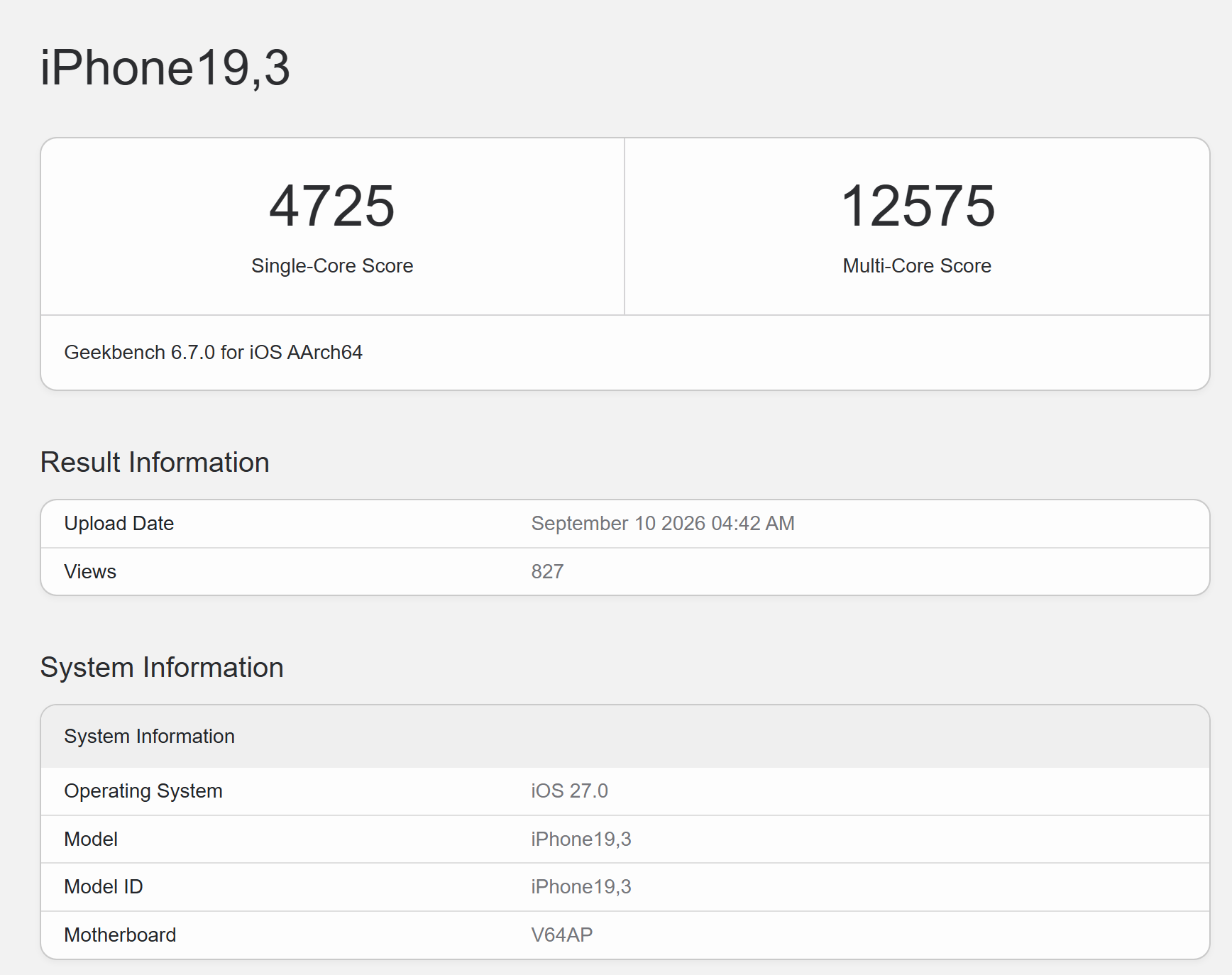
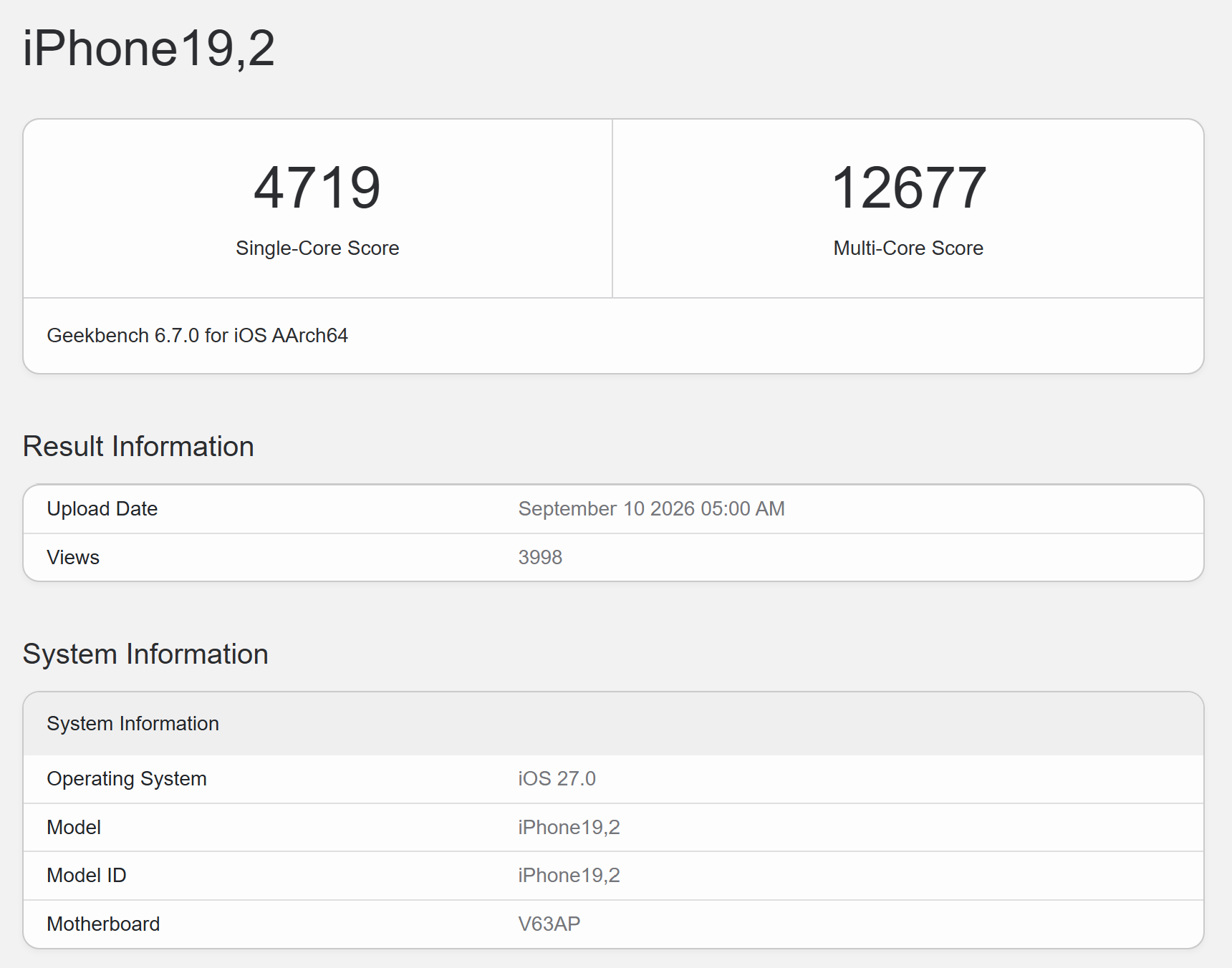
The iPhone 18 Pro single-core score in the Geekbench 6 database is 4719 points, and the multi-core score is 12677 points; the iPhone 18 Pro Max scores are 4725 points and 12575 points respectively. Both models are equipped with six-core A20 Pro processors, and test data shows that the CPU frequency is approximately 4.93GHz. Since both phones use the same chip, their CPU performance is basically at the same level.
Compared with the A19 Pro powered by the previous generation iPhone 17 Pro, currently exposed test results show that the single-core performance of the A20 Pro has been improved by approximately 21% to 23%, and the multi-core performance has been improved by approximately 27% to 28%. If subsequent official retail models can maintain this result, then the A20 Pro will become a generation of mobile chips that Apple has significantly improved in performance in recent years.
In terms of GPU, the A20 Pro also performed strongly. Metal test data from Geekbench 6 shows that the seven-core GPU on the iPhone 18 Pro series has a performance improvement of about 38% to 40% compared to the six-core GPU on the iPhone 17 Pro. This result is basically consistent with the official data released by Apple at the press conference. Apple previously claimed that the A20 Pro’s new seven-core GPU graphics performance can be up to 40% higher than that of the A19 Pro.
From an architectural perspective, the A20 Pro uses TSMC’s 2nm process and is Apple’s first smartphone chip using the 2nm process. The chip is equipped with a six-core CPU, including two new high-performance cores and four energy-efficiency cores; the GPU is upgraded to seven cores, and a neural accelerator is added to improve the processing capabilities of local artificial intelligence tasks. The chip is also equipped with a 32-core neural engine and has 50% higher memory bandwidth than the previous generation.
Apple has also specifically enhanced the sustained performance of the A20 Pro this time. Because high-performance chips are prone to heat limitations when running for long periods of time, Apple redesigned the chip packaging structure and used a larger vapor chamber to help dissipate heat. Apple said that the iPhone 18 Pro's vapor chamber area is three times that of the iPhone 17 Pro, and it helps to conduct the heat generated by the chip out more effectively by circulating deionized water.
Thanks to the new chip packaging and heat dissipation system, Apple claims that the sustained performance of the A20 Pro equipped with the iPhone 18 Pro is up to 40% higher than the previous generation A19 Pro, and twice that of the A18 Pro. This means that this upgrade is not just focused on short-term peak running scores. Apple also hopes to enable the chip to maintain high performance for a longer period of time in high-load scenarios such as long-term gaming, video processing, and local AI computing.
The performance improvement of A20 Pro is also closely related to Apple’s strategy of strengthening device-side artificial intelligence in recent years. The new chip’s GPU neural accelerator can provide higher FP8 computing power, while the wider memory interface is also conducive to running large language models. Apple hopes that by increasing local computing power, more artificial intelligence tasks can be completed directly on the iPhone, thereby reducing reliance on cloud servers and improving response speed and privacy performance.
However, the Geekbench results currently exposed still cannot fully represent the actual user experience. MacRumors points out that these tests are single, early-stage benchmark results that have not yet been independently verified, and the running scores cannot be completely equated with sustained performance in real use. Especially during long gaming sessions, continuous video rendering, or other high-load tasks, temperature, power management, and system scheduling can all impact final performance. Therefore, the long-term performance of the A20 Pro on actual devices needs to be confirmed through more tests after the iPhone 18 Pro series is officially launched.
According to the arrangements announced by Apple, iPhone 18 Pro and iPhone 18 Pro Max will be available for pre-order on September 12 and will be officially launched on September 18. Both models are equipped with A20 Pro. The iPhone 18 Pro starts at US$1,199, and the iPhone 18 Pro Max starts at US$1,299. For the first time, a storage capacity version of up to 2TB is available.
Comments