
Abstract:
The head of British air traffic control said he believed a software glitch that affected tens of thousands of passengers and canceled a large number of flights on Tuesday was not caused by a cyber attack. "We will of course carry out a thorough and comprehensive investigation. At present we have ruled out cyber factors and we do not believe this is a cyber attack." Martin Rolfe told BBC Radio 4's "Today" program on Wednesday.
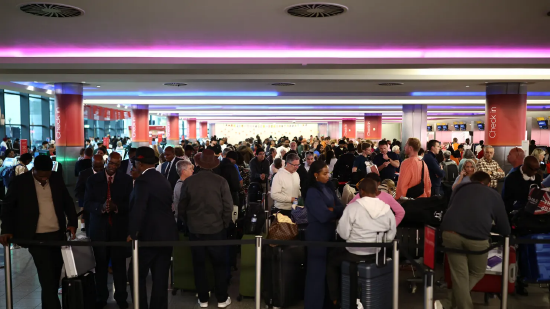
On September 8, 2026, at Terminal 3 of Heathrow Airport in west London, due to the failure of the British National Air Traffic Service's air traffic control system, flights were in widespread chaos, and passengers were queuing up with their luggage.
He added: "In our 50 years of operation, we have never seen the same kind of failure happen repeatedly, so this should be a completely new problem that we have never seen before."
Data from flight tracking website Flightradar24 showed that a total of 1,300 flights in and out of UK airports were canceled on Tuesday; as of early Wednesday morning, a further 177 flights had been cancelled.
The vast majority of canceled flights are concentrated at London Heathrow, one of Europe's busiest airports. London Stansted Airport, Gatwick Airport, as well as Birmingham and Manchester Airports were also severely affected.
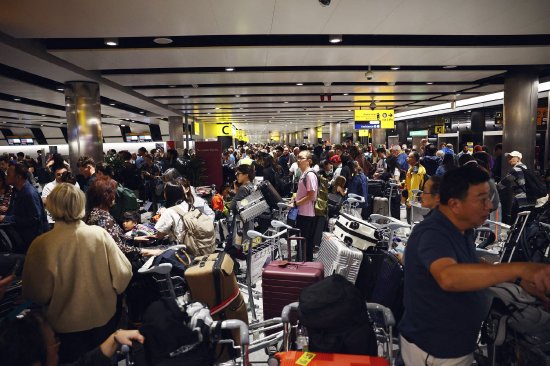
The UK's National Air Traffic Services (NATS) confirmed the technical glitch shortly before 2pm local time on Tuesday. Although the fault was fixed by 7:30 p.m., backlogs of flights, misaligned aircraft and crews, and staff reaching their shift limits continued to cause travel chaos into Wednesday. Officials remind passengers planning to travel on Wednesday to confirm the latest flight status with their airline.
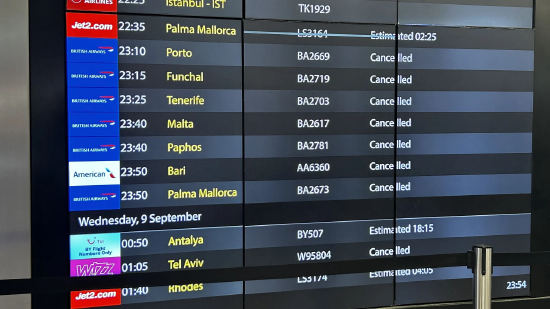
September 8, 2026 On the same day, at Gatwick Airport in London, England, the arriving flight information display showed the flight status.
Rolfe said NATS takes responsibility for the impact of the accident on passengers, airlines and airports.
"We will not take traffic restriction measures lightly. We have to do this only when we encounter problems that cannot be solved quickly to ensure the safety of air flights." He told the BBC, "As soon as conditions permit, we will do everything possible to restore this highly complex system as soon as possible."
NATS provides air traffic control services to 15 airports in the UK, handles around 2.5 million flights a year, and manages the high-altitude airspace used by commercial aircraft in the UK.
Major airlines issued sharp criticism of the agency and its management on Wednesday, noting that the accident was the third major failure in recent years. A radar technical failure in July 2025 caused the cancellation of more than 150 flights; during the long weekend holiday in August 2023, a failure of the NATS flight plan processing subsystem caused nationwide flight chaos that lasted for several days.
Neal McMahon, Chief Operating Officer of Irish Ryanair, said that the NATS failure was "extremely bad" and affected both holidaymakers and business travelers.
"It is unbelievable that the fees NATS charges airlines and passengers continue to rise every year, while service levels continue to deteriorate. After the system collapsed in 2023, we were told that lessons would be learned... but now tragedy has happened again." McMahon said in a statement.
A spokesman for low-cost airline Wizz Air said: "We are extremely disappointed that NATS has once again experienced a technical glitch, causing widespread disruption to the British Airways network."
"The failure was completely beyond the control of the airline, and passengers once again encountered delays and flight cancellations," the spokesperson said.
Heathrow Airport has experienced a series of disruptions recently: a fire last weekend disrupted rail traffic to the UK's largest airport; in March 2025, the entire airport was closed for almost the whole day due to a fire caused by a power grid failure.
Comments