
Abstract:
CERN, the European Organization for Nuclear Research, is developing a new generation of superconducting magnets for the next round of upgrades to the Large Hadron Collider (LHC). These magnets, which use new materials and manufacturing processes, have reached a magnetic field strength of 11.3 Tesla in tests and will become an important part of the future high-brightness Large Hadron Collider.
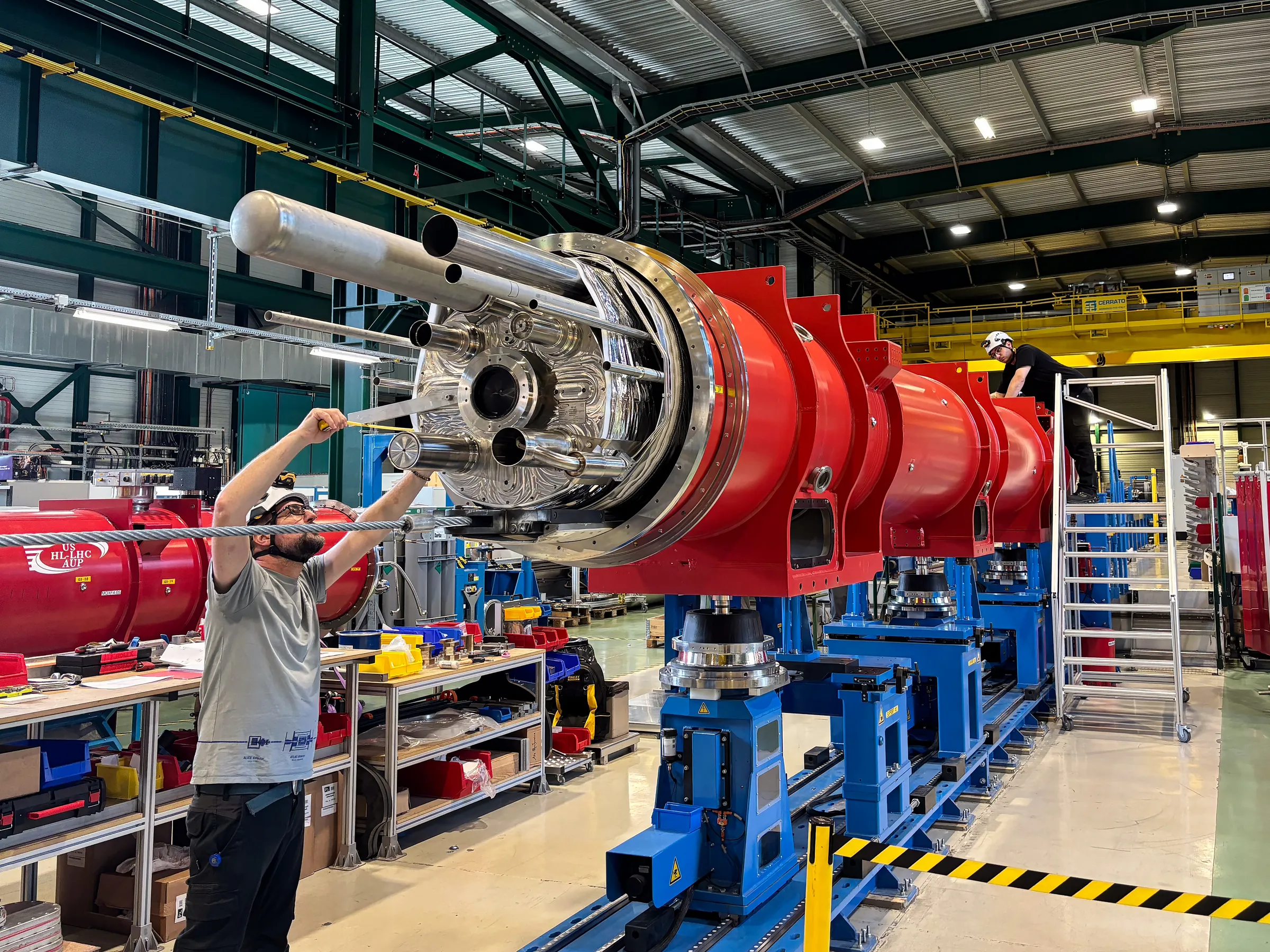
The Large Hadron Collider uses extremely powerful magnetic fields to control particle beams, allowing particles to travel and collide at speeds close to the speed of light, thereby helping scientists study the basic composition of matter. Currently, the LHC can conduct about 40 million collisions per second in a single experiment, with the number of particles involved in each collision being about 60. By continuously increasing the frequency of collisions and the number of particles, scientists can more effectively search for rare particles and previously unobserved physical phenomena.
The next phase of the upgrade project that CERN is advancing is called the High-Luminosity Large Hadron Collider (High-Luminosity LHC), which is expected to launch a new round of experiments after 2030. The goal after the upgrade is to increase the number of particles involved in each collision to 140 to 200, while maintaining a collision frequency of about 40 million times per second. The so-called "high brightness" refers to the fact that more particle collisions can occur per unit time, thereby increasing the chance of discovering rare physical phenomena.
To achieve this, the collider will need compact, reliable magnets with stronger magnetic fields. Traditional LHC dipole magnets use niobium titanium (NbTi) superconducting coils, and the magnetic field intensity can reach 8.3 Tesla, which is approximately 166,000 times the Earth's magnetic field intensity. However, the performance of the niobium-titanium material is close to the upper limit of the magnetic field strength it can achieve, so a new generation of quadrupole magnets began to use niobium-tin (Nb₃Sn) superconducting materials, with a target magnetic field strength close to 12 Tesla.
One of the main difficulties facing this technology upgrade is that niobium-tin materials have completely different mechanical properties from traditional niobium-titanium materials. Niobium-titanium has good ductility and can be bent and wound after forming a superconducting material; niobium-tin is very fragile and cannot withstand the large mechanical stress generated during the coil winding process once the superconducting phase is formed.
To solve this problem, the researchers adopted a manufacturing process called "Wind-and-React". To put it simply, the material that has not yet formed the final superconducting phase is wound into a coil, and then through high-temperature heat treatment, niobium and tin react, and finally the niobium-tin superconducting material is formed.
During the specific manufacturing process, the research team first used a 760-meter-long superconducting cable and wound it around the central frame to form a set of coils with a length of about 7.2 meters and apertures of 150 millimeters. The coils are then placed in an inert gas environment for a strictly controlled heat treatment.
The heat treatment process lasts for several days, and the temperature rises sequentially, staying at about 210 degrees Celsius and 400 degrees Celsius for a period of time, and finally reaches about 650 degrees Celsius. After this process, the niobium and tin in the cable react chemically to form a niobium-tin compound with superconducting properties.
Because the niobium tin material is very fragile after formation, extreme care must be taken during subsequent handling of the coil. Any excessive bending or mechanical deformation may damage the superconducting material and affect the electrical performance and structural reliability of the magnet.
After completing the heat treatment, the researchers also use liquid epoxy resin to treat the coil, allowing the resin to fill the internal voids, cracks and gaps, and then solidify into a hard polymer structure to improve the mechanical stability of the coil.
This manufacturing project is led by a team of about 60 people led by CERN magnet engineer Susana Izquierdo Bermúdez. She has been involved in the research and development of new magnets since 2012, and her work involves coil winding testing, electromagnetic design, mechanical design, manufacturing and performance verification.
According to the research results published by the research team in IEEE Transactions on Applied Superconductivity, they manufactured more than 120 coils for 4.5-meter-long magnets and more than 70 coils for 7.2-meter-long magnets for the LHC upgrade project. Each quadrupole magnet requires four coils.
The entire project resulted in the production of 250 coils, of which 25 failed quality requirements due to human error and electrical or mechanical performance defects during the manufacturing process. The researchers pointed out that this type of superconducting magnet requires extremely high manufacturing precision, and even very small flaws may render the entire coil unusable. There was a coil that had to be scrapped because it was suspected that a metal particle was caught between the winding and the protective component, which might affect its operating performance.
In September this year, the team completed quality control testing of the 7.2-meter-long magnet and confirmed that its peak magnetic field strength reached 11.3 Tesla. The magnets are currently performing well, and researchers have begun to continue manufacturing spare coils and magnets to meet the needs of future LHC upgrade projects.
This achievement is not simply the pursuit of higher magnetic field numbers, but means that CERN has advanced niobium tin superconducting materials from laboratory research and development to large-scale, strict quality control engineering manufacturing stage. For the High-Brightness Large Hadron Collider, a stronger magnetic field will help researchers control particle beams more effectively, allowing the collider to achieve higher particle collision capabilities within a given space, providing key infrastructure for particle physics experiments after 2030.
This research was published in "IEEE Transactions on Superconducting Applications" on September 24, 2026. IEEE Spectrum updated the report on November 10, correcting the number of particle collisions in each experiment.
Comments