
Abstract:
An interactive experience dynamically generated by AI based on the current conversation and user needs. This means that ChatGPT is gradually transforming from a "chatbot that answers questions" to an "intelligent assistant capable of making tools on the spot." In the past, users might need to ask ChatGPT for calculation methods and then open a calculator to complete the calculation themselves; now AI can directly generate an operable calculation tool and embed it in the answer.
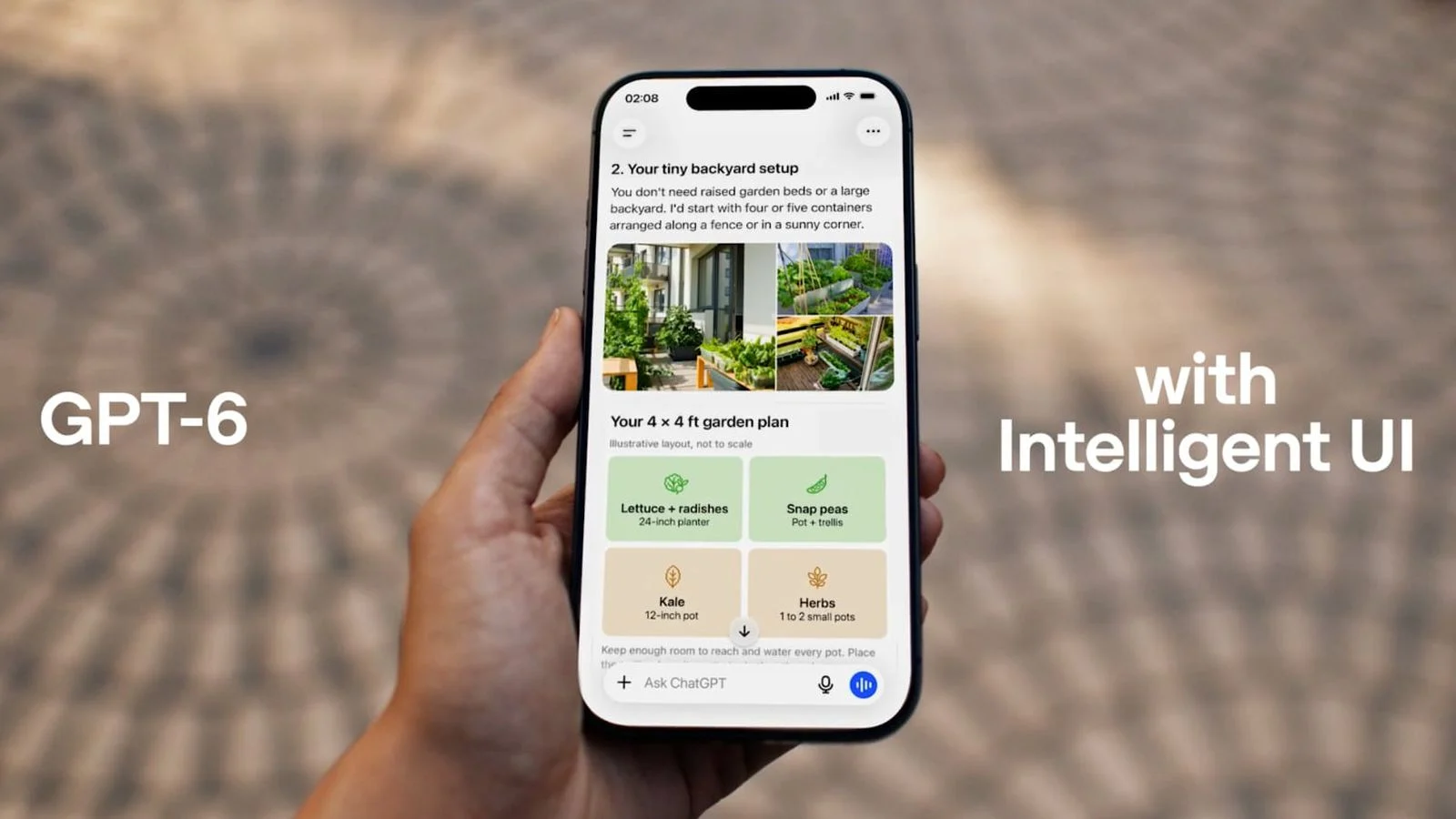
OpenAI stated that the core foundation of Intelligent UI is a set of native, streamable interface component libraries, and a compiler that can process the interface while the model generates content. In other words, AI does not first generate a whole paragraph of text and then simply format it with the ChatGPT client. Instead, it determines what interface structure should be used during the process of generating answers.
This mechanism also allows interactive elements to gradually appear along with the answer content. Users do not have to wait for the model to be fully completed before seeing the final result. Parts of the interface can be gradually presented as the generation process progresses.
GPT-6 itself is also tuned for response speed. OpenAI said that the model can start outputting answers while it is still thinking, so users can see some results earlier without having to wait for the model to completely finish internal processing before starting to display content.
This update also means that the visual presentation of ChatGPT has changed significantly. In the past, even if the model could generate complex data analysis, it was often presented in the form of text, Markdown tables or static images; now, AI can actively select charts, buttons, forms and other interface elements that are closer to traditional software based on the problem.
For ordinary users, the significance of this change may be more intuitive than simply improving a few benchmark scores. Users do not need to know how to write programs, nor do they need to master web development or data visualization tools. They only need to tell ChatGPT what task they want to complete, and AI can directly create a tool that can be used in the current conversation.
OpenAI has also begun to expand the scope of use of GPT-6 this time. GPT-6 and Intelligent UI are first open to ChatGPT Plus, Pro, Business and Enterprise users, and will be rolled out to Free and Go users later.
The GPT-6 versions obtained by different user levels are different. Plus, Pro, Business and Enterprise users get GPT-6 Sol, while Free and Go users will get GPT-6 Luna.
Currently GPT-6 is mainly used in the Chat dialogue interface of ChatGPT, and the models in Work and Codex have not been replaced simultaneously. This means that this release is first targeted at ordinary chat and daily task scenarios, rather than immediately changing OpenAI’s product system for professional work and programming development.
From the perspective of product form, Intelligent UI may represent an important direction for the future development of ChatGPT. Traditional software usually requires developers to design the interface in advance, and then users operate it according to a fixed process; AI-driven intelligent interfaces can instantly generate corresponding operation interfaces based on the current needs of users.
For example, the same chat window can become a currency conversion tool when the user is asking about exchange rates, a trip planner when the user is planning a trip, a bill splitting tool when the user is calculating expenses, and an interactive teaching interface with charts and multiple-choice questions when the user is learning knowledge. Users don’t need to install different apps or find corresponding websites or tools.
This model is actually blurring the line between "chat" and "app." In the past, ChatGPT was mainly responsible for understanding user needs and giving answers, but the actual execution of tasks often still required the use of other software. Intelligent UI attempts to make ChatGPT directly become a task execution environment, so that the answer itself has certain application attributes.
Of course, this model also means that the AI system needs to take on more responsibilities. When a model begins to directly generate buttons, forms, calculators and even small applications, the interaction between the user and the AI-generated interface is no longer just about reading text, but may involve actual operations and decisions. As a result, the accuracy of generated content, interface behavior, and security will all become more important.
At present, OpenAI is first to apply Intelligent UI within ChatGPT. Whether it will be further opened to developers in the future, whether it can generate similar dynamic interfaces through APIs, and whether these interactive components can be saved and run independently, more details need to be announced later.
In any case, the combination of GPT-6 and Intelligent UI shows that the competition for AI assistants is no longer just about "whose model is smarter." When the gap between different models in text understanding and reasoning capabilities gradually narrows, how to directly transform model capabilities into tools that users can operate may become an important direction in the next stage of AI product competition.
If this model further matures, users may no longer need to distinguish between "asking a question" and "using an application" when facing AI in the future. Users only need to describe what they want to accomplish, and AI can instantly generate the interface needed to complete the task during the conversation. ChatGPT itself may gradually evolve from a chat window into a general computing platform that can dynamically generate applications.
Learn more:
https://openai.com/zh-Hans-CN/index/gpt-6-for-everyone/
Comments