
Abstract:
It was reported that developer MAAN recently released OpenDLSS-NR, which is an open source Vulkan reimplementation of NVIDIA's DLSS 5 neural rendering network. The core breakthrough of this project is that it allows DLSS 5 to run on non-RTX 50 series graphics cards for the first time.
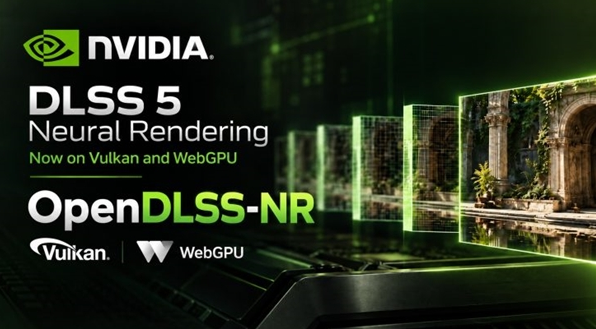
OpenDLSS-NR accurately reproduces the 71-block neural network structure in DLSS 5 runtime DLL version 310.8.0, and the developer claims that its output results are "bit-level consistent" with NVIDIA's official implementation. Not only the final image, but also the output of all 75 intermediate block boundaries match byte by byte.
The network adopts U-Net architecture, combines the shift window Transformer and the global visual Transformer, uses FP8 activation value and FP16 cumulative accuracy, and the model weight is about 141MiB.
In terms of performance, data measured by MAAN using RTX 4070 SUPER shows that the execution time at 768×768 resolution is only 2.8 milliseconds, 1080p is 7.8 milliseconds, 1440p is 12.6 milliseconds, and 4K is 29.3 milliseconds. These data show that the complete network of DLSS 5 can already perform efficiently on the Ada Lovelace architecture.

What is even more groundbreaking is the WebGPU ported version. This version does not rely on NVIDIA Tensor Core or native FP8 support and runs entirely in the browser. The execution time at 512×512 resolution is 72 milliseconds. Although it is much slower than the 2.7 milliseconds of the native implementation, it is enough to prove that the neural network of DLSS 5 can be decoupled and run on non-NVIDIA hardware.
Currently there are still restrictions on this project. The warehouse does not contain NVIDIA's proprietary model weights, and users need to provide them themselves. It is also not a ready-to-use game module, but an independent implementation that comes with a demo renderer based on the Google Filament engine, which supports motion vectors and timing feedback, but does not implement DLSS super-resolution functionality.
For RTX 40 series users who cannot use official DLSS 5, this project shows another possibility. Although still far from actual game deployment, it proves that the core technology of DLSS 5 does not rely entirely on the latest hardware.
Comments