
Abstract:
Recently, on the playground of a campus in Jiangxi, a water rocket made of plastic buckets and transparent pipes stood steadily on the green field. The stands were filled with teachers and students watching, and everyone was full of expectations, waiting for the moment of launch. This water rocket, built by students led by science teacher Wang Yin, has received a lot of attention on the Internet with its complete multi-stage separation and parachute recovery process. Many netizens called it "too hardcore."
After the launch command was issued, dense water mist sprayed out from the bottom of the rocket, and the rocket body dragged white water vapor straight into the sky. This strap-on water rocket has two boosters, and its appearance replicates the configuration of the launch vehicle. The transparent rocket body can even see the internal structure clearly.
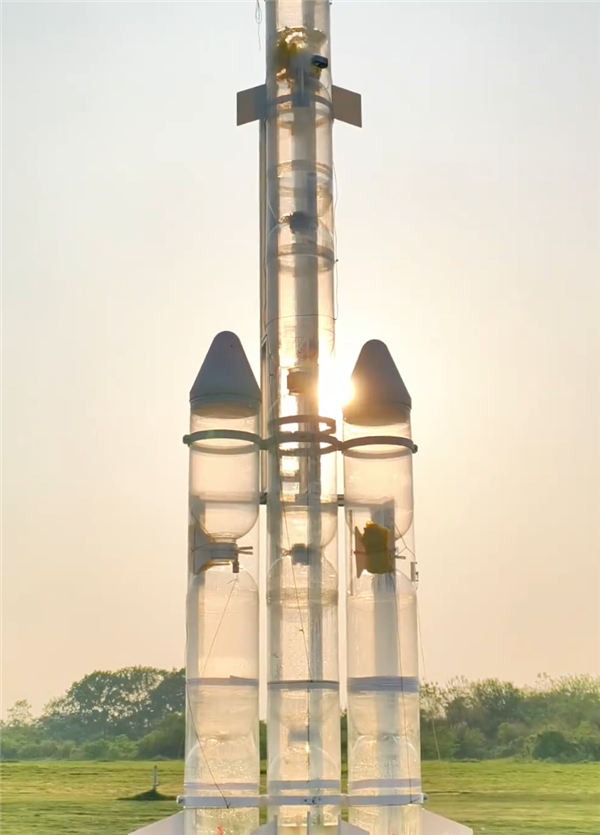
After climbing to a high altitude, the rocket operated according to the preset process, first completing the separation of the booster, and then the first and second stages of the rocket separated smoothly, and the two stages of the rocket continued to fly separately.
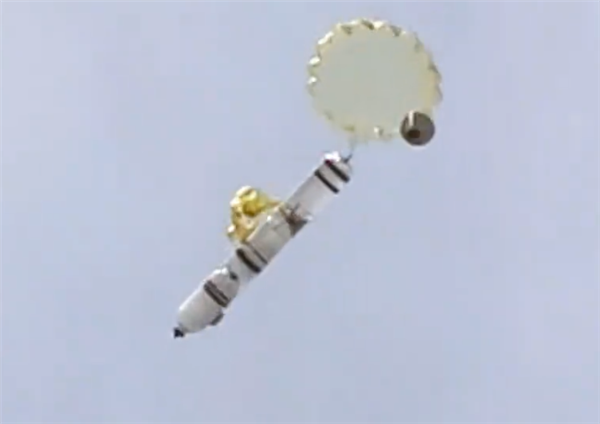
After reaching the highest point, the parachutes of the rocket body popped out one after another, and the light yellow parachute opened in the air, slowly falling with the rocket body, achieving safe recovery. The entire process is highly similar to the launch logic of a real launch vehicle.
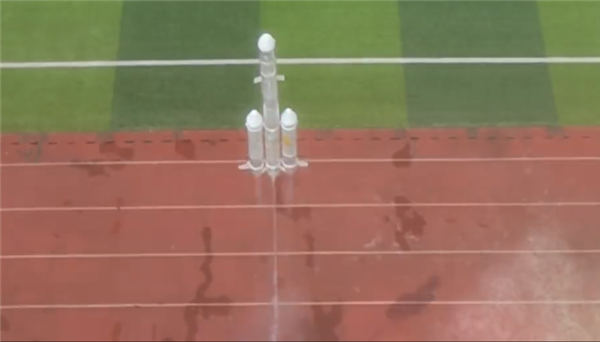
The entire process relies on water and air pressure to generate power. No gunpowder is used, and only common plastic buckets, beverage bottles and other materials are used to complete the production.
Teacher Wang Yin hopes to use this popular science project to transform abstract aerospace principles into visible experiments. Let students design, assemble, and debug with their own hands, and understand mechanics, air pressure, and aviation knowledge through trial and error.
Comments