
Abstract:
Following the earlier technology community's successful porting of DLSS technology to previous-generation graphics cards, the global PC hardware and game mod circles have once again experienced a major breakthrough. Private developers have successfully broken through NVIDIA's official hardware intergenerational blockade on DLSS frame generation technology, allowing GeForce RTX 20 series graphics cards based on the "Turing" microarchitecture to directly run NVIDIA's own DLSS frame generation pipeline for the first time.
This technical verification not only directly challenges NVIDIA's official statement that frame generation can only be supported by Ada Lovelace and newer architecture's proprietary optical flow accelerator (OFA), but also once again triggered a heated discussion among the player community about the limitations of decentralizing functions of old graphics cards.
In the official technical support strategy, NVIDIA has always strictly limited basic DLSS single frame generation (Frame Generation) to graphics cards with RTX 40 series and above architecture, while higher-level multi-frame generation (Multi Frame Generation, referred to as MFG) is further locked to the latest RTX 50 series. For older hardware such as the RTX 20 series and RTX 30 series, the official has always refused to provide any form of official native frame generation support on the grounds that the performance of the older generation optical flow accelerator is weak and cannot complete bidirectional optical flow analysis without causing severe picture artifacts and high latency.
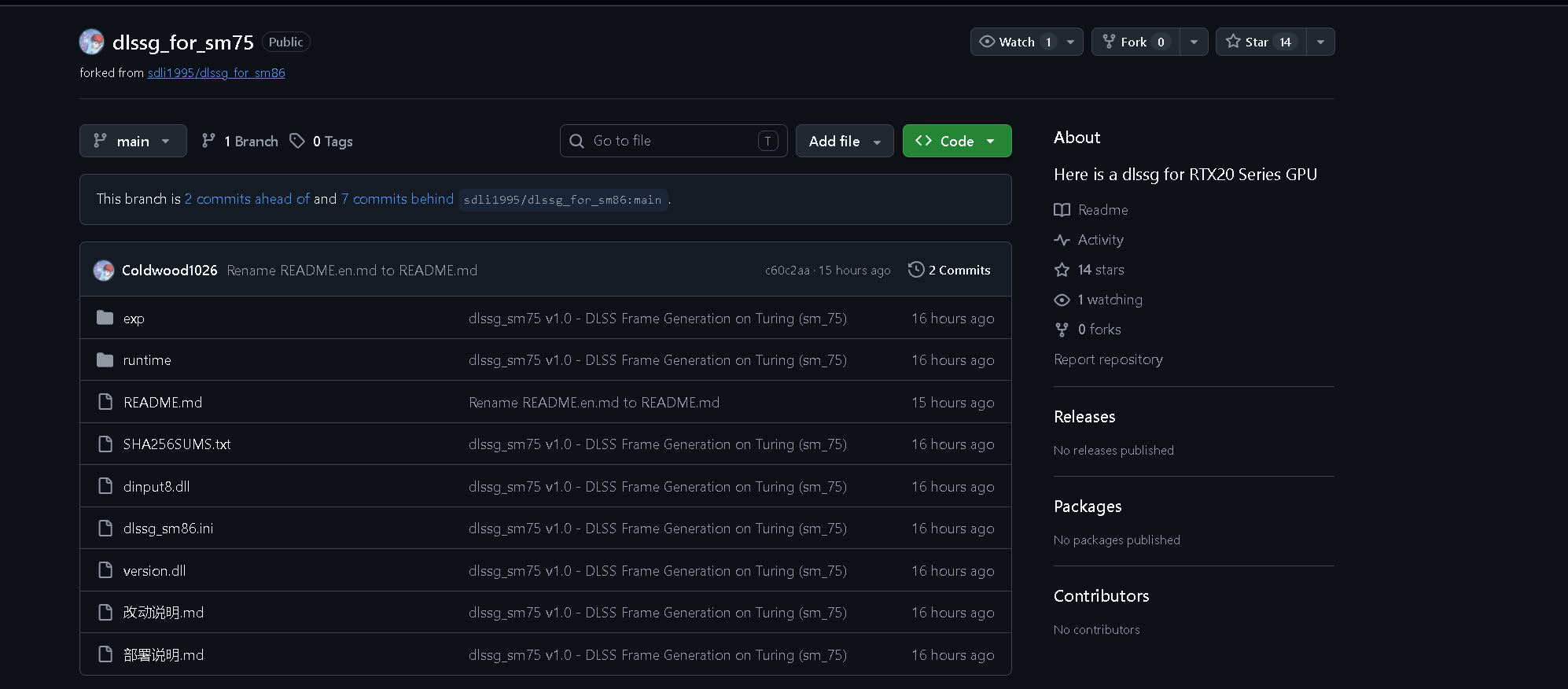
What is essentially different from the "DLSSG-to-FSR3" transfer patch that has been widely circulated on the Internet is that the early old card compatibility solution only hijacked the DLSS call instructions within the game and redirected them to AMD's completely open source FSR 3 frame insertion pipeline for execution; while the new Turing patch launched this time implements genuine NVIDIA native closed-source link calls. This Mod is further evolved based on the previous code results of porting DLSS frame generation to the RTX 30 series "Ampere" architecture, directly calling the official original NVIDIA nvngx_dlssg 310.1 runtime dynamic link library. Through decompilation and reconstruction, the developers replaced all the underlying GPU core computing kernels (Kernels) that were originally optimized for the new architecture with versions specially compiled for the Turing architecture SM75 instruction set. They also conducted deep deception in the hardware identity verification process, tricking the system into directly identifying the aging RTX 20 graphics card as the modern RTX 40 series Ada Lovelace core, thus successfully bypassing the architectural access control and successfully triggering the native frame insertion switch in the game.
In the actual test and verification process, the developer conducted a real-machine loading test for the DirectX 12 version of "The Witcher 3: Wild Hunt" next-generation version on a laptop equipped with a GeForce RTX 2060 Max-Q mobile graphics card. The test showed that the "DLSS Frame Generation" option in the game graphics settings menu was successfully lit and can be turned on freely, and the measured frame rate in the game was immediately doubled.
However, judging from the initial comprehensive experience feedback from the early adopter community, this unofficial unlocking solution is still in a rough early experimental stage. On hardware forums such as Reddit, some RTX 2060 desktop users who took the lead in actual testing pointed out that the basic 2X frame generation mode can run relatively stably in some scenarios, but once the higher-end 3X mode is turned on, the screen will have more serious dynamic ghosting and motion artifacts, and the 4X mode is even more prone to crashing or severe screen tearing; at the same time, due to the old Tensor Core's computing power overhead is relatively high, and its additional rendering delay and absolute performance gain during actual operation do not have the upper hand compared to the AMD FSR frame interpolation scheme with a more general algorithm. In addition, because the patch involves underlying core file replacement and dynamic link library injection, some test users encountered compatibility failures such as crashes or anti-cheating alarms when launching specific games such as "Dead Space: Remastered".
Hardware industry and technology analysts pointed out that although the current privately transplanted Mod still has obvious corner burrs in terms of stability, picture purity, and energy efficiency, and may trigger system security interception, so it is not recommended for ordinary players to use it in the main game environment, but it has completely confirmed in terms of technical logic that the old Turing graphics card does have the underlying potential to execute the DLSS frame generation algorithm in terms of physical computing power. As private reverse engineering teams continue to break through the architectural barriers set by green factories, the controversy over whether hardware manufacturers are motivated by "guaranteing strict user experience bottom lines" or "artificially creating technology generation gaps in order to accelerate hardware replacement" will surely spark a new round of gaming and thinking in the circle of PC hardware enthusiasts.
Comments