
Abstract:
For a long time, the extreme asymmetry between the front and back sides of the moon in topography, crustal thickness, and chemical composition has always been one of the most compelling core unsolved mysteries in the field of planetary science. A latest numerical simulation study conducted by an international joint team of planetary scientists provides a very convincing theoretical explanation for this century-old mystery: The results published in an authoritative astronomy journal show that in the early stages of the moon's evolution, a huge dwarf planet-level object violently impacted the moon's south pole region. The deep heat column generated by the impact violently agitated the moon's internal structure, fundamentally changing the migration trajectory of the lunar mantle material, and ultimately creating the "double-sided" asymmetric pattern of the moon seen today.
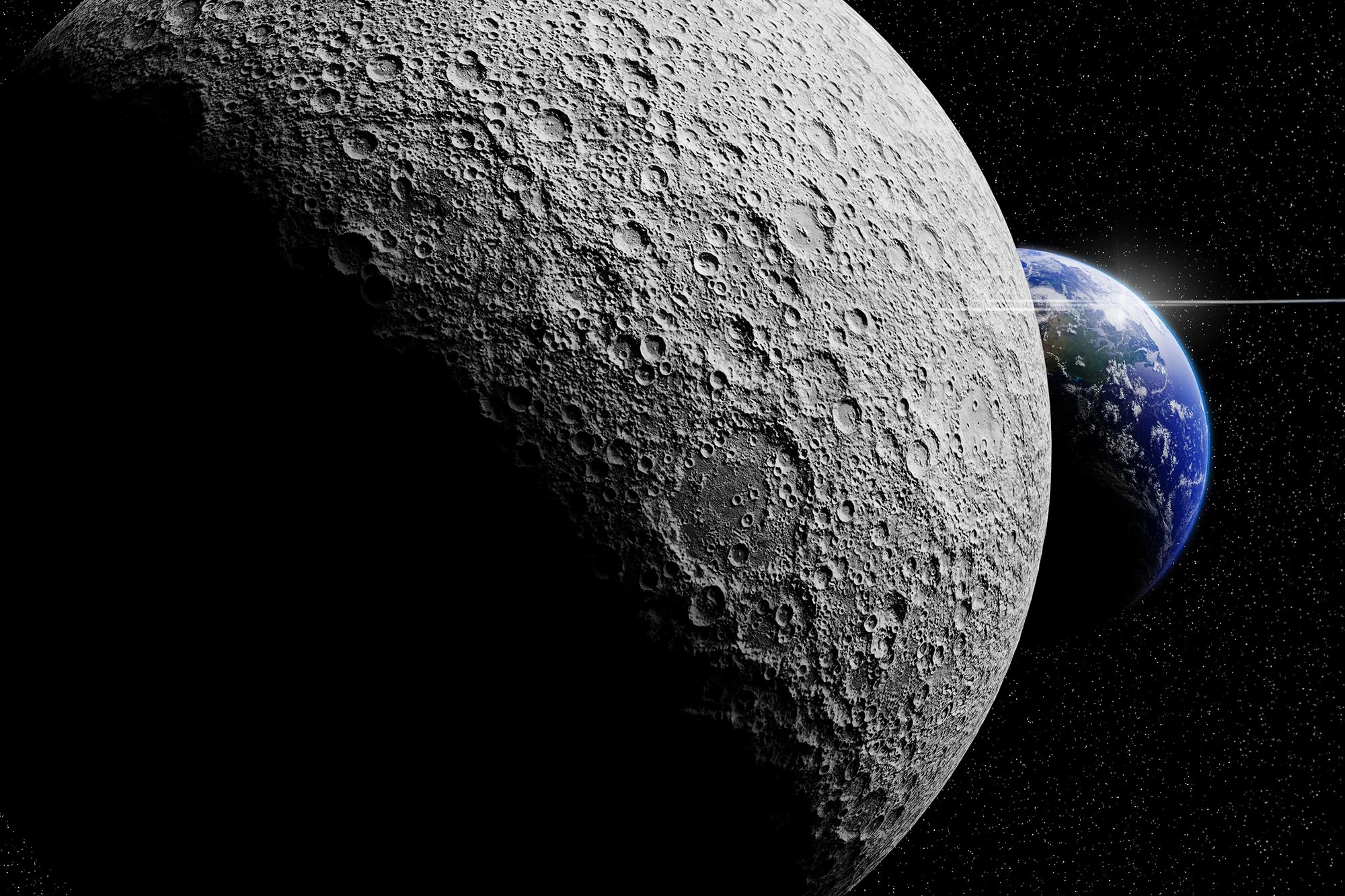
Humanity's understanding of the moon's asymmetry began in the early era of space exploration. The front side of the moon facing the Earth is dotted with vast, flat, darker "lunar maria". These maria are essentially plains filled by massive volcanic basalt lava flows billions of years ago. Not only that, the front side of the moon is also rich in radioactive heating elements called "KREEP" (named after the English abbreviation of potassium, rare earth elements and phosphorus) and heavy metals such as titanium. In contrast, the far side of the moon facing away from the Earth presents a completely different appearance - there is almost no large area of basalt lunar maria, the crust is much thicker than the front side, the surface is densely covered with ancient impact craters, and there is an extreme lack of radioactive heat-generating elements. Why the same natural satellite forms two completely different "faces" in the same celestial evolution environment has triggered numerous intense academic conjectures in the academic community for decades.
In order to thoroughly identify this deep driving force, the research team relied on high-precision planetary dynamics codes and supercomputer clusters to conduct a full-scale multi-physics simulation of the moon's early magma ocean cooling process and celestial collision dynamics. Scientists have focused their attention on the famous "South Pole-Aitken Basin" (SPA Basin) on the far side of the moon - one of the largest known impact structures in the solar system, spanning more than 2,500 kilometers. Simulation results show that about 4.3 billion years ago, during the critical window period when the magma ocean on the moon's surface had not completely solidified, a giant celestial body with a diameter of several hundred kilometers hit the moon's south pole at a very high relative speed, instantly injecting immeasurable kinetic and thermal energy into the moon's interior.
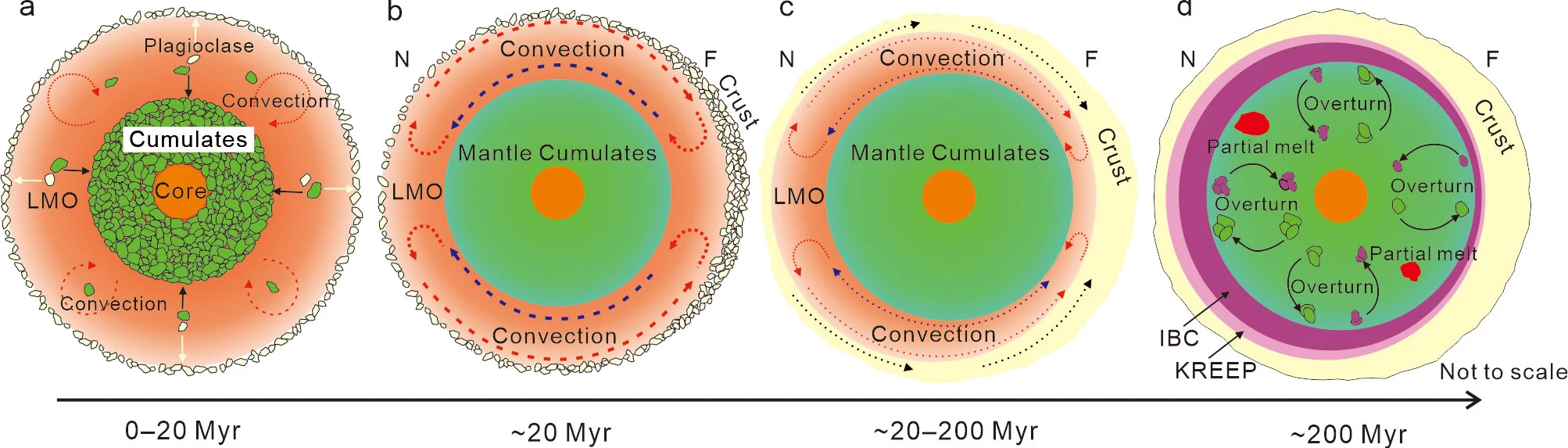
The powerful impact not only created a huge basin several kilometers deep on the lunar surface, but also created a large-scale giant thermal plume deep inside the moon. This continuously heating thermal anomaly destroyed the original balance of gravity subsidence and thermal convection inside the moon. Like a huge underground pump, the KREEP melt layer, which may have been evenly distributed in the deep moon and rich in radioactive heat-generating elements (thorium, uranium and potassium), was strongly pushed and driven along the lunar mantle asthenosphere to the other end of the moon - the frontal Procellarium region of the moon that now faces the Earth.
With the large-scale asymmetric enrichment of radioactive heating materials with long half-lives deep in the front of the moon, the decay heat continuously released by these elements continued to heat the overlying lunar mantle rocks for hundreds of millions or even billions of years, prompting periodic large-scale local remelting, and ultimately triggered long-lasting and violent volcanic eruptions. Basalt lava burst through the relatively thin frontal crust again and again and spewed out, filling ancient basins and condensing into the dark lunar maria visible to the naked eye today; on the far side of the moon, because most of the heating material has been squeezed out by impact dynamics, the backside lunar mantle, which lacks deep sustained heat sources, quickly cooled and solidified. The crust not only maintained its original thick state, but also avoided being covered by subsequent volcanic lava.
Planetary physicists pointed out that this simulation study not only seamlessly connects the giant impact event in the Antarctic-Aitken Basin with the unique KREEP rock enrichment and volcanic history on the moon's front side in the same dynamic chain for the first time, but also provides a decisive theoretical basis for reinterpreting the in-situ geological samples brought back from the far side of the moon and the polar regions by Chang'e-6 and the Artemis program in the future. Research has proven that in the early stages of the formation of terrestrial planets and large satellites, a single catastrophic large-body collision was enough to completely reorganize the deep thermal evolution route and geochemical differentiation process of the celestial body. This mechanism also has far-reaching implications for understanding the origin of the diverse landforms of Mercury, Mars and even rocky exoplanets.
Comments